
Yes, a fiduciary advisor can help lower investment fees by identifying unnecessary fund expenses, overlapping services, and account charges, then recommending suitable alternatives. The advisor’s own fee and any taxes or exit charges from changing investments still belong in the comparison; a lower fund expense alone does not prove you will spend less overall.
- Can a fiduciary advisor help lower investment fees? Yes, but compare total costs, not fund expenses alone.
- VIMNewEngland provides financial planning and investment management within one advisory relationship.
- A fiduciary recommendation must address your interests; it does not guarantee the lowest fee.
- Request a written comparison that includes advisory fees, investment expenses, and transition consequences.
Can a fiduciary advisor help lower your investment fees?
A fiduciary advisor can reduce unnecessary investment expenses, but savings must be demonstrated account by account. For a 2026 review, the useful evidence is your actual holdings, account agreements, fund disclosures, and the proposed advisory agreement—not a general promise about cheaper investing.
Start with the qualities that distinguish a fiduciary financial advisor. You want someone who explains both the cost of the recommendation and the reason it serves your financial plan.
Ask the advisor to complete a comparison like this before you authorize changes:
| Cost or decision | Keeping your current arrangement | Moving to the proposed arrangement |
|---|---|---|
| Advisory services | Identify what you pay and receive now | Identify the proposed fee and included work |
| Investment expenses | List expenses for your existing holdings | List expenses for the proposed holdings |
| Account charges | Identify custody, transaction, and administrative charges | Confirm which charges remain or change |
| Transition consequences | Identify consequences of leaving investments unchanged | Identify potential realized gains and exit charges |
| Best for | Investors whose current costs and services remain appropriate | Investors with a documented improvement in cost, service, or suitability |
| Main limitation | Unnecessary expenses remain unless addressed | Transition costs or advisory fees can offset fund savings |
This comparison separates a cheaper investment from a better overall arrangement. Neither column wins automatically.
Why this matters
Investment expenses reduce the amount of your return that you keep. Yet avoiding every paid service is not the same as making a sound financial decision. You also need to understand what work the advisor will perform and whether that work addresses your needs.
For a New England household balancing retirement accounts, taxable investments, and estate decisions, an investment change can affect more than fund expenses. Selling a holding in a taxable account can create a capital gain, while changing retirement accounts raises different questions about account features and withdrawal rules.
Your 2026 fee review should answer two separate questions: Are you paying unnecessary expenses, and are the remaining expenses buying services you need? Keep those questions separate so a discussion about value does not replace a clear accounting of costs.
Where a fiduciary advisor can find unnecessary costs
Investment expenses
Mutual funds and exchange-traded funds have operating expenses that affect returns. An advisor can examine whether a holding has a suitable alternative with lower expenses, considering its investment objective, risks, and role in your portfolio.
The limitation is that similar labels do not guarantee equivalent investments. Before approving a replacement, ask what changes besides the expense ratio: market exposure, management approach, diversification, or tax consequences.
Overlapping services
You can pay for services at different levels of an investment arrangement. An advisory relationship and a separately managed investment strategy, for example, require a clear explanation of who does what and how each charge applies.
Multiple charges are not automatically inappropriate. The question is whether each service has a distinct purpose and whether you understand the combined expense. Ask the advisor to identify any work you would be paying for twice.
Account and transaction charges
Some costs depend on how an account is held or used rather than which investments it owns. Review account administration, trading, transfer, and termination terms alongside investment expenses.
An advisor can explain alternatives, but a transfer is not automatically the answer. Moving accounts creates paperwork and can change account features; keeping an account can be reasonable when the proposed benefit does not justify the disruption.
Investments with exit restrictions
Certain investment or insurance contracts impose surrender charges or other restrictions when you leave. Those terms deserve attention before anyone recommends replacing the holding.
A fiduciary review should examine the existing contract, not simply compare its ongoing expense with a new investment. A recommendation to retain a holding temporarily can be reasonable when an immediate exit creates an avoidable cost.
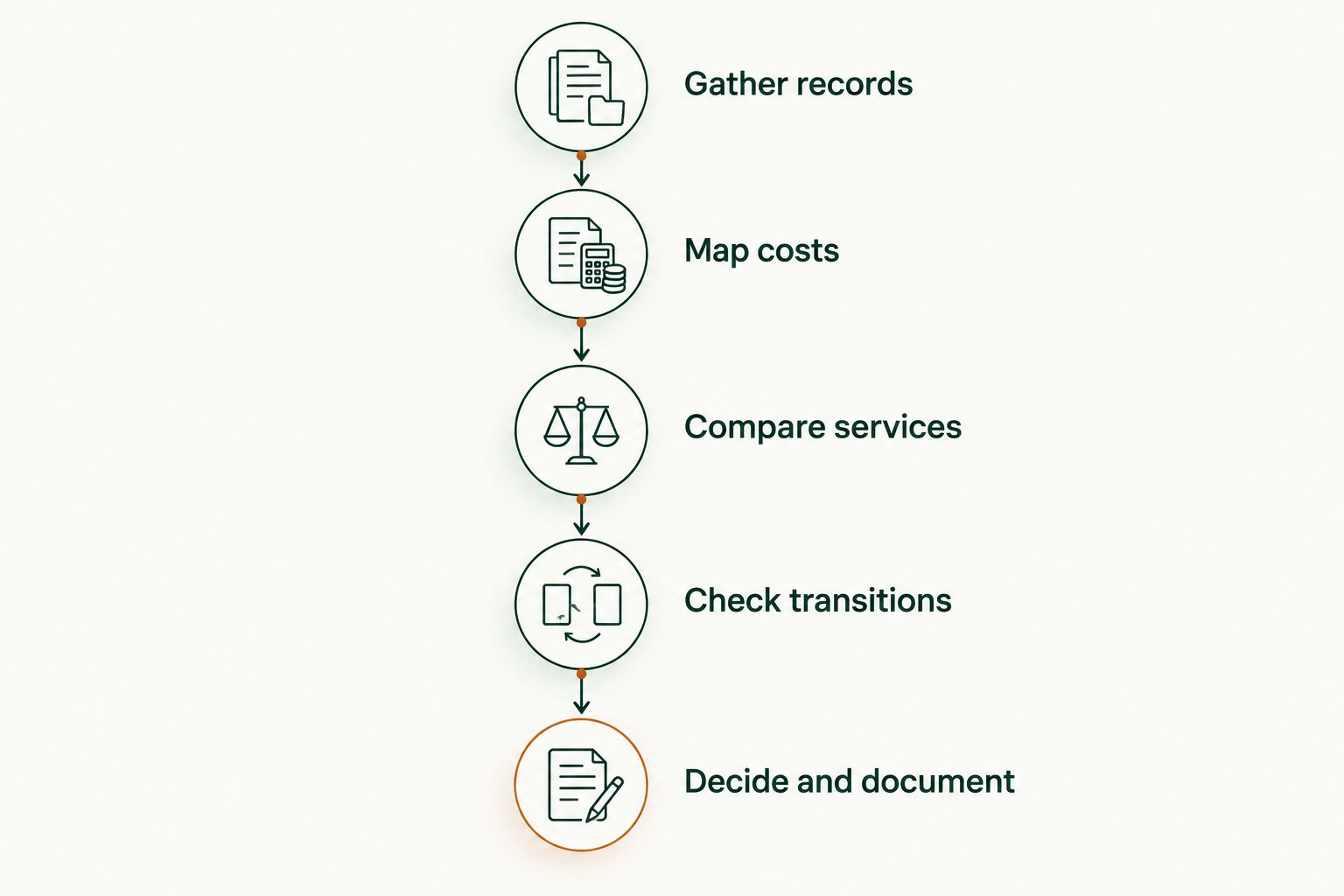
How should you review investment fees in 2026?
Use this sequence to turn a general conversation into a decision you can evaluate. Ask for the findings in writing so you can distinguish confirmed charges from assumptions.
- Gather records. Assemble 12 months of account statements, your advisory agreement, current holdings, and relevant investment disclosures. Include retirement and taxable accounts, even when they are held at different institutions.
- Map costs. Identify advisory fees, fund expenses, account charges, and any separate investment-management charges. Ask which expenses appear on statements and which are reflected within investment returns.
- Compare services. Describe the work included in your current relationship and the proposed relationship. Separate ongoing investment management from financial planning, tax coordination, and estate-planning coordination.
- Check transitions. Identify unrealized gains, restrictions, exit charges, and holdings that can transfer without being sold. Have your tax professional review material tax consequences before you approve sales.
- Decide and document. Request 1 written comparison covering ongoing costs, transition consequences, services, and the reason for each recommended change. Keep it with the final agreement.
A complete review does not require you to move every account. It requires enough information to understand what should change and what should stay.
Why investment fee savings vary
The potential savings depend on your starting arrangement and the changes that are appropriate for you. These factors explain why an advisor cannot establish your result from an account balance alone:
- Existing investment expenses. A portfolio already using suitable, low-expense investments leaves less room for fund-level savings.
- Advisory scope. Investment management alone is not the same service as an ongoing relationship that also covers financial planning.
- Account type. Selling appreciated investments in a taxable account has different consequences from trading within a retirement account.
- Contract restrictions. Surrender terms, termination charges, and transfer restrictions can affect whether a change makes sense now.
- Portfolio needs. A suitable replacement must address your risk, liquidity needs, and investment objectives—not just expenses.
- Transition method. Transferring eligible holdings without selling them differs from liquidating the portfolio and rebuilding it.
Ask for the reason behind every proposed change, not just the lower expense attached to it. If the recommendation changes your investment risk or creates a tax obligation, that belongs in the same explanation.
Does fiduciary mean the advisor is always cheaper?
No. A fiduciary obligation concerns acting in your best interest; it does not promise the lowest available fee or a particular investment result. You still need to evaluate compensation, conflicts, services, and the specific recommendation.
An advisor can reasonably recommend a paid service when its scope fits your needs. The explanation should make clear why the service is appropriate and why a less expensive alternative does not meet the same need.
For your 2026 review, request the firm’s Form ADV Part 2A brochure and advisory agreement. Read the sections addressing fees, compensation, conflicts, and business practices, then ask the advisor to explain any terms you do not understand.
Does fee-only advice eliminate investment expenses?
No. Fee-only describes how the advisor is compensated; it does not mean that funds, accounts, or transactions carry no separate expenses. Ask for the full cost picture rather than treating the compensation label as the answer.
Keep 2 questions on your meeting agenda: How does the advisor get paid, and what other expenses will your accounts bear? An answer to the first question does not resolve the second.
An explicit explanation also helps you compare proposals fairly. If one proposal includes planning and another covers only portfolio management, note that difference before deciding which arrangement provides better value.
Should you switch advisors just to lower fees?
Not without comparing the costs and services you would leave with those you would receive. Lower ongoing expenses matter, but so do transition consequences, continuity, and whether the new relationship addresses your actual needs.
First ask your current advisor to explain the existing arrangement and identify available improvements. You might be able to address an unnecessary expense without changing firms or selling investments.
If a switch remains appropriate, request a transfer plan that distinguishes assets to retain, assets to transfer, and assets proposed for sale. Do not interpret a recommendation to consolidate accounts as permission to liquidate everything.
Where an integrated advisory relationship fits
VIMNewEngland is best suited to individuals and families seeking financial planning and investment management in one advisory relationship. Its stated services connect savings, retirement, taxes, and estate planning rather than treating portfolio decisions as a separate task.
That scope is relevant when a fee decision intersects with retirement withdrawals, a business interest, or a family estate plan. The limitation is equally important: integrated advice does not establish that your investment fees will fall. You still need a proposal tied to your accounts and circumstances.
When considering VIMNewEngland for financial planning and investment management, ask which work is included, what requires outside professional support, and how investment expenses will be explained. The benefit to evaluate is coordinated decision-making, not an assumed savings figure.
Discuss your investment costs
Ask how your investment expenses fit with retirement, tax, and estate-planning decisions.
FAQ
Can a fiduciary advisor help lower investment fees without selling everything?
Yes, a fiduciary advisor can review investment fees without recommending that you sell everything. The appropriate changes depend on your holdings, account terms, tax circumstances, and available alternatives.
Will a fiduciary advisor guarantee that I save money?
No, fiduciary status does not guarantee savings. Ask for a written comparison of advisory fees, investment expenses, account charges, and transition consequences before deciding.
Are fund expense ratios included in my advisory fee?
Do not assume fund expense ratios are included in your advisory fee. Ask the advisor to identify separately what the advisory agreement charges and what the underlying investments cost.
What should I bring to an investment fee review?
Bring 12 months of account statements, your advisory agreement, current holdings, and relevant investment disclosures. Include contract terms for investments with surrender or transfer restrictions.
Can changing investments create taxes?
Selling an appreciated investment in a taxable account can create a taxable capital gain. Ask the advisor and your tax professional to evaluate that consequence before approving a sale.
Should I choose the advisor with the lowest fee?
Choose an advisor whose services, compensation, and recommendations fit your needs, rather than selecting on the lowest fee alone. Compare equivalent services and require a clear explanation of any additional expense.
How should I compare fiduciary advisors in 2026?
Compare fiduciary advisors in 2026 using their written service scope, compensation disclosures, conflicts, and recommendations for your accounts. VIMNewEngland offers financial planning and investment management within one advisory relationship; assess that scope alongside the proposed costs.
One last thing
Ask the advisor to identify what should not change. A credible fee review can support retaining an inexpensive fund, leaving an account in place, or postponing a sale with tax consequences. Recommendations to keep suitable holdings deserve the same explanation as recommendations to replace them.
Before signing a 2026 agreement, make sure the written proposal distinguishes ongoing expenses from transition consequences. You should understand not only what you will pay, but also what decision each charge supports.