
A retirement plan review has no fixed duration: the time depends on whether you need an update to an existing plan or a fresh analysis of your retirement income, investments, and taxes. The appointment is only part of the work; document review, analysis, and any account changes have separate timelines. Before scheduling, ask for the meeting length, the expected delivery date for recommendations, and the steps that follow.
- How long does a retirement plan review take? Separate meeting time, analysis time, and implementation time.
- An existing-plan update has a narrower scope than rebuilding retirement income assumptions from the beginning.
- VIMNewEngland provides retirement planning and investment management within an integrated advisory relationship.
- Ask what you will receive, which documents are required, and when recommendations will be ready.
How long does a retirement plan review take?
The useful answer is a schedule tied to your decisions, not a single appointment length. A portfolio check, a retirement-readiness assessment, and a review after a spouse’s death involve different questions and different supporting records.
For retirement planning in 2026, separate the work into these stages:
- Preparation: You provide current records and identify the decisions you need help making.
- Analysis: The advisor checks assumptions, evaluates alternatives, and identifies missing information.
- Discussion: You review findings, ask questions, and agree on priorities.
- Implementation: You authorize changes and coordinate any work involving account providers or other professionals.
VIMNewEngland provides financial planning and investment management as an integrated advisory relationship. When discussing a review, ask which of these stages the proposed schedule includes.
A promised meeting date does not necessarily mean recommendations will be ready that day. Likewise, receiving recommendations does not mean account transfers, beneficiary changes, or legal documents are complete.
Why this matters
A useful retirement review ends with clearer decisions, not simply a completed appointment. If you leave knowing your portfolio balance but not how your spending will be funded, the review has not answered the retirement-income question.
Your 2026 review should distinguish facts from assumptions. Current account balances are facts; future spending, investment returns, and retirement dates require assumptions that you can examine and revise.
Ask the advisor to name the decision each part of the review supports. That keeps the discussion focused when your financial life includes taxable investments, retirement accounts, property, or a business.
Existing-plan update: check what has changed
An existing-plan update starts with a prior plan rather than a blank page. Its purpose is to identify whether changes in your life or finances require changes to your retirement strategy.
Best for: You already have a documented plan and want to check whether its assumptions still fit. The advantage is focus; the limitation is that an update cannot repair an incomplete baseline without additional work.
Bring the previous plan and flag changes before the meeting. These include retirement timing, household spending, income, debts, health coverage, family responsibilities, and intended gifts.
For a 2026 update, ask which assumptions were refreshed and which were carried forward. A recent printout is not enough if the underlying spending estimate or retirement date is outdated.
Retirement-readiness review: test the income plan
A retirement-readiness review addresses whether your resources and expected income support your intended retirement. It requires more than checking investment performance.
Best for: You are deciding when to stop working, reduce work, or begin drawing from savings. The advantage is a direct connection to a major life decision; the limitation is that the answer depends on spending estimates and other assumptions.
The discussion should connect your expected expenses with income sources and withdrawals. Ask how the analysis treats taxes, health coverage, irregular expenses, and changes in household income.
Social Security illustrates why the underlying decisions matter. Retirement benefits can generally begin at age 62, while delayed retirement credits stop at age 70; the Social Security Administration explains that claiming age affects your monthly benefit. Those are planning inputs, not a prescribed review duration.
Major-change review: revisit connected decisions
A major-change review addresses an event that alters several parts of your financial life. Retirement, divorce, an inheritance, a business sale, or a spouse’s death can change the starting point for the analysis.
Best for: Your existing plan no longer reflects your household, assets, or responsibilities. The advantage is the opportunity to reconnect related decisions; the limitation is that unresolved legal, tax, or ownership questions can prevent final recommendations.
Separate immediate decisions from those requiring further information. A cash need deserves its own attention, while a proposed asset transfer might require tax analysis or legal advice before you act.
Do not measure progress only by whether everything is finished. A written list of resolved decisions, open questions, and responsible parties makes the remaining work visible.
| Review type | Best for | Main benefit | Main limitation |
|---|---|---|---|
| Existing-plan update | Checking a documented plan after changes | Keeps attention on changed assumptions | Depends on the quality of the original plan |
| Retirement-readiness review | Deciding when and how to retire | Connects spending with income and withdrawals | Requires usable spending and income estimates |
| Major-change review | Reworking a plan after a significant event | Coordinates decisions across your financial life | Can depend on outside records or professional advice |
Why retirement plan review time varies
The scope of the decision determines the work. These factors explain why a meeting estimate and a completed-review estimate are different:
- Document readiness: Missing statements, benefit estimates, or tax records leave questions unresolved. Ask which documents are essential before analysis begins.
- Quality of the existing plan: A documented spending estimate and clear goals provide a starting point. Unverified assumptions require further discussion.
- Account and ownership complexity: Retirement accounts, taxable investments, trusts, and business interests raise different planning questions. Identify ownership as well as balances.
- Decisions under review: Updating a retirement date is different from comparing withdrawal approaches or assessing a business-sale transition. Name the decisions before requesting a schedule.
- Professional coordination: Tax and legal questions can require input from your tax professional or attorney. Clarify who requests that input and who follows up.
- Implementation requirements: Analysis and action are separate. Account paperwork, permissions, and provider processing belong on their own schedule.
For a 2026 review, ask the advisor to identify the current bottleneck rather than give a general explanation about complexity. You need to know whether the next step belongs to you, the advisor, or someone else.
How can you prepare without doing the advisor’s work?
You do not need to build your own retirement model before seeking advice. Your job is to provide accurate records and explain what you want your money to support.
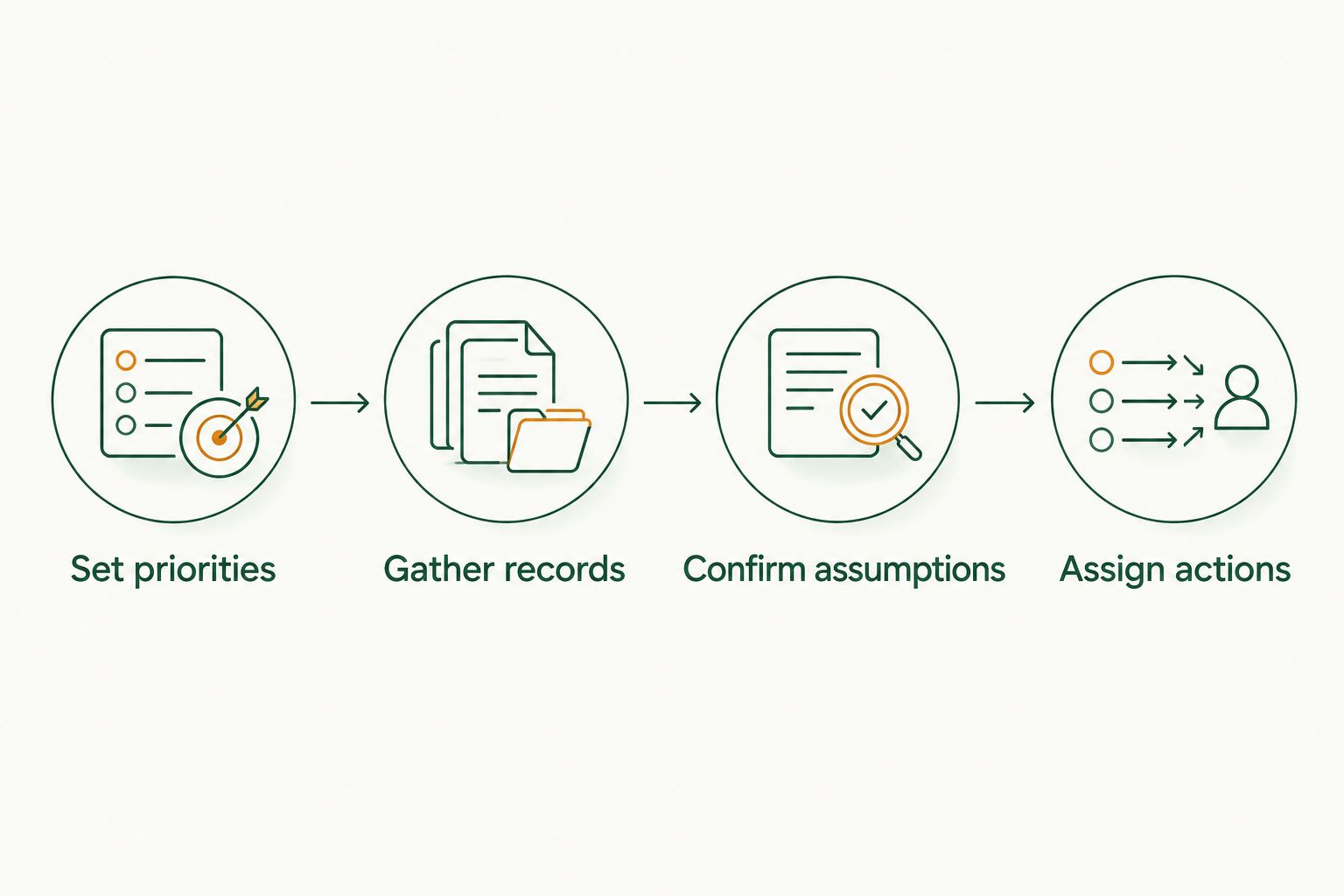
Use this preparation sequence:
- Set priorities. Write down the decisions you want answered, such as whether to retire, change withdrawals, or adjust investment risk. Put the most consequential question first.
- Gather records. Collect current account statements, income information, benefit estimates, tax returns, and relevant estate documents. Ask the advisor which records apply to your review and how to submit them securely.
- Confirm assumptions. Outline regular spending, irregular expenses, expected income changes, and family commitments. Mark estimates as estimates rather than presenting them as settled facts.
- Assign actions. Before the review ends, record who will do what next. Include unanswered questions and the information needed to resolve them.
Send important questions ahead of the appointment rather than saving them for the closing minutes. If you and your spouse have different retirement expectations, make that part of the agenda; a projection cannot settle an unstated disagreement about spending or work.
What should you receive when the review is complete?
Ask for a clear explanation of the findings and next steps in the format covered by your advisory agreement. Do not assume every review includes a newly written financial plan.
A useful completion discussion identifies:
- Updated assumptions: What changed in spending, income, retirement timing, or other inputs.
- Decisions reached: What you agreed to change and what you agreed to leave alone.
- Open questions: What remains unresolved and why it matters.
- Action ownership: Who handles each next step and what approval is required.
- Review triggers: Which future changes should prompt another conversation.
“No change” is a valid recommendation when the advisor explains the reasoning. Activity is not the same as progress, and a retirement review does not need to produce a trade or transfer to be useful.
If the work reveals that your underlying plan needs rebuilding, distinguish that assignment from the original review. This guide to building a full financial plan addresses that broader scope.
Can you finish a retirement plan review in one meeting?
A single meeting can resolve a clearly defined question when the necessary information is already available. It does not, by itself, establish that every part of your retirement plan has been reviewed.
Ask whether the appointment is for gathering information, discussing completed analysis, or approving actions. Those purposes require different preparation.
Does a review include moving retirement accounts?
A retirement plan review does not inherently require moving accounts. Evaluating your plan and carrying out an account transfer are separate decisions.
Ask why any proposed move supports your goals, what alternatives were considered, and which steps require your authorization. Keep the transfer schedule separate from the review schedule.
Should you wait until you are ready to retire?
Do not wait for a retirement date to become final before discussing decisions that affect it. A review can help you examine the consequences of different dates rather than simply document a decision already made.
Health coverage deserves attention alongside income. Medicare eligibility generally begins at age 65, according to Medicare; retiring before that age raises a separate coverage-planning question.
Where an integrated advisory relationship fits
VIMNewEngland is best suited to individuals, families, and business owners seeking retirement planning connected with investment management, tax planning, and estate planning. That structure is relevant when a retirement decision affects more than your investment allocation.
VIMNewEngland is a fee-only, SEC-registered investment adviser. An integrated relationship does not remove the need for clear scope: ask what the retirement review covers, what requires a separate assignment, and when your attorney or tax professional should participate.
For your 2026 planning conversation, start with the decision you need to make rather than a request to “check everything.” A defined question gives the advisor a clearer basis for explaining the work and its schedule.
Discuss your retirement planning needs
Ask how retirement income, investments, taxes, and estate planning fit together.
FAQ
How long does a retirement plan review take from start to finish?
A retirement plan review has no fixed duration because preparation, analysis, discussion, and implementation are separate stages. Ask for a schedule that identifies the recommendations delivery date and any work excluded from it.
Is the first appointment the actual retirement plan review?
The first appointment is not necessarily the completed review. Confirm whether it is intended to gather information, discuss analysis, or agree on actions.
What should I bring to a retirement plan review?
Bring the records relevant to the decisions under review, including current account statements, income information, spending estimates, and your existing plan. Ask which tax and estate documents are needed and how to provide them securely.
Can I get useful advice before all my documents are ready?
You can discuss goals and identify missing information before every document is ready. Recommendations that depend on missing facts should remain clearly separated from decisions supported by verified information.
Does a retirement review mean I need to change investments?
A retirement review does not automatically require investment changes. Keeping the current approach is a valid outcome when the analysis supports it and the reasoning is explained.
Can my spouse participate in the retirement review?
Ask to include your spouse when retirement decisions affect shared spending, income, or family responsibilities. Discuss differences in expectations before treating household assumptions as agreed.
How do I know the retirement review is finished?
The review is finished when the agreed scope has been addressed and you understand the findings, unresolved questions, and next steps. Implementation can continue afterward on a separate schedule.
One last thing
Before ending the review, ask: What decision can I now make that I could not make before this conversation? The answer is a better measure of usefulness than the length of the appointment.
Then ask which assumption would change that decision. You will leave with both a recommendation and a reason to revisit it when your circumstances change.