
Yes, retirement planning can include Social Security optimization by comparing claiming ages and coordinating benefits with your investments, taxes, and household income needs. The goal is not simply to collect the largest monthly benefit; it is to choose a claiming strategy that supports your retirement and protects a surviving spouse. Delaying benefits also requires a plan for paying expenses before those benefits begin.
- Can retirement planning include Social Security optimization? Yes—compare claiming ages within your full retirement income plan.
- Social Security retirement benefits generally begin as early as age 62; delayed retirement credits stop at age 70.
- Compare household income, survivor benefits, taxes, and portfolio withdrawals—not just monthly benefit amounts.
- VIMNewEngland combines financial planning and investment management in one advisory relationship.
Can retirement planning include Social Security optimization?
Social Security optimization belongs inside retirement planning, not beside it. A claiming decision changes how much you receive, when you need investment withdrawals, and what income remains after a spouse dies. Those decisions should use the same spending assumptions and account information.
VIMNewEngland fits individuals and families seeking financial planning and investment management in one advisory relationship. That integrated approach keeps retirement income decisions connected to the rest of your financial life.
The Social Security Administration's published retirement guidance provides the foundation for a 2026 comparison: retirement benefits generally become available at age 62, full retirement age depends on your birth date, and delayed retirement credits stop at age 70. Your own earnings record determines the benefit estimates to compare.
| Claiming option | Best for | Main advantage | Main trade-off |
|---|---|---|---|
| Claim at age 62 | People who need benefits earlier or have circumstances favoring an earlier start | Income begins sooner | Monthly retirement benefits are permanently reduced relative to claiming at full retirement age |
| Claim at full retirement age | People seeking their unreduced retirement benefit without further delay | No early-claiming reduction | Forgoes the additional retirement benefit available through delayed retirement credits |
| Delay until age 70 | People prioritizing a larger monthly retirement benefit who can fund the waiting period | Delayed retirement credits increase the monthly retirement benefit | Other income or assets must cover expenses while benefits are delayed |
These are planning options, not rankings. The right claiming age depends on the household that must live with the decision.
Why this matters
A Social Security decision reaches beyond the deposit arriving each month. Claiming earlier changes the income your portfolio must supply now; delaying changes the income it must supply later. For couples, the higher earner's decision also affects potential survivor income.
In 2026, compare those outcomes in one retirement projection. A plan that shows a larger future benefit but ignores the withdrawals needed to reach it is incomplete. So is a plan that assumes both spouses' benefits continue unchanged after either spouse dies.
For New England households with investment accounts, pensions, or business income, coordination matters more than a stand-alone claiming calculation. Your plan should show how these income sources work together and which decisions need attention before you file.
Claiming at age 62: earlier income, a smaller monthly benefit
Age 62 is generally the earliest starting age for Social Security retirement benefits. Starting before full retirement age reduces your monthly retirement benefit, and reaching full retirement age later does not erase that early-claiming reduction.
Best for: people whose immediate income needs or personal circumstances support an earlier start. An earlier claim supplies income before later claiming options begin. The trade-off is a smaller monthly retirement benefit for the rest of your life, subject to applicable adjustments.
Do not judge this option from the benefit estimate alone. Compare the reduced benefit with the investment withdrawals you would otherwise need, your employment plans, and your spouse's income position. A need for income now is different from a preference to avoid using savings.
If you continue working before full retirement age, review the retirement earnings test before filing. Benefits can be withheld when earnings exceed the applicable limit; the Social Security Administration later adjusts benefits at full retirement age to account for months withheld.
Full retirement age: an unreduced retirement benefit
Full retirement age is the age at which you qualify for your unreduced Social Security retirement benefit. It depends on your birth date and reaches age 67 under the Social Security Administration's published schedule.
Best for: people seeking an unreduced benefit without funding a further delay. This option avoids the reduction associated with early retirement claiming. It does not provide the additional retirement benefit earned by waiting beyond full retirement age.
For your 2026 plan, confirm your actual full retirement age rather than assuming it matches your spouse's or a friend's. Use your Social Security statement to compare the estimated benefit at that age with earlier and later starting dates.
Full retirement age also changes how employment income interacts with benefits. Once you reach full retirement age, the retirement earnings test no longer limits benefits because of your earnings. Federal income taxes are a separate issue and still require review.
Delaying until age 70: a larger retirement benefit
Delaying your own retirement benefit beyond full retirement age earns delayed retirement credits until age 70. Waiting beyond age 70 does not earn additional delayed retirement credits.
Best for: people who prioritize a larger monthly retirement benefit and can cover expenses while waiting. The advantage is a higher benefit than starting at full retirement age. The trade-off is receiving no retirement benefit during the delay and using other resources instead.
A sound comparison includes the withdrawals needed during that waiting period. Identify which accounts would fund expenses, how those withdrawals affect taxes, and how the remaining portfolio supports later spending. Delaying is not automatically the right answer simply because the monthly benefit is larger.
For a married household, examine the higher earner's claiming decision carefully. Delayed retirement credits can increase the survivor benefit associated with that worker's record. That makes household income after a death part of the claiming analysis, not a separate estate-planning detail.
Why the right claiming strategy varies
The same claiming age does not suit every retirement. These factors explain why your recommendation should differ from a generic calculator result:
- Income needs: Your spending and dependable income determine whether you can cover expenses before benefits start.
- Health and longevity: Personal health circumstances affect how you weigh earlier payments against a larger later benefit.
- Spouse and survivor benefits: Each spouse's earnings record and claiming decisions affect household income and survivor protection.
- Employment income: Working before full retirement age introduces the retirement earnings test into the decision.
- Taxes and withdrawals: Retirement account distributions, investment income, and Social Security taxation change spendable income.
- Portfolio demands: Funding a delay changes when you draw on investments and how much remains available for later needs.
Compare the full household outcome, not a single break-even age. A break-even calculation compares cumulative benefits across claiming dates, but it does not by itself capture taxes, investment withdrawals, or the surviving spouse's income needs.
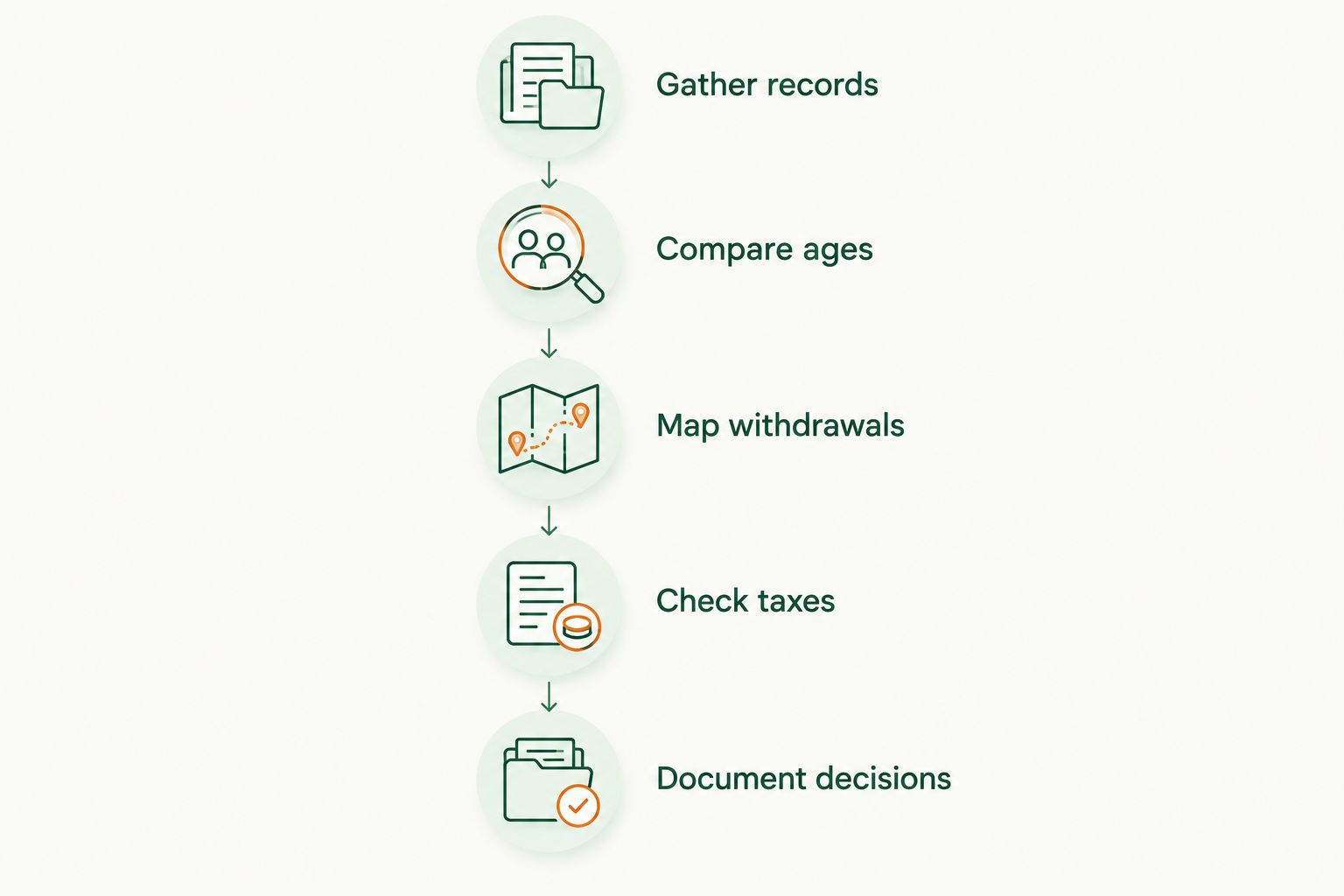
How to include Social Security in your retirement plan
Use a repeatable process rather than starting with a preferred claiming age. The objective is a written recommendation with clear assumptions and a workable income schedule.
Gather records
Obtain your current Social Security statement and review your earnings history. The Social Security Administration bases retirement benefits on your highest 35 years of earnings, so an incomplete or incorrect record deserves attention before you rely on the estimates.
Collect your spouse's statement, investment account information, pension details, and a realistic spending estimate. Keep retirement dates and Social Security claiming dates separate: stopping work does not require you to claim immediately.
Compare ages
Compare starting at age 62, your full retirement age, and age 70. For couples, compare different combinations rather than assuming both spouses should file together.
Use consistent spending and investment assumptions across the scenarios. Otherwise, the comparison mixes a claiming decision with unrelated changes and becomes difficult to interpret.
Map withdrawals
Identify how expenses will be paid before and after benefits start. Separate cash reserves, taxable investments, retirement accounts, pensions, and earned income so you can see which source fills each gap.
The Social Security claiming-to-retirement-income workflow connects the filing decision to that income schedule. The key deliverable is a plan you can follow, not just a chart of benefit amounts.
Check taxes
Review the federal tax treatment of Social Security alongside your other income. Under IRS rules, up to 85% of Social Security benefits can be included in taxable income; that does not mean benefits face an 85% tax rate.
For a 2026 decision, use the applicable tax rules and your expected income. Evaluate retirement account withdrawals and any planned Roth conversions together rather than assuming that a larger gross benefit produces the same increase in spendable income.
Document decisions
Write down the recommended claiming dates, the reasons for them, and the circumstances that would trigger a review. Include who handles filing and which estimates still need confirmation.
Keep the plan understandable. You should be able to explain how expenses are covered before claiming, what changes afterward, and what happens to household income if either spouse dies.
What should you expect from an advisor?
Ask for a comparison that connects benefits to spending, investments, taxes, and survivor income. A recommendation to claim at a particular age should explain both its advantage and its cost to the household—not merely point to the largest monthly payment.
VIMNewEngland provides fee-only financial planning and investment management as one advisory relationship. Its retirement planning should be evaluated on the same practical standard: whether the advice connects your decisions and gives you a clear next step.
Before acting, ask these questions:
- Which earnings records and benefit estimates does the comparison use?
- How will expenses be funded before benefits start?
- What changes if retirement or employment plans change?
- What income remains for a surviving spouse?
- Which assumptions would change the recommendation?
An advisor helps evaluate the decision. The Social Security Administration determines eligibility and benefits, and you still need to complete the filing process.
Should my spouse and I claim Social Security together?
No, spouses do not need to claim retirement benefits at the same time. Compare each spouse's earnings record, available benefits, and household cash needs before choosing dates.
Can I retire before claiming Social Security?
Yes, retiring and claiming Social Security are separate decisions. Your retirement plan must identify the income or assets that cover expenses between leaving work and starting benefits.
Does waiting until age 70 increase every type of benefit?
No, age 70 is the endpoint for delayed retirement credits on your own retirement benefit. Spousal and survivor benefits follow different rules, so do not apply the worker's claiming strategy to every benefit category.
FAQ
Can retirement planning include Social Security optimization?
Yes, retirement planning can include Social Security optimization by comparing claiming dates with taxes, investment withdrawals, and household income needs. The recommendation should explain how you fund retirement before and after benefits begin.
What's the earliest age I can claim Social Security retirement benefits?
Age 62 is generally the earliest age for Social Security retirement benefits. Claiming before full retirement age reduces your monthly retirement benefit.
Is age 70 always the best age to claim Social Security?
No, age 70 is not always the best claiming age. Delaying increases your own retirement benefit through delayed retirement credits, but the decision also depends on health, income needs, survivor protection, and the resources available while you wait.
Can I work while receiving Social Security retirement benefits?
Yes, you can work while receiving Social Security retirement benefits. Before full retirement age, benefits can be withheld under the retirement earnings test; after full retirement age, that earnings test no longer applies.
Does Social Security optimization include taxes?
Yes, Social Security optimization should include taxes. Under IRS rules, up to 85% of benefits can be included in taxable income, which is different from paying an 85% tax rate.
Will a surviving spouse keep both Social Security benefits?
Generally, a surviving spouse does not receive both benefits added together. Social Security coordinates retirement and survivor benefits, generally providing a combined amount equal to the higher eligible benefit, subject to eligibility and claiming rules.
Can a financial advisor file my Social Security claim for me?
A financial advisor's retirement recommendation does not automatically submit your Social Security claim. Confirm the filing steps with the Social Security Administration and establish who is responsible for completing them.
One last thing
Check your earnings record before debating your claiming age. Social Security uses your highest 35 years of earnings, and missing earnings can affect the benefit estimates underlying your plan. A carefully chosen date cannot correct an inaccurate record.
For your 2026 review, bring your current statement and a list of the accounts that will fund retirement. An integrated planning discussion with VIMNewEngland should connect those records to one practical question: how will your household pay its expenses before, during, and after the claiming transition?