
The cost to update an estate plan in 2026 depends on whether you need a targeted amendment, replacement documents, or changes to asset ownership; get a written quote for the specific work rather than relying on a general average. Document preparation is only part of the scope: ask separately about attorney review, deed work, trust funding, and financial-advisor coordination. Compare quotes for the same completed outcome, not just the same document name.
- For how much does it cost to update an estate plan, compare written scopes rather than document names.
- An estate-planning attorney handles legal documents; a financial advisor helps connect them to your accounts.
- VIMNewEngland combines estate-planning considerations with financial planning and investment management.
- A signed amendment does not, by itself, update account ownership or beneficiary designations.
Why this matters
An estate-plan update should connect your current wishes, legal documents, and financial accounts. Changing one without reviewing the others leaves unfinished work, even when the new documents are properly signed.
For the division of responsibilities, start with how a financial advisor can help with estate planning. Your attorney determines the legal changes; your advisor helps identify the financial information and account-level actions that need attention.
How much does it cost to update an estate plan?
The useful comparison is the total scope of the update, including implementation. Ask the attorney to separate document review, drafting, execution, and any asset-transfer work in the engagement letter. Ask your financial advisor which coordination tasks fall within your existing advisory agreement.
An amendment, a trust restatement, and a replacement estate plan are different assignments. They should not be treated as interchangeable quotes.
| Update approach | Best for | What the scope should address | Limitation to discuss |
|---|---|---|---|
| Targeted amendment | A specific change to otherwise suitable documents | Review of existing terms, the requested change, and signing requirements | A narrow edit does not resolve unrelated weaknesses |
| Trust restatement | Broader revisions to an existing revocable trust | Updated trust terms and review of related documents | Account titles and related documents still need attention |
| Replacement plan | Documents that no longer fit your circumstances | A coordinated review of wills, trusts, powers of attorney, and health-care documents | Requires more decisions and follow-through than an isolated edit |
| Implementation review | Connecting documents to actual assets | Ownership, beneficiary forms, deeds, and responsibility for follow-up | Does not substitute for legal drafting or legal advice |
Before accepting a proposal, ask what happens if the attorney discovers that the original assignment is too narrow. A clear process for approving additional work is more useful than a quote that leaves its boundaries unstated.
Targeted amendment: clarify what stays unchanged
A targeted amendment is an option to discuss when your underlying plan still fits but a particular provision needs revision. Examples include changing a nominated executor, successor trustee, or beneficiary provision, subject to your attorney's review.
The advantage is a focused assignment. The limitation is equally important: changing a name or clause does not establish that the rest of the plan remains suitable.
Give the attorney the complete signed documents and all existing amendments. Ask whether the requested change affects another provision, such as a successor appointment or distribution instruction. Best for a contained change, not an assumed shortcut around a full review.
Trust restatement: review the surrounding documents
A trust restatement revises the terms of an existing trust rather than simply attaching another amendment. Ask your attorney whether restatement is appropriate for your trust and circumstances.
The advantage is having revised terms collected in a unified document. The limitation is that the trust does not stand alone: your will, powers of attorney, account records, and beneficiary instructions still need to fit the revised plan.
Ask whether the assignment includes reviewing how assets are titled and identifying follow-up with financial institutions. Best for broader trust revisions when your attorney confirms that retaining the existing trust structure makes sense.
Replacement plan: compare the complete assignment
A replacement plan deserves consideration when your family circumstances, residence, ownership arrangements, or distribution goals have changed substantially. The attorney should explain why replacement is preferable to amending the existing documents.
The advantage is the opportunity to review the plan as a connected whole. The trade-off is a wider assignment, including decisions about fiduciaries, beneficiaries, incapacity instructions, and implementation.
Ask which existing documents will be superseded and how to handle old copies. Best for circumstances that require reconsidering the plan's structure, rather than merely updating its wording.
Why estate-plan update costs vary
The work required depends on what needs changing and what must happen after signing. These factors help you compare the scope of competing proposals:
- Document condition. Complete signed documents and prior amendments give the attorney a clearer starting point than an incomplete collection of drafts.
- Extent of changes. Replacing a fiduciary designation is a different assignment from revising how assets pass among family members.
- Asset ownership. Individually owned property, joint ownership, retirement accounts, and trust assets require different reviews.
- Property locations. Real estate in different states raises questions about local legal requirements and deed work.
- Tax considerations. State estate-tax exposure, federal estate-tax rules, and retirement-account income taxes require distinct analysis.
- Implementation responsibility. A proposal limited to drafting differs from one that includes assistance with deeds, account changes, and follow-up.
Ask each professional to explain which factors apply to you. Avoid treating the longest document package as the most suitable one; the assignment should follow your needs.
What should a written quote include?
A useful engagement letter identifies deliverables, exclusions, billing arrangements, and responsibility for implementation. It should also explain how you approve work outside the original assignment.
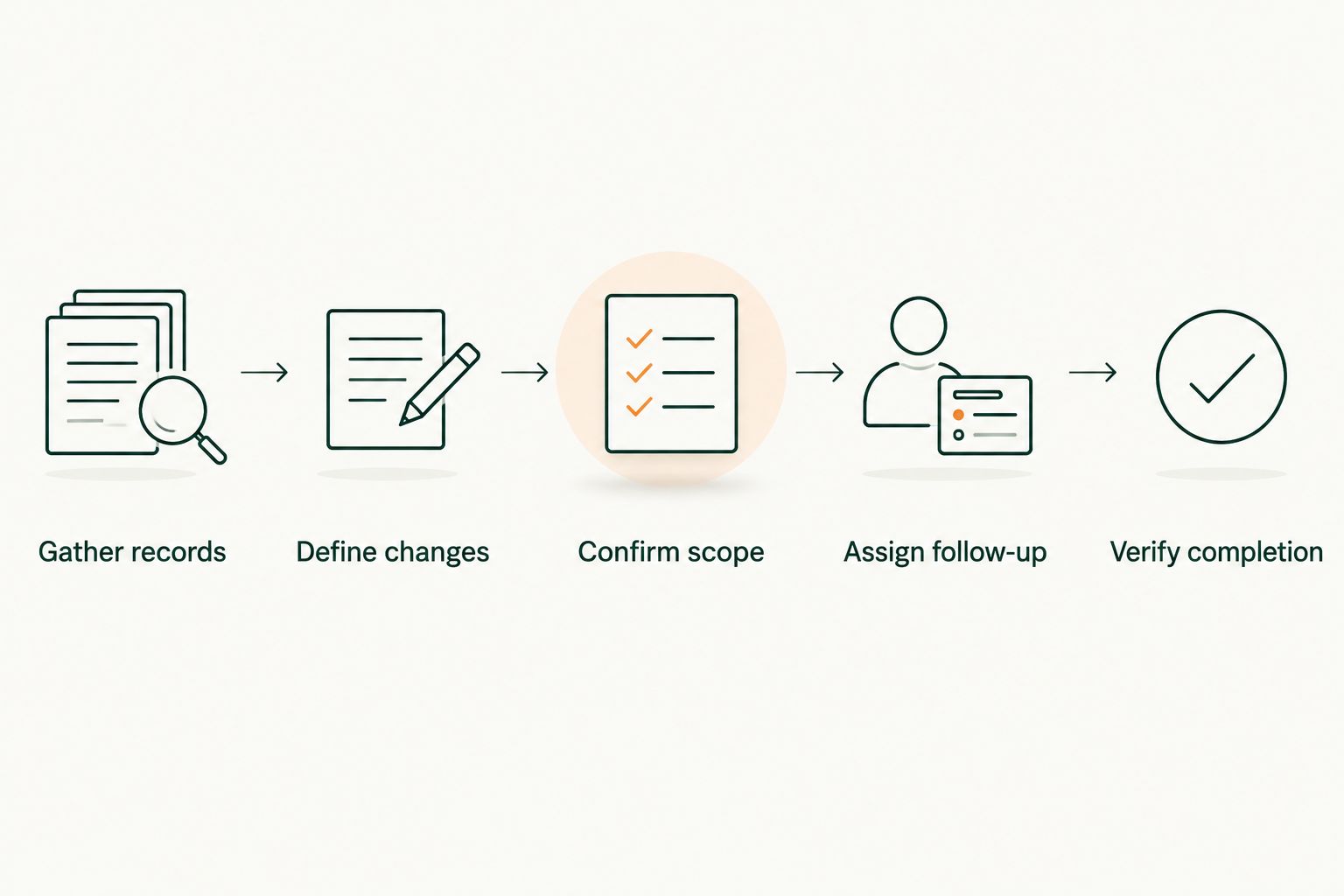
Use this sequence when requesting a 2026 estate-plan update:
- Gather records. Assemble signed estate documents, amendments, asset statements, beneficiary confirmations, deeds, and relevant business agreements.
- Define changes. Write down what has changed and what you want the revised plan to accomplish.
- Confirm scope. Ask which documents and legal questions the attorney will review, draft, or exclude.
- Assign follow-up. Identify who handles signing, ownership changes, beneficiary submissions, and institutional questions.
- Verify completion. Request confirmation that required documents were signed and agreed account-level actions were completed.
For each stage, identify the responsible person. An instruction to change an account is not evidence that the institution accepted the change.
Keep the engagement letter and completion records with your estate-planning file. Your executor or successor trustee should know where to locate the relevant documents, without needing unrestricted access to your accounts today.
Does a federal estate-tax exemption mean I can skip an update?
No. Estate planning also addresses incapacity, fiduciary appointments, asset ownership, and who receives your property. A federal tax threshold does not answer those questions or eliminate a separate state-level review.
For 2026 deaths, the federal basic estate-tax exclusion is $15,000,000. Massachusetts uses a $2,000,000 estate-tax filing test and a $99,600 credit; ask your attorney how the filing rules and credit apply to your estate. A filing threshold is not the same thing as the amount of tax due.
These figures describe tax rules, not estate-plan update charges. They explain why a New England household should not use the federal exclusion alone to decide whether its documents need attention.
For a 2026 review, give your attorney an asset inventory that identifies ownership, location, and relevant beneficiary arrangements. Do not assume that the balance of your investment account equals your taxable estate or determines whether a return is required.
Is updating beneficiaries enough to update my estate plan?
No. Beneficiary forms address particular assets, while wills, trusts, and incapacity documents serve different purposes. Review them together rather than assuming that one change updates everything else.
For accounts governed by beneficiary designations, those designations generally control the transfer rather than the will. Your attorney should review the intended result before you name a trust, change contingent beneficiaries, or make changes involving retirement accounts.
After submitting forms, retain the institution's confirmation. A saved draft or an instruction sent to someone else is not the same as an accepted designation.
Can my financial advisor replace my estate-planning attorney?
No. A financial advisor's planning role does not replace an attorney's legal advice and drafting. The useful division is legal design with your attorney and financial coordination with your advisor.
Your advisor can help organize account information, identify beneficiary questions, and connect estate decisions with retirement and investment planning. Your attorney determines the legal approach and prepares the necessary legal documents.
VIMNewEngland is best for New England individuals, families, and business owners seeking integrated financial planning and investment management. Its estate-planning role belongs within that advisory relationship, not as a substitute for legal counsel. Confirm the scope of coordination and any separate professional engagements before proceeding.
How do I keep the update focused?
Prepare a decision list before the legal meeting. Separate facts that have changed from questions you have not resolved, such as who should act as successor trustee or how an inheritance should be managed.
A useful preparation file includes:
- Current signed documents and every amendment.
- An asset list showing owner, account type, and beneficiary arrangement.
- Property locations and relevant deeds.
- Names of proposed executors, trustees, and agents.
- Family or business changes that affect your instructions.
- Questions about what your existing advisory agreement includes.
VIMNewEngland provides fee-only financial planning and investment management as an integrated relationship. The benefit is a connected discussion of savings, retirement, taxes, investments, and estate-planning considerations; the boundary is that legal drafting still requires the appropriate legal professional.
You can review VIMNewEngland to understand the firm's advisory focus. For any 2026 engagement, ask how your financial advisor and attorney will exchange information with your permission and who will track unfinished actions.
FAQ
How much does it cost to update an estate plan in 2026?
The cost depends on the legal changes and implementation work included in your assignment. Request a written quote that separates document review, drafting, signing assistance, and follow-up involving accounts or property.
Is an amendment always better than replacing my estate plan?
No. An amendment suits a contained change only when the underlying documents remain appropriate. Ask your attorney to explain whether a narrow revision leaves other issues unresolved.
Does updating my will also update my retirement-account beneficiaries?
No. Updating a will does not itself change retirement-account beneficiary forms. Review those designations separately and obtain confirmation from the institution after submitting changes.
Can my financial advisor write my will or trust?
A financial advisory relationship does not itself provide legal drafting services. Use an estate-planning attorney for legal documents and ask your advisor to help coordinate financial information and account-level follow-up.
Should I review my estate plan after moving to another state?
Yes. Ask an attorney familiar with your new state's law to review your documents, property arrangements, and applicable tax rules. Do not assume that moving automatically invalidates every existing document.
Does a trust restatement finish the entire update?
No. A trust restatement addresses trust terms, but related documents, asset titles, and beneficiary designations still require review. Confirm which implementation tasks are included in the engagement.
What should I bring to an estate-plan update meeting?
Bring signed documents, amendments, an asset inventory, beneficiary records, deeds, and relevant business agreements. Add a short list of changed circumstances and the decisions you want help making.
One last thing
Ask for a completion list, not just a signing appointment. It should identify which documents were executed, which ownership or beneficiary changes were required, and which institutions confirmed those changes.
Keep unresolved tasks visible until someone closes them. A finished document and a finished estate-plan update are not necessarily the same thing.
This article is educational and does not provide individualized legal or tax advice. Review your circumstances with your estate-planning attorney and tax professional.