
Yes, a fiduciary financial advisor can help you avoid probate by identifying ownership gaps, reviewing beneficiary designations, and coordinating account changes with your estate attorney. The advisor does not replace the attorney who advises on state law and prepares legal documents. Avoiding probate depends on how each asset transfers at death—not simply on having an advisor, a will, or a signed trust.
- Can a fiduciary financial advisor help avoid probate? Yes—through beneficiary reviews, ownership checks, and estate attorney coordination.
- A signed revocable trust does not keep assets outside probate unless ownership or transfer arrangements support it.
- VIMNewEngland connects financial planning, investment management, and estate planning within one advisory relationship.
- Probate avoidance does not automatically reduce estate taxes or protect assets from creditors.
Why this matters
Your estate documents and financial accounts need to tell the same story. A will might leave everything to your children, while an old retirement account still names someone else as beneficiary. A trust might describe your wishes without owning the investment account intended to fund those wishes.
For your 2026 review, focus on implementation rather than the size of the document binder. Understanding how a financial advisor helps with estate planning starts with separating legal decisions from the financial work needed to carry them out.
Can a fiduciary financial advisor help avoid probate?
Yes. A fiduciary financial advisor helps identify assets that lack an intended transfer arrangement and coordinates the financial steps your attorney recommends. The attorney determines which legal arrangements fit your family and applicable state law.
Use this division of responsibilities when discussing your estate plan:
| Task | Financial advisor's role | Estate attorney's role | What you should verify |
|---|---|---|---|
| Asset inventory | Organize accounts, ownership, and beneficiary records | Evaluate legal ownership and transfer consequences | Every significant asset is included |
| Beneficiary review | Identify missing or inconsistent designations | Advise on legal and trust-related issues | The institution has accepted your instructions |
| Trust implementation | Help coordinate eligible account changes | Draft the trust and advise on funding | Intended assets are properly connected to the trust |
| Real estate transfer | Include property in the planning inventory | Advise on deeds and state-specific requirements | Required documents are completed and recorded |
| Ongoing review | Flag financial changes that affect the plan | Update documents when legally appropriate | New assets follow the intended plan |
A fiduciary duty is not a probate exemption. It concerns the advisor's obligations to clients; it does not change account ownership or give the advisor authority to practice law.
Beneficiary designations: best for eligible accounts
A valid beneficiary designation generally allows an eligible account to pass under its account agreement rather than through instructions in a will. Retirement accounts and life insurance commonly use beneficiary designations. Eligible bank and brokerage accounts can also offer payable-on-death or transfer-on-death arrangements, subject to applicable rules.
The benefit is a direct transfer mechanism. The limitation is that an outdated designation can undermine your intentions, and naming your estate generally directs the proceeds into estate administration rather than around it.
Ask your advisor to review primary and contingent beneficiaries. Your attorney should address minors, beneficiaries receiving means-tested benefits, blended-family concerns, and proposed trust beneficiaries. Employer retirement plans also have rules, including spousal rights, that need separate attention.
Do not retitle an IRA into your revocable living trust during your lifetime as though it were an ordinary brokerage account. Retirement accounts require their own beneficiary and tax analysis.
Revocable living trusts: best for coordinated transfer instructions
A properly funded revocable living trust can keep trust-owned assets outside probate while providing instructions for management during incapacity and after death. It can be useful when you want continuing oversight of an inheritance rather than an outright transfer.
The advantage is coordination: the trust can address who manages assets, who benefits, and when distributions occur. The limitation is implementation. Signing the trust does not automatically transfer your individually owned property into it.
Your attorney should identify what belongs in the trust and what should pass through a separate beneficiary arrangement. Your advisor can help coordinate eligible investment-account changes and check the resulting statements.
A pour-over will can direct remaining estate assets into a trust after death. It does not, by itself, keep those remaining assets out of probate.
Survivorship ownership: best for a specific shared-ownership goal
Property held under an applicable survivorship arrangement generally passes to the surviving owner outside probate when an owner dies. But not all joint ownership includes survivorship rights, and the wording matters.
The benefit is continuity for the surviving owner. The limitation is that adding an owner changes more than your estate plan: it can affect control, exposure to that person's creditors, and tax treatment.
Do not add an adult child to an account solely because it sounds easier than creating an estate plan. Ask your attorney whether a beneficiary designation, trust, or different arrangement better matches your actual goal.
Which probate-avoidance approach fits which asset?
No single approach fits every account or property. Use this comparison to frame your attorney discussion, not as instructions to change ownership yourself.
| Approach | Best for | Main benefit | Main limitation |
|---|---|---|---|
| Beneficiary designation | Eligible retirement, insurance, bank, or investment accounts | Names the intended recipient directly | Requires current, valid instructions and appropriate beneficiary choices |
| Revocable living trust | Assets needing coordinated management or distribution instructions | Connects ownership with continuing instructions | Requires proper funding and ongoing maintenance |
| Survivorship ownership | Property intentionally shared with a surviving owner | Supports transfer to that surviving owner | Changes ownership rights and can introduce other legal consequences |
| Will alone | Naming estate beneficiaries and other testamentary instructions | Directs assets administered through the estate | Does not itself avoid probate |
A will still matters even when probate avoidance is a priority. Your attorney can explain its role alongside trusts and beneficiary designations, including instructions that financial account forms cannot provide.
Why probate-avoidance planning varies
Your plan should reflect your assets and family, not a standard account-retitling checklist. These factors change the work involved:
- Current ownership. Individually owned property, trust-owned property, and survivorship property follow different transfer rules.
- Account type. Retirement accounts require different treatment from taxable brokerage accounts and bank deposits.
- State law. Your domicile and the location of real estate affect the legal analysis.
- Beneficiary circumstances. Minors, disability-related benefits, divorce, and blended families require particular care.
- Business interests. Operating agreements and transfer restrictions can affect how ownership passes.
- Implementation history. New accounts, refinanced property, and assets acquired after signing documents need review.
For New England households with property in more than one state, ask your attorney specifically about ancillary probate. An estate plan needs to account for where property is located, not just where you live.
How do I turn estate documents into a working plan?
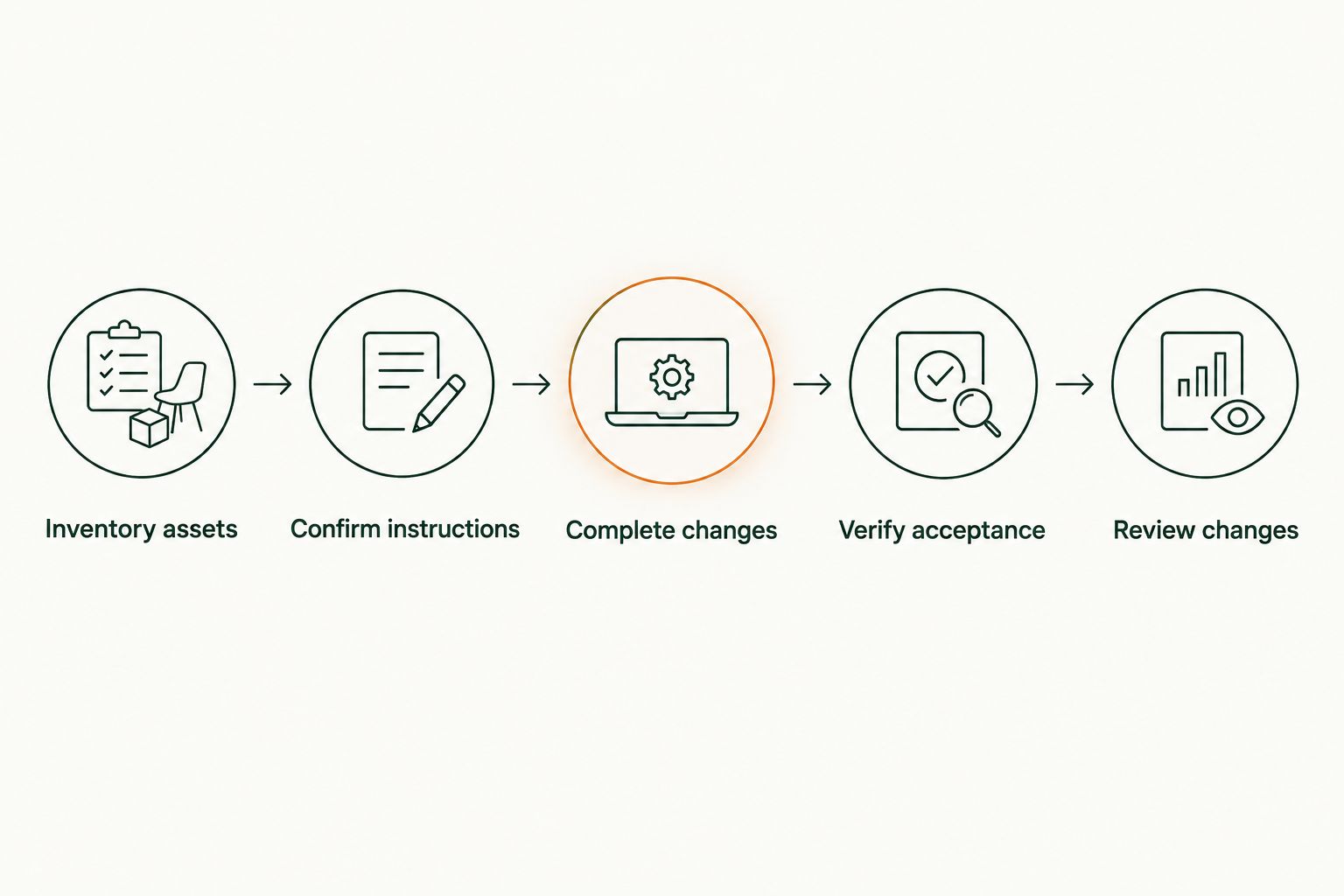
Use your 2026 estate review to connect documents with actual account records. The goal is written confirmation of completed changes, not a list of changes everyone assumes happened.
- Inventory assets. Gather current statements, deeds, insurance records, business agreements, and existing estate documents. Record each asset's legal owner and intended recipient.
- Confirm instructions. Have your attorney identify the appropriate transfer mechanism for each asset. Ask your advisor to flag conflicts with investment, retirement, or cash-flow needs.
- Complete changes. Submit institution-specific beneficiary and ownership forms. Have legal documents and deeds handled through the appropriate legal process.
- Verify acceptance. Check accepted beneficiary records, updated account titles, and completed property records. Keep confirmation with your estate-planning records.
- Review changes. Revisit the inventory after relevant family, property, account, or legal changes. Assign responsibility for each remaining task.
An advisor's spreadsheet is useful, but it is not the controlling beneficiary record. Confirm what the custodian, insurer, plan administrator, or property record actually shows.
Does avoiding probate also avoid estate taxes?
No. Probate and estate taxation are separate questions. An asset can pass outside probate and still count toward an estate-tax calculation. A revocable living trust generally does not remove assets from your taxable estate merely because it avoids probate.
For 2026 deaths, the federal basic estate-tax exclusion is $15,000,000. Massachusetts has a $2,000,000 estate-tax filing test and a $99,600 estate-tax credit; the filing test is not a substitute for calculating the tax under applicable rules.
These figures describe estate-tax rules, not probate thresholds. Your attorney and tax professional should evaluate the applicable filing requirements, prior gifts, deductions, and state rules before you make transfers.
For a Massachusetts family, a plan addressing only federal estate tax leaves a separate state question unanswered. Likewise, a plan addressing only probate leaves tax, liquidity, and inheritance-management questions unanswered.
Can I avoid probate without setting up a trust?
Yes. Valid beneficiary designations and applicable survivorship ownership can transfer certain assets outside probate without a trust. Whether that covers your entire estate depends on what you own and how each asset is titled.
A trust becomes a different conversation when you want continuing management, restrictions on distributions, or coordinated instructions across assets. Choose the arrangement for its legal and family purpose—not simply because someone calls it probate avoidance.
Who makes sure the account changes actually happen?
You should agree on responsibility with your advisor, attorney, and financial institutions. The attorney identifies the legal arrangement; the advisor helps connect it to your financial accounts; institutions process their required forms.
Ask for a written task list showing the asset, required change, responsible person, and completion evidence. Do not assume that an advisor's access to an account includes authority to change beneficiaries or legal ownership.
Where a coordinated advisory relationship fits
VIMNewEngland is best for individuals, families, and business owners seeking integrated financial planning and investment management. Its fee-only fiduciary advisory relationship includes savings, retirement, taxes, and estate planning rather than treating those topics as unrelated decisions.
The benefit is a connected view of your financial life. The boundary is equally important: VIMNewEngland's financial planning does not replace an estate attorney's legal advice, document preparation, or state-specific ownership analysis.
When speaking with VIMNewEngland, ask how estate-planning recommendations connect with account implementation and ongoing financial reviews. Define the work and responsibility before assuming coordination is included in every task.
Connect your accounts and estate plan
Discuss how financial planning and investment management fit your family's estate-planning needs.
FAQ
Can a fiduciary financial advisor guarantee that my family avoids probate?
No. A fiduciary financial advisor cannot guarantee probate avoidance. The outcome depends on ownership, valid transfer instructions, applicable law, and completion of the required legal and institutional steps.
Does having a will keep my accounts out of probate?
No. A will generally directs the distribution of assets administered through your estate; it does not itself create a nonprobate transfer. Valid beneficiary arrangements, survivorship ownership, and properly funded trusts operate differently.
Will a living trust avoid probate if I never move assets into it?
A living trust does not keep an individually owned asset outside probate merely because the trust exists. Your attorney should identify which assets need funding or another legally effective transfer arrangement.
Should I name my trust as the beneficiary of my IRA?
Name a trust as an IRA beneficiary only after legal and tax review. Trust beneficiary provisions can affect inherited-account distribution rules and tax treatment, so the decision requires more than matching names across documents.
Does avoiding probate eliminate Massachusetts estate tax in 2026?
No. Avoiding probate does not eliminate Massachusetts estate tax in 2026. Assets transferred outside probate can still be included in the estate-tax analysis.
What should I bring to an estate-planning meeting with my advisor?
Bring current account statements, beneficiary confirmations, deeds, insurance records, business agreements, and existing estate documents. Include your intended recipients and any family circumstances that affect how an inheritance should be managed.
Can VIMNewEngland replace my estate-planning attorney?
No. VIMNewEngland provides financial planning and investment management, not a replacement for estate counsel. Your attorney should handle legal advice and document preparation while the financial planning relationship addresses the related account and investment decisions.
One last thing
Ask this at your next review: If I died with today's account titles and beneficiary forms, which assets would still need probate? That question tests the plan you actually have, not the plan you intended to finish.
For your 2026 records, keep a verified asset inventory beside your signed estate documents. The paperwork matters. So does proof that your accounts follow it.
This article is educational and does not provide individualized legal or tax advice. Consult your estate attorney and tax professional before changing ownership or beneficiary arrangements.