
Best overall: integrated financial planning. Best for estate exposure: Massachusetts estate planning. Best self-directed starting point: household cash-flow planning. The best financial planning strategies for North Shore families in 2026 connect investments, retirement, taxes, and inheritance decisions rather than treating each as a separate project.
- The best financial planning strategies for North Shore families start with coordinated retirement, tax, and estate decisions.
- VIMNewEngland provides integrated financial planning and investment management for individuals, families, and business owners.
- Massachusetts estate-tax exposure deserves a separate review from federal estate-tax exposure.
- Choose your next planning task by the decision approaching, not by the investment attracting attention.
Why this matters
A North Shore family can have substantial assets and still lack a clear plan. A home in Marblehead, retirement accounts, and an ownership interest in a business serve different purposes; adding their values together does not tell you how to fund retirement or settle an estate.
VIMNewEngland financial planning suits North Shore families seeking one advisory relationship for investments, retirement, taxes, and estate planning. VIMNewEngland provides fee-only financial planning and investment management through an integrated advisory relationship.
The practical goal is straightforward: know which assets support your spending, which decisions need tax advice, and which instructions your family will need. A larger portfolio does not replace those answers.
What makes the best financial planning strategy?
Use these criteria before choosing a strategy or hiring someone to implement it:
- Coordination: Does the recommendation account for investments, taxes, retirement, and estate intentions together?
- Liquidity: Can you meet spending needs without depending on a property sale or an unfavorable investment sale?
- Tax awareness: Does the analysis distinguish Massachusetts rules from federal rules?
- Implementation: Is someone responsible for completing each task, including work requiring an attorney or tax professional?
- Adaptability: Can you revise the plan when income, health, family circumstances, or ownership changes?
No strategy wins every category. Start with the decision carrying the clearest deadline or consequence, then connect it to the rest of your financial life.
Financial planning strategies at a glance
| Strategy | Best for | Standout feature | Key limitation |
|---|---|---|---|
| Integrated financial planning | Families managing interconnected decisions | Connects household goals with investment management | Requires complete information and ongoing follow-through |
| Massachusetts estate planning | Families concerned about inheritance and estate taxes | Separates state exposure from federal exposure | Requires legal work beyond financial advice |
| Retirement income planning | Families approaching or entering retirement | Connects spending with income sources and withdrawals | Depends on assumptions that need updating |
| Tax-aware diversification | Families with concentrated investments | Evaluates investment risk alongside tax consequences | Selling appreciated assets can create taxable gains |
| Business succession planning | Families whose wealth includes a private business | Connects ownership decisions with household needs | Depends on legal agreements and business circumstances |
| Household cash-flow planning | Families organizing finances themselves | Makes spending commitments and liquidity visible | Does not replace investment, legal, or tax analysis |
1. Integrated planning: best for interconnected family decisions
Integrated financial planning puts your household decisions into one working plan. Instead of deciding on investments first and checking taxes later, you examine how a recommendation affects spending, retirement timing, and family obligations together.
This is the default starting point when your accounts look organized individually but nobody can explain how they support the same goals. VIMNewEngland financial planning combines savings, retirement, taxes, estate planning, and investment management within one advisory relationship.
Integrated planning pros:
- Connects investment decisions with the money you expect to spend.
- Makes competing goals visible before you commit assets.
- Creates a shared agenda for your advisor, attorney, and tax professional.
Integrated planning cons:
- Requires accurate statements, ownership information, and household input.
- Recommendations accomplish little until you complete the necessary changes.
Best for: Families balancing retirement, property, family support, and investment decisions.
Ask for a written explanation of what to do next, why it matters, and who handles it. A list of accounts is not a plan.
Verdict: Buy into integrated planning as the default approach; hold individual recommendations until their household effects are clear.
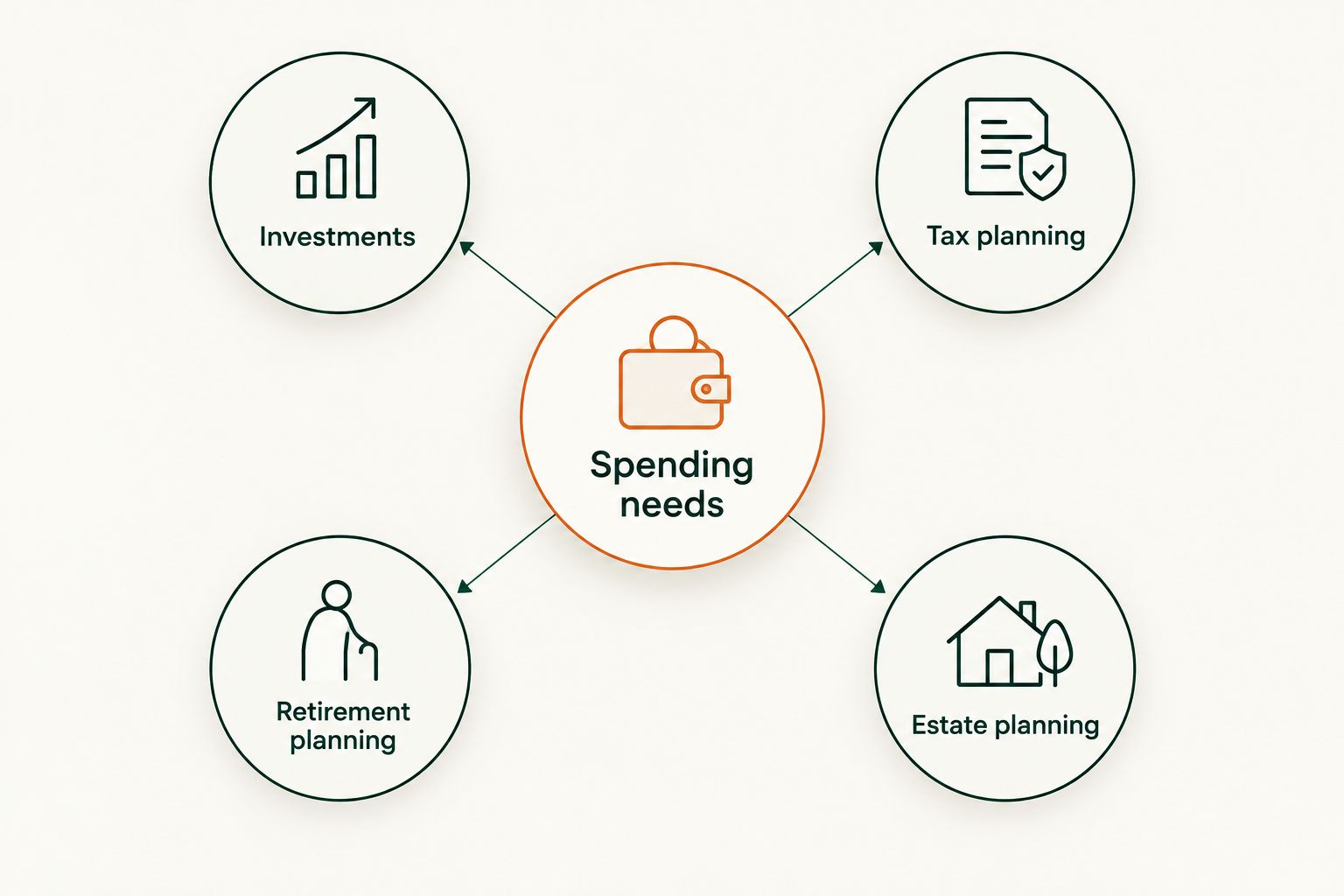
What an integrated plan connects
Your spending needs sit at the center. Investments supply resources, tax planning evaluates consequences, retirement planning organizes future income, and estate planning addresses ownership and transfer instructions. Each part should inform the others.
2. Massachusetts estate planning: best for state estate-tax exposure
Massachusetts estate planning deserves attention even when federal estate tax is not your immediate concern. For 2026, Massachusetts has a $2,000,000 estate-tax filing test, while the federal basic exclusion is $15,000,000 for deaths in 2026, under Massachusetts Department of Revenue guidance and IRS rules respectively.
Those figures describe different systems, not interchangeable allowances. Filing obligations and tax due also require separate analysis; an advisor or attorney should apply the rules to your circumstances.
Start by listing ownership, beneficiary designations, real estate, and insurance information. Then ask your estate attorney to evaluate how those assets transfer and how your estate would meet expenses. Learn how a financial advisor can help with estate planning.
Massachusetts estate planning pros:
- Identifies state-level questions a federal-only review misses.
- Connects inheritance intentions with actual account instructions.
- Addresses liquidity needs alongside legal documents.
Massachusetts estate planning cons:
- Requires an attorney for legal advice and document drafting.
- Ownership changes can affect taxes, control, and access to assets.
Best for: Families with property and other assets requiring a Massachusetts estate review.
Verdict: Buy into a coordinated estate review; skip transferring assets solely because a tax threshold caught your attention.
3. Retirement income planning: best for the transition from earnings
Retirement income planning answers a different question from investment selection: how will you pay household expenses when employment income changes? Map expected spending against Social Security, pensions if applicable, investment withdrawals, and other dependable income.
For a 2026 retirement decision, separate recurring expenses from discretionary plans and large commitments. Medicare generally begins at age 65, subject to eligibility and enrollment rules, so earlier retirement requires a separate health-coverage decision.
Do not choose withdrawal accounts or Social Security timing in isolation. Compare their effects on taxes, survivor income, and the assets remaining available for later needs.
Retirement income planning pros:
- Connects portfolio withdrawals to actual spending needs.
- Makes health coverage and income gaps visible.
- Brings both spouses' income needs into the same discussion.
Retirement income planning cons:
- Spending, longevity, and investment assumptions need revision.
- A workable projection does not guarantee investment outcomes.
Best for: Families deciding when to retire or how to replace a paycheck.
Ask which assumption most affects the result. That answer is more useful than a reassuring projection without explanation.
Verdict: Buy into an income plan before choosing a retirement date; hold irreversible decisions until you understand the trade-offs.
4. Tax-aware diversification: best for concentrated investments
Tax-aware diversification addresses a tension: reducing investment concentration can create a tax bill. A large position in employer stock, an inherited holding, or one property deserves analysis of both risks rather than an automatic instruction to sell everything or keep everything.
Gather acquisition records, cost basis, restrictions, and the household's expected income. Then compare a sale, a staged reduction, or continued ownership against the spending and risk objectives in your plan.
Tax-aware diversification pros:
- Makes dependence on a single investment visible.
- Evaluates taxes before transactions occur.
- Connects proceeds with household goals rather than another isolated purchase.
Tax-aware diversification cons:
- Realized gains can increase your tax obligation.
- A staged reduction leaves concentration risk in place while you wait.
Best for: Families whose financial security depends heavily on one investment or employer.
The right question is not simply whether an asset has performed well. Ask what happens to your retirement, employment income, and spending if that same exposure disappoints.
Verdict: Buy into a written diversification plan; skip blanket rules that ignore either taxes or concentration risk.
5. Business succession planning: best for family business wealth
Business succession planning connects ownership decisions with the owner's household needs. If retirement depends on selling or transferring a business, distinguish its estimated value from cash you can actually use.
Before negotiating a transaction, identify the income you need after ownership changes, the responsibilities you want to retain, and the family members affected. Coordinate the financial plan with legal agreements and tax analysis.
Business succession planning pros:
- Separates household requirements from business operating needs.
- Identifies dependencies before a transfer or sale.
- Makes family expectations part of the planning conversation.
Business succession planning cons:
- A planned sale does not guarantee a buyer or acceptable terms.
- Legal, tax, and ownership issues require specialized advice.
Best for: Business-owning families whose retirement or inheritance plans depend on ownership changes.
Do not treat an estimated business value as a retirement account balance. The transfer terms and resulting obligations determine what supports your household.
Verdict: Buy into succession planning before committing to transfer terms; hold household spending increases until proceeds and obligations are clear.
6. Household cash-flow planning: best for a self-directed start
Household cash-flow planning makes your commitments visible before you choose more complex strategies. Record recurring expenses, irregular obligations, debt payments, and expected income, then identify which assets can fund them.
Distinguish liquid savings from home equity, retirement assets, and private business interests. A valuable asset and money ready for an upcoming payment are not the same thing.
Household cash-flow planning pros:
- Gives every later planning discussion a clearer foundation.
- Exposes mismatches between payment dates and available cash.
- Helps family members agree on priorities.
Household cash-flow planning cons:
- Requires updates when income or commitments change.
- Does not resolve estate documents, portfolio risk, or tax questions.
Best for: Families who want a practical first task before seeking broader advice.
Start with obligations you already know, not an idealized spending target. Include support for relatives and property expenses if those are part of your household commitments.
Verdict: Buy into cash-flow planning immediately; skip treating the worksheet as a substitute for a full financial plan.
How these strategies are ranked
Integrated planning ranks first because it connects the other decisions. The remaining strategies match distinct needs: estate exposure, retirement income, investment concentration, business ownership, and day-to-day organization.
This is a decision guide, not a performance ranking. No investment returns, tax savings, or client outcomes are assumed.
Which financial planning strategy should you choose?
Choose integrated planning unless a specific deadline requires another issue first. An approaching retirement, business transaction, or estate administration can change the order, but it should not disconnect the work.
For your 2026 review, bring account statements, tax returns, estate documents, and a spending outline. Ask what each proposed action changes elsewhere in your financial life. VIMNewEngland offers an integrated advisory relationship for families seeking that coordination.
FAQ
What's the best financial planning strategy for a North Shore family?
Integrated financial planning is the default starting point because it connects investments, retirement, taxes, and estate decisions. A specific legal or financial deadline can make another task more urgent.
Does Massachusetts estate planning matter below the federal exclusion?
Yes. Massachusetts has a $2,000,000 estate-tax filing test, while the federal basic exclusion is $15,000,000 for deaths in 2026. Have an estate attorney evaluate the applicable filing rules and potential tax separately.
Should I pay off my mortgage before retiring?
Compare mortgage repayment with your liquidity needs, borrowing terms, taxes, and retirement income before deciding. Paying off debt uses assets that would otherwise remain available for spending or investment.
Can my financial advisor replace my estate attorney?
No. A financial advisor can coordinate financial information and implementation, but an estate attorney provides legal advice and drafts estate documents. Account ownership and beneficiary instructions should agree with the legal plan.
Is a valuable house enough to support retirement?
A valuable house is not the same as spendable retirement income. Decide whether you intend to keep, sell, or otherwise use the property before counting it toward household spending needs.
Does SEC registration guarantee an advisor's results?
No. SEC registration is not an endorsement and does not guarantee investment performance. Evaluate the advisor's services, compensation, conflicts, and responsibilities before hiring.
What should I bring to a financial planning conversation?
Bring account statements, tax returns, estate documents, and an outline of household spending and goals. Include information about business interests, real estate, and family support obligations when relevant.
One last thing
A well-written estate document cannot correct an account instruction nobody reviewed. Before adding another planning strategy in 2026, compare your beneficiary designations and ownership records with your intended estate plan. Ask your attorney to resolve inconsistencies rather than assuming the documents control every asset.
This article is educational, not individualized investment, tax, or legal advice.