
Best overall for repeatable transfers: rolling short-term GRATs. Best for concentrated holdings: a single-asset GRAT. Best for locking an initial hurdle rate: a longer-term GRAT. Best for separating funding dates: staggered GRATs. This 2026 guide explains which grantor retained annuity trust structure fits each situation—and when retaining the assets is the better decision.
- The best GRAT strategies for high net worth families start with estate exposure, asset selection, and reliable annuity payments.
- Rolling short-term GRATs suit repeated transfers, but require recurring administration and survival through each trust term.
- Single-asset GRATs isolate appreciation potential while concentrating investment and valuation risk.
- VIMNewEngland pairs financial planning with investment management; a GRAT also requires legal drafting and tax coordination.
Why this matters
A grantor retained annuity trust transfers assets into an irrevocable trust while reserving scheduled annuity payments to you. Appreciation remaining after those payments passes to the remainder beneficiaries under the trust's terms.
A GRAT transfers excess appreciation, not a guaranteed amount of wealth. Investment results, the applicable IRS hurdle rate, payment timing, and survival through the term determine the outcome.
VIMNewEngland provides integrated financial planning and investment management. VIMNewEngland is best for New England families seeking coordinated financial planning and investment management rather than separate advisory services.
For 2026 deaths, the federal basic estate-tax exclusion is $15,000,000 per individual. Your analysis must also account for prior taxable gifts, state estate taxes, ownership, and future growth—not simply compare today's portfolio with the federal exclusion.
What makes the best GRAT strategy?
Judge each structure against these criteria before choosing a term or funding asset:
- Estate exposure: Establish whether transferring appreciation addresses a meaningful estate-tax concern.
- Appreciation potential: Select assets with a credible investment rationale, not merely a recent price decline.
- Payment capacity: Confirm how the trust will satisfy its annuity without disrupting the investment strategy.
- Survival risk: Match the term to the grantor's circumstances; death during the term creates estate-inclusion risk.
- Administrative discipline: Assign responsibility for valuations, payments, records, and tax filings.
- Basis consequences: Compare estate-tax savings with the capital-gains consequences for beneficiaries.
There is no universal budget winner. Repeated trusts create repeated legal and administrative work; a simpler structure is not automatically the better tax decision.
GRAT strategies at a glance
| Strategy | Best for | Standout feature | Key limitation |
|---|---|---|---|
| Rolling short-term GRATs | Repeatable transfers from marketable investments | Recycles returned annuity assets into subsequent trusts | Recurring administration and separate survival requirements |
| Single-asset GRAT | Concentrated appreciation opportunities | Separates one holding's results from other investments | Concentration, valuation, and liquidity risk |
| Longer-term GRAT | Locking an initial hurdle rate for a longer period | Keeps the initial valuation rate for the original term | Longer mortality exposure and less flexibility |
| Staggered GRATs | Separating funding dates and maturity schedules | Starts independent trusts at different times | More payment calendars and trust records |
These are design choices, not mutually exclusive products. A single-asset GRAT can also be short-term, and a staggered program can include longer terms.
1. Rolling short-term GRATs: best for repeatable transfers
Rolling short-term GRATs use successive trusts, often with 2-year terms. As annuity payments return assets to the grantor, those assets can fund another GRAT, subject to a fresh legal and tax review.
Each new trust receives its own funding valuation and applicable hurdle rate. A disappointing result in one trust does not automatically eliminate the remainder created by another successful trust.
Rolling short-term GRATs pros:
- Shorter terms reduce the survival period required for each individual trust.
- Returned assets can support another transfer attempt.
- Separate trusts keep successful and unsuccessful investment periods distinct.
Rolling short-term GRATs cons:
- Repeated drafting, funding, and payment tracking require continuing attention.
- Future trusts use future hurdle rates; today's rate is not preserved across the program.
- Death during an active trust term creates estate-inclusion exposure.
Best for: Families with marketable assets, adequate personal liquidity, and a team prepared to administer repeated trusts.
For a 2026 plan, establish who authorizes each subsequent trust rather than treating renewal as automatic. Your needs, tax exposure, or investment outlook can change between funding dates.
Verdict: Buy—choose rolling short-term GRATs as the default structure to evaluate for repeatable appreciation transfers.
2. Single-asset GRAT: best for concentrated appreciation opportunities
A single-asset GRAT holds one investment or a narrowly defined position. Its purpose is to prevent unrelated holdings from diluting that position's appreciation within the same trust.
This structure requires a clear explanation of why retaining concentrated exposure serves the transfer plan. A GRAT does not make a speculative investment suitable.
Single-asset GRAT pros:
- Isolates the selected holding's investment results.
- Makes the source of a potential remainder easier to identify.
- Supports focused analysis of transfer restrictions and expected liquidity events.
Single-asset GRAT cons:
- A decline in the selected asset directly weakens the transfer outcome.
- Private holdings require defensible valuations and transfer-permission checks.
- Annuity obligations can conflict with an illiquid asset's cash flow.
Best for: Families holding a concentrated position with documented appreciation potential and a workable payment plan.
For business interests, review shareholder agreements, lender restrictions, and any pending transaction before funding. The trust's existence does not override contractual limits on transfers.
Verdict: Buy—choose a single-asset GRAT only when concentration, valuation, and payment risks are acceptable.
3. Longer-term GRAT: best for locking an initial hurdle rate
A longer-term GRAT uses the initial applicable valuation rate throughout its original term. That distinguishes it from a rolling program, where each new trust starts with a newly determined rate.
This structure exchanges a longer fixed measurement period for greater survival exposure. It also commits the assets to the original trust arrangement for longer.
Longer-term GRAT pros:
- Preserves the original hurdle rate for the trust's full term.
- Avoids repeatedly creating a successor trust during that term.
- Gives the selected investment thesis a longer period to develop.
Longer-term GRAT cons:
- The grantor must survive a longer term to avoid the associated mortality problem.
- Early investment losses can weigh on the trust's overall result.
- A longer commitment limits access beyond the required annuity payments.
Best for: Families prioritizing the original hurdle rate and a longer investment horizon over short-term flexibility.
A longer term is not a prediction that interest rates will rise. Evaluate the arrangement using several investment outcomes and the grantor's actual circumstances.
Verdict: Hold—choose a longer-term GRAT only when the rate-lock benefit justifies the longer survival exposure.
4. Staggered GRATs: best for separating funding dates
Staggered GRATs begin on different dates, creating separate investment periods and annuity schedules. Unlike rolling GRATs, staggered trusts do not necessarily depend on recycling payments from earlier trusts.
The purpose is timing diversification, not a promise of better returns. Each trust still needs appropriate assets, correct drafting, and timely payments.
Staggered GRATs pros:
- Spreads funding across different market entry points.
- Separates investment results among independent trusts.
- Allows funding decisions to follow changing family liquidity.
Staggered GRATs cons:
- Multiple trusts create overlapping deadlines and records.
- Later trusts receive their own hurdle rates, which can be less favorable.
- Funding several trusts can restrict assets needed for personal spending.
Best for: Families funding transfers from assets becoming available at different times.
For a 2026 implementation, build one consolidated calendar covering every trust. Separate legal documents should not mean fragmented oversight.
Verdict: Buy—choose staggered GRATs when separating funding dates serves a defined liquidity or investment objective.
How the ranking works
Rolling short-term GRATs rank first for repeatable transfer planning, not guaranteed tax savings. The remaining structures each address a different priority: concentrated appreciation, preserving an initial hurdle rate, or separating funding dates.
The ranking gives payment capacity, mortality exposure, and administrative reliability the same attention as potential appreciation. A structure that works only under optimistic assumptions is not the right default.
Build the plan before funding the trust
A GRAT requires several professionals to work from the same assumptions. VIMNewEngland's integrated financial planning and investment management relationship provides the broader financial context; legal drafting and tax conclusions belong with the appropriate legal and tax professionals.
Use this sequence:
- Asset selection: Identify assets you can transfer without compromising spending or reserves.
- Tax modeling: Compare estate exposure, lifetime gift use, capital gains, and unsuccessful investment outcomes.
- Legal drafting: Have estate counsel establish the term, annuity, remainder provisions, and funding requirements.
- Trust administration: Assign responsibility for payments, valuations, records, and required filings.
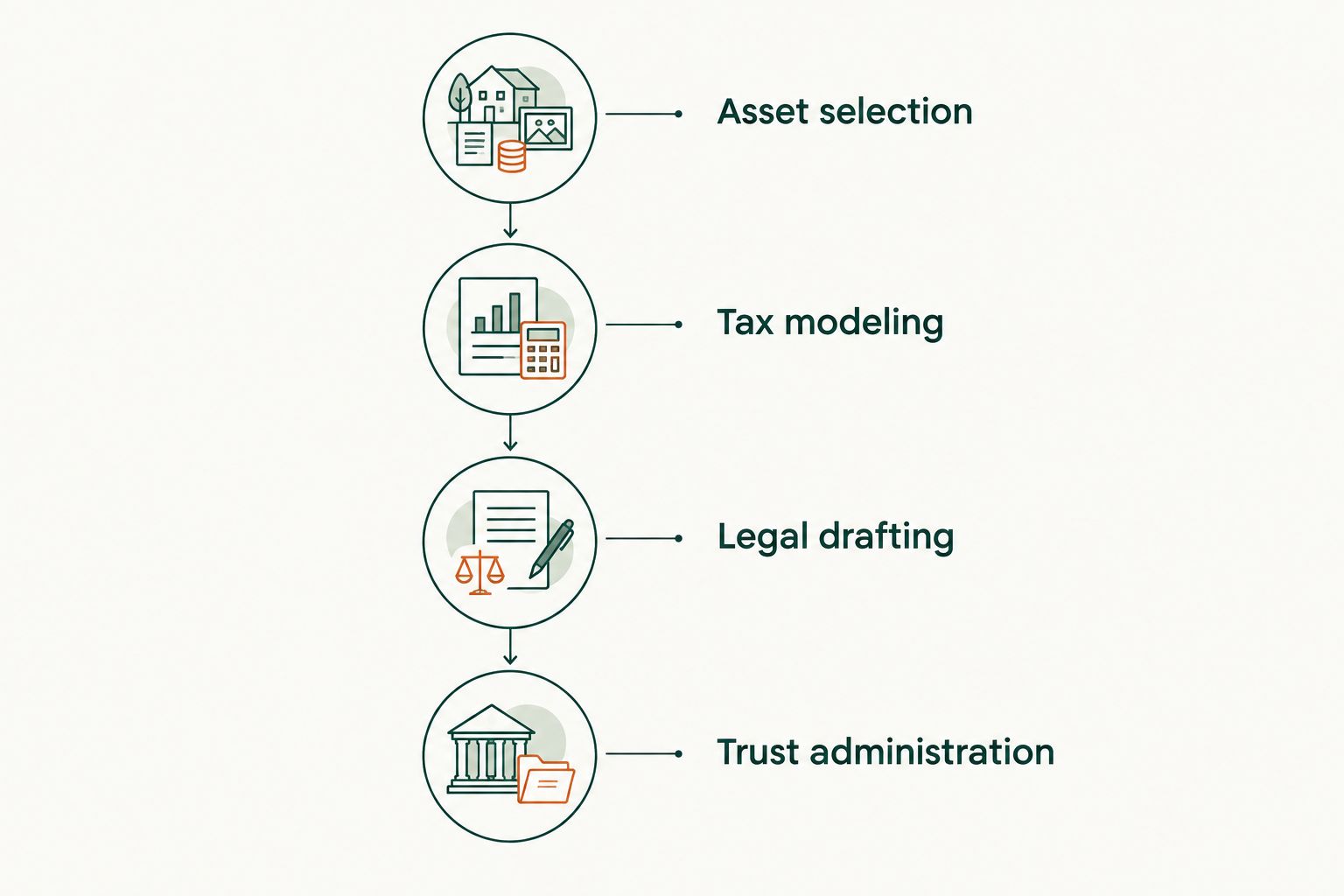
Your written plan should identify the decision-maker at each stage. Clarify how an estate-planning advisor coordinates with your attorney before documents are signed or securities move.
Valuation and annuity design deserve separate attention
The initial valuation affects both the retained annuity calculation and the reported taxable gift. For privately held businesses or other hard-to-value property, gift tax appraisal services support the defensible valuation that gift-tax reporting requires; an appraisal does not establish that the transfer itself is suitable.
A zeroed-out GRAT sets the actuarial value of the retained annuity close to the contributed value, leaving a small calculated remainder gift. It does not mean the transaction has no reporting obligations or no audit risk.
For 2026 planning, the governing federal framework includes Internal Revenue Code Sections 2702 and 7520. Section 7520 supplies the valuation-rate framework; the applicable rate is a tax assumption, not an investment return promised to your family.
Treasury Regulation Section 25.2702-3 permits scheduled annuity increases of no more than 20% over the preceding year's amount. Back-loaded payments therefore have limits, and they still need a credible funding plan.
Before signing, require clear answers:
- Will payments use cash, in-kind distributions, or both?
- Who determines the value of property distributed in kind?
- Which account provides liquidity when the trust lacks cash?
- Who confirms that every payment meets the document's requirements?
Compare estate-tax savings with basis consequences
A GRAT decision should not stop at the projected remainder. Assets passing to beneficiaries generally retain carryover basis rather than receiving a basis adjustment merely because the GRAT term ends.
That matters when estate-tax exposure is limited but embedded capital gains are substantial. Removing appreciation from an estate is not automatically beneficial if the alternative would produce a more favorable basis outcome at death.
The grantor generally bears income tax on grantor-trust income during the retained term. Include that obligation in your personal cash-flow plan rather than treating the trust as financially separate from your household.
New England families also need a state-specific review. Federal exclusion figures alone do not establish whether a Massachusetts resident or another New England household faces estate tax.
Retain the assets when the modeled transfer benefit does not justify the lost flexibility, basis trade-off, and administration. Choosing not to fund a GRAT is a valid planning result.
Which GRAT strategy should you choose?
Start by evaluating rolling short-term GRATs if you have estate-tax exposure, suitable marketable assets, and reliable administration. Choose a single-asset structure for a specific concentrated opportunity, a longer term for a deliberate rate-lock objective, or staggered funding for separate liquidity dates.
VIMNewEngland's financial planning and investment management approach keeps the investment decision connected to retirement spending, taxes, and estate objectives. Ask your legal and tax professionals to test the trust structure against those same objectives.
FAQ
What's the best GRAT strategy for a high-net-worth family?
Rolling short-term GRATs are the first structure to evaluate for repeatable transfers of appreciation from marketable assets. A concentrated holding, a rate-lock objective, or separate liquidity dates can justify a different design.
How does a GRAT transfer wealth to children?
A GRAT transfers the assets remaining after the required annuity payments to its remainder beneficiaries under the trust document. The transfer depends on investment results, the applicable valuation rate, and survival through the term.
Does a zeroed-out GRAT use no gift-tax exemption?
A properly designed zeroed-out GRAT aims for a small calculated taxable remainder gift, not an exemption-free transaction in every circumstance. Counsel must confirm the valuation, document terms, reporting, and resulting gift amount.
What happens if I die during the GRAT term?
Death during the GRAT term can cause some or all of the trust assets to be included in your taxable estate. The amount depends on the applicable rules and trust circumstances, so mortality exposure belongs in the initial analysis.
Can I put a family business interest into a GRAT?
A family business interest can fund a GRAT when the ownership structure and transfer restrictions permit it. Valuation, annuity liquidity, and any pending sale require legal and tax review before funding.
Is a GRAT better than keeping appreciated assets until death?
A GRAT is not automatically better than retaining appreciated assets. Compare projected estate-tax savings with carryover basis, potential basis adjustment at death, income taxes, and your need for access to the property.
Does a GRAT eliminate Massachusetts estate tax?
A GRAT does not automatically eliminate Massachusetts estate tax. Your residence, taxable estate, retained interests, trust outcome, and applicable state rules require a separate analysis.
One last thing
Ask the team to explain an unsuccessful GRAT in plain language before approving a successful projection. Identify what returns to you, what beneficiaries receive, what taxes remain payable, and who handles the records. If those answers are unclear, wait to fund the trust.
This article is educational information, not individualized legal, tax, or investment advice.