
Best overall: staged sales with specific-lot selection. Best for urgent risk reduction: immediate diversification. Best for charitable goals: donating appreciated shares. This 2026 guide compares the best strategies for managing concentrated stock positions, including hedging and exchange funds, by what each accomplishes and what you give up.
- The best strategies for managing concentrated stock positions start with your spending needs, tax basis, and trading restrictions.
- Staged sales are the default for balancing diversification with control over realized gains.
- Immediate diversification fits investors whose essential goals depend too heavily on one company.
- VIMNewEngland provides integrated financial planning and investment management for individuals, families, and business owners.
- Charitable gifts, hedging, and exchange funds solve different problems; none replaces a household financial plan.
Why this matters
A concentrated position makes one company responsible for too much of your financial security. The exposure becomes harder to absorb when that company also provides your salary, bonus, or future equity awards.
The right question is not simply whether the shares will rise. It is whether a decline would force you to postpone retirement, sell other assets, or change spending you intended to protect.
VIMNewEngland combines financial planning and investment management in one advisory relationship. That structure connects a stock-sale decision with retirement spending, taxes, savings, and estate planning rather than treating the holding as an isolated investment.
Reduce concentration according to what your financial plan needs—not what your purchase price makes emotionally comfortable.
What makes the best concentrated-stock strategy
Use these criteria to choose a strategy in 2026:
- Risk reduction: Does the strategy actually reduce dependence on the company, or merely change how you hold the exposure?
- Tax control: Can you select tax lots, coordinate realized losses, or spread gains without leaving essential goals exposed?
- Liquidity: Will you have usable funds when retirement spending, taxes, or other commitments come due?
- Execution freedom: Do company policies, securities laws, or contractual restrictions limit sales, gifts, or hedges?
- Complexity: Can you explain the strategy's obligations, failure points, and exit process before committing?
- Goal fit: Does the strategy serve your household, charitable intentions, and estate plan without creating a different problem?
A tax benefit does not compensate for a strategy that leaves you unable to fund an important obligation. Apply the criteria in that order when liquidity is essential.
Concentrated-stock strategies at a glance
| Strategy | Best for | Standout feature | Key limitation |
|---|---|---|---|
| Staged sales | Investors balancing taxes and gradual diversification | Specific-lot sales tied to a written schedule | Unsold shares remain exposed |
| Immediate diversification | Investors needing prompt risk reduction | Removes the targeted exposure once sales settle | Realizes taxable gains in taxable accounts |
| Appreciated-share donations | Investors with existing charitable intentions | Transfers shares rather than selling them first | Donated assets no longer fund personal goals |
| Protective puts or collars | Investors seeking temporary downside protection | Changes the position's payoff over a defined term | Contract terms, costs, and tax rules complicate execution |
| Exchange funds | Eligible investors able to accept long commitments | Exchanges a single-stock contribution for a pooled interest | Restricted liquidity and tax deferral, not elimination |
1. Staged sales: best for controlled diversification
Staged sales reduce a concentrated position through planned transactions rather than a single decision. In a taxable account, specific-lot identification lets you choose which shares to sell, subject to proper instructions and confirmation through your custodian.
Best for: Investors who can tolerate remaining exposure while coordinating gains with their broader tax picture.
Start with a target exposure and a sale schedule. Review the schedule when your financial needs change—not every time the stock moves.
Staged sales pros:
- Turns an emotional decision into an executable process.
- Supports deliberate selection of higher-basis or otherwise appropriate lots.
- Allows coordination with realized losses and other income.
Staged sales cons:
- Leaves remaining shares exposed to company-specific losses.
- Requires follow-through when a rising stock makes selling uncomfortable.
- Does not guarantee a lower total tax bill.
Before the first 2026 sale, reconcile acquisition dates, adjusted basis, and prior equity-compensation reporting. A strategy built on incorrect basis can produce incorrect gain calculations.
Verdict: Buy into a staged-sale plan when your household can withstand the remaining exposure.
2. Immediate diversification: best for protecting essential goals
Immediate diversification sells the portion of the position that your plan cannot afford to keep exposed. Proceeds then support cash needs and an investment allocation designed around your goals.
Best for: Investors whose retirement, near-term spending, or financial independence depends too heavily on one holding.
The relevant comparison is the tax consequence of selling versus the consequence of retaining the risk. Waiting for a preferred tax outcome leaves the investment outcome uncertain.
Immediate diversification pros:
- Reduces the targeted company exposure promptly.
- Creates funds for taxes, spending, and reinvestment.
- Simplifies the portfolio without adding a specialized structure.
Immediate diversification cons:
- Accelerates recognition of gains in a taxable account.
- Gives up participation in future gains on shares sold.
- Requires a reinvestment plan to avoid replacing concentration with indefinite cash holdings.
Separate the tax reserve from money available to invest. Then build the replacement allocation deliberately; buying a fund heavily exposed to the same company can retain more overlap than intended.
Verdict: Buy into immediate diversification when protecting essential goals outweighs controlling the timing of gains.
3. Appreciated-share donations: best for existing charitable goals
Donating appreciated shares transfers ownership to a charity instead of selling the shares and donating cash. For qualifying gifts, the donor generally does not recognize the embedded capital gain; deduction treatment depends on the asset, holding period, recipient, and applicable limits.
Best for: Investors who already intend to give and do not need the donated assets for personal spending.
Long-term capital-gain property generally requires a holding period of more than 1 year. Confirm recipient acceptance and complete the required transfer and documentation before treating a gift as finished.
Appreciated-share donation pros:
- Reduces the donated company's share of your holdings.
- Connects diversification with a genuine charitable objective.
- Avoids a donor sale of the contributed shares when properly structured.
Appreciated-share donation cons:
- Permanently removes the assets from your personal finances.
- Deduction limits can prevent using the full deduction immediately.
- Restricted shares and pending transactions require additional review.
Do not use a charitable gift as a substitute for money you need. IRS Publication 561 addresses donated-property valuation, while Publication 526 explains charitable-contribution rules; your tax professional should apply those rules to the proposed gift.
Verdict: Buy into appreciated-share giving only when the charitable commitment stands on its own.
4. Protective puts or collars: best for temporary protection
A protective put gives you the contractual right to sell shares at a specified exercise price during the contract's applicable term. A collar combines a protective put with a written call, limiting downside under its terms while also limiting upside.
Best for: Investors who need a defined period of protection and can use options under applicable trading and company rules.
A hedge changes exposure; it does not automatically create a diversified portfolio. Contract expiration also creates another decision point.
Protective puts and collars pros:
- Define protection for the shares and term covered.
- Provide an alternative to an immediate outright sale.
- Allow the protection level to reflect a specific planning need.
Protective puts and collars cons:
- Put premiums and trading expenses reduce the economic benefit.
- Written calls restrict upside and can result in assignment.
- Constructive-sale, straddle, and holding-period rules can change tax treatment.
Before using a hedge in 2026, have securities counsel or company compliance personnel confirm whether it is permitted. Your tax professional should review the exact contracts, not just the strategy's name.
Verdict: Hold until the contract terms, tax consequences, and company restrictions are understood.
5. Exchange funds: best for eligible, patient investors
An exchange fund pools contributed positions from multiple investors in a partnership structure. When the contribution qualifies for tax-deferred treatment, an investor exchanges a concentrated holding for an interest in the pooled portfolio without immediately recognizing the contributed gain.
Best for: Eligible investors who prioritize diversification and tax deferral over ready access to their assets.
An exchange fund is not an exchange-traded fund. Its documents determine contribution acceptance, redemption restrictions, expenses, and distribution mechanics.
Exchange fund pros:
- Provides exposure to a pool rather than only the contributed stock.
- Can defer gain recognition when the structure and contribution qualify.
- Offers an alternative worth evaluating for substantial low-basis holdings.
Exchange fund cons:
- Restricts liquidity under the fund's terms.
- Adds partnership reporting and structural complexity.
- Defers embedded gains rather than making them disappear.
Review the actual portfolio, retained exposures, redemption provisions, and tax consequences of distributions. Do not assume the pool is appropriate merely because it contains more securities than your current position.
Verdict: Wait until eligibility, liquidity needs, and independent tax review support the commitment.
How to turn the ranking into a decision
Build a decision file before choosing a transaction. VIMNewEngland's integrated financial planning and investment management relationship connects the investment decision with the household needs it must support.
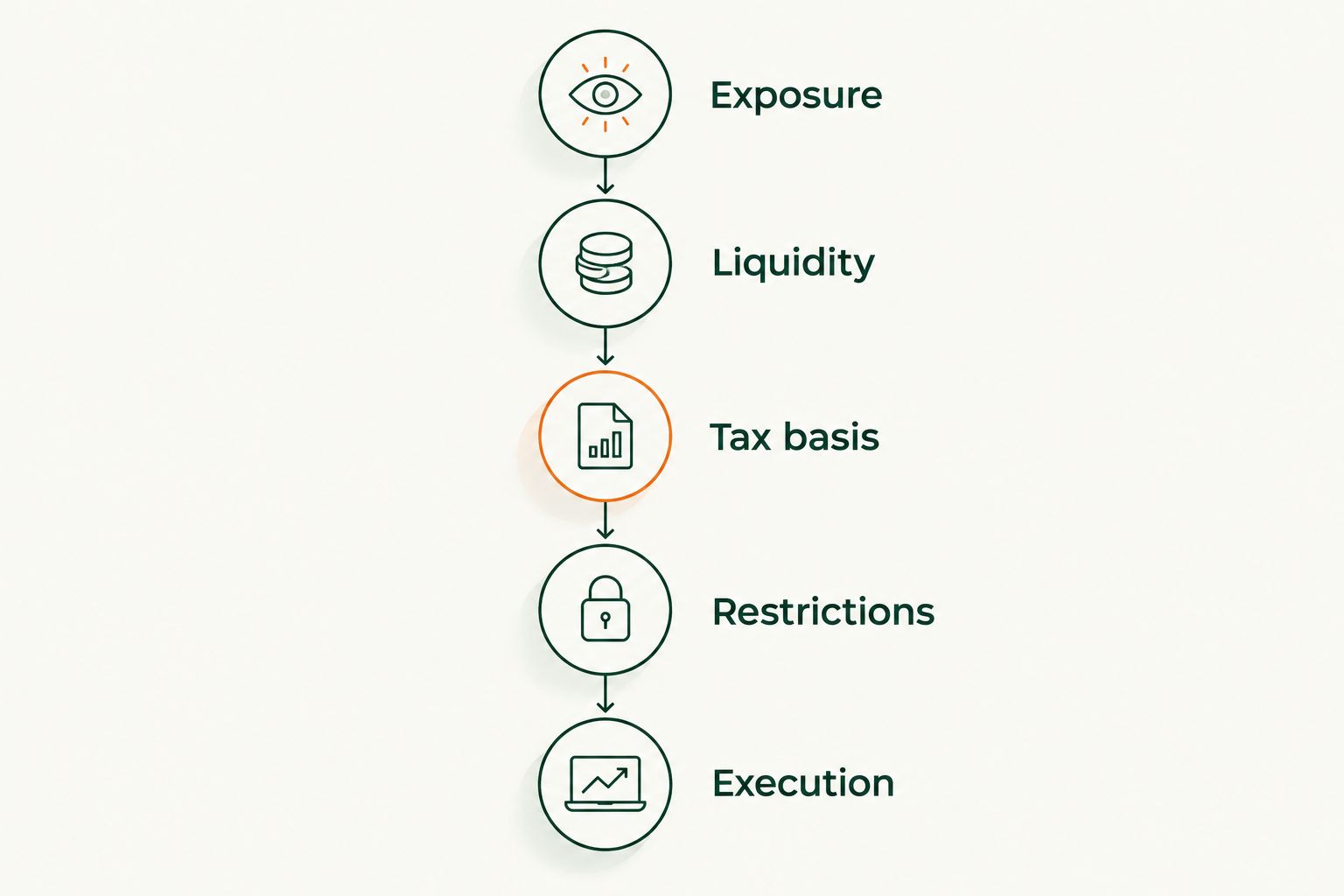
Use these checkpoints in order:
- Exposure: List the stock across taxable accounts, retirement accounts, trusts, and equity awards. Identify employment income tied to the same business.
- Liquidity: Separate funds needed for spending and taxes from assets that can remain invested.
- Tax basis: Verify acquisition dates, adjusted basis, and unrealized gains by lot.
- Restrictions: Identify trading windows, material nonpublic information, company policies, and transfer limitations.
- Execution: Document the chosen transactions, tax reserve, replacement allocation, and review triggers.
The checkpoints prevent a common mismatch: choosing an appealing tax strategy before establishing whether you can afford its remaining risk or restricted liquidity.
For 2026 planning, include your tax professional before executing—not only when preparing the return. Restricted or insider holdings also require legal and company-compliance review; a trading plan does not excuse trading on material nonpublic information.
If you coordinate sales with tax-loss harvesting, remember that the wash-sale rule covers purchases of substantially identical securities within 30 days before or 30 days after a loss sale. Review activity across relevant accounts, including automatic purchases; IRS Publication 550 explains the rule and related investment-tax treatment.
Connect your stock decision to your plan
Review investment management alongside retirement, taxes, savings, and estate planning.
How the strategies are ranked
Staged sales rank first because they combine direct risk reduction with control over execution. Immediate diversification moves ahead when essential goals cannot tolerate the remaining exposure.
Charitable gifts, hedges, and exchange funds rank by distinct purposes—not by promised returns or universal tax savings. These are planning comparisons, not performance-test results.
Which concentrated-stock strategy should you choose?
Start with staged sales unless your financial plan requires faster risk reduction. Add charitable giving only for assets you genuinely intend to donate; evaluate hedges and exchange funds only when their specific trade-offs fit.
VIMNewEngland is best suited to investors who want financial planning and investment management coordinated in one relationship. For a concentrated holding, that means evaluating what the household needs before deciding what to sell or retain.
FAQ
What's the best strategy for managing a concentrated stock position?
Staged sales are the default when you can tolerate remaining exposure while diversifying. Immediate diversification takes priority when a decline would threaten essential spending or retirement goals.
Should I sell all my company stock at once?
Sell promptly when the remaining company exposure exceeds what your financial plan can absorb. Otherwise, compare staged sales with your tax situation, trading restrictions, and liquidity needs.
Can I diversify concentrated stock without paying tax?
Some qualifying structures defer gains, and qualifying charitable gifts can avoid donor recognition of the contributed gain. Neither result is equivalent to selling shares, keeping unrestricted proceeds, and eliminating all tax consequences.
Is donating appreciated stock better than donating cash?
Donating appreciated stock can be more tax-efficient when the gift qualifies and you already intend to give. Confirm holding periods, deduction limits, recipient eligibility, and transfer requirements before proceeding.
Does a collar eliminate the risk of owning company stock?
A collar does not eliminate every risk of owning company stock. Protection depends on contract terms and duration, while written calls limit upside and tax rules can affect the result.
Is an exchange fund the same as an ETF?
An exchange fund is not an ETF. It generally uses a pooled partnership structure with eligibility requirements, restricted liquidity, and tax rules that require individual review.
What should I review before selling concentrated stock in 2026?
Review household exposure, spending needs, tax basis, and trading restrictions before a 2026 sale. Establish a tax reserve and a replacement investment allocation before treating the proceeds as available for other goals.
One last thing
Keeping shares is also an investment decision. Ask whether you would buy the same position with cash today; if not, identify what justifies retaining it beyond avoiding a tax bill.
Your 2026 plan does not need a perfect exit price. It needs a clear connection between the risk you retain and the life that money is intended to support.
This article is educational, not individualized investment, tax, or legal advice. Coordinate transactions with your financial advisor, tax professional, and attorney as appropriate.