
Best overall: model the deal structure before signing. Best for qualifying shareholders: review the qualified small business stock exclusion. Best for spreading eligible gains: consider an installment sale. The best tax strategies for selling a business in 2026 depend on what you own, how the buyer pays, and what your family needs after closing.
- The best tax strategies for selling a business start with comparing after-tax proceeds before agreeing to deal terms.
- Qualified small business stock treatment requires documented eligibility; an eligible company alone is not enough.
- Installment sales spread eligible gain recognition but introduce buyer repayment risk.
- VIMNewEngland connects financial planning and investment management for owners preparing for life after a business sale.
Why this matters
A headline sale amount does not tell you how much money will support your retirement. Debt repayment, transaction expenses, taxes, escrow, and deferred payments all affect what reaches your accounts.
For a 2026 exit, begin with an after-tax cash-flow projection rather than a preferred tax tactic. VIMNewEngland provides integrated financial planning and investment management; your transaction attorney and tax adviser must determine the legal structure and tax treatment of the sale.
VIMNewEngland is best for New England business owners seeking integrated financial planning and investment management around a business exit. That relationship complements transaction advice; it does not replace it.
What makes the best business-sale tax strategy?
Judge each strategy against these criteria before comparing potential savings:
- Eligibility: Your entity, ownership history, assets, and transaction must qualify.
- After-tax proceeds: Compare money you keep, not just the tax deferred.
- Payment certainty: Separate cash at closing from promises of future payment.
- Personal control: Identify restrictions on spending, ownership, and charitable assets.
- Implementation timing: Establish what must happen before negotiations advance.
- Family fit: Protect retirement income, estate goals, and cash reserves together.
A tax reduction is not a good trade if it leaves you dependent on a buyer whose finances you cannot control. Likewise, giving away business interests only makes sense when you genuinely want the recipient to own their value.
Business-sale tax strategies at a glance
| Strategy | Best for | Standout feature | Key limitation |
|---|---|---|---|
| Deal-structure modeling | Owners negotiating transaction terms | Compares tax character and net proceeds | Buyer and seller preferences can conflict |
| QSBS eligibility review | Shareholders with potentially qualifying stock | Tests access to a federal gain exclusion | Detailed acquisition, holding, and business requirements |
| Installment sale | Sellers comfortable receiving payments over time | Defers eligible gain as payments arrive | Buyer default risk and recognition exceptions |
| Pre-sale charitable giving | Owners with established charitable goals | Transfers eligible interests before a sale | Irrevocable gift and assignment-of-income concerns |
| State-tax review | Owners with multistate businesses or residency changes | Examines sourcing and state conformity | Moving does not erase business-source income |
| Capital-loss coordination | Sellers with realized capital gains and investment losses | Matches eligible losses against capital gains | Does not offset every type of sale income |
| Pre-sale estate planning | Owners transferring future family wealth | Coordinates ownership and estate exposure | Transfers can create gift-tax and basis consequences |
1. Deal-structure modeling: best for negotiating owners
An asset sale and a stock sale can produce very different tax results. In an asset sale, the allocation among inventory, equipment, goodwill, and other assets affects whether proceeds receive ordinary-income or capital-gain treatment.
A C corporation asset sale followed by a distribution can involve 2 tax layers: corporate tax and shareholder tax. Other structures require their own analysis; do not apply that result to every business.
Deal-structure modeling pros:
- Identifies tax consequences before terms become difficult to change.
- Separates sale proceeds from consulting, employment, and interest income.
- Creates a basis for negotiating allocations and payment terms.
Deal-structure modeling cons:
- Requires reliable basis and asset records.
- Cannot remove the buyer's competing tax objectives.
Best for: Owners still able to negotiate the form and allocation of a sale.
Verdict: Hold signing until your tax adviser compares the feasible structures in writing.
2. QSBS review: best for potentially qualifying shareholders
Qualified small business stock, or QSBS, receives special federal treatment under Internal Revenue Code Section 1202 when its requirements are met. Eligibility depends on facts including issuance, acquisition date, holding period, corporate status, and business activities.
For a 2026 sale, acquisition-date rules matter. Have your tax adviser apply the provisions governing your specific shares rather than copying an exclusion threshold or holding period from an older article.
QSBS review pros:
- Identifies a potential exclusion rather than merely postponing tax.
- Encourages collection of original issuance and ownership records.
- Clarifies whether federal treatment and state treatment differ.
QSBS review cons:
- Eligibility requires more than being a small company.
- Missing records complicate the analysis.
- Not every business activity or ownership arrangement qualifies.
Best for: Owners holding stock that warrants a documented Section 1202 review.
Verdict: Hold any assumption of an exclusion until your tax adviser documents eligibility.
3. Installment sales: best for planned deferred payments
An installment sale generally involves receiving at least one payment after the tax year of sale. Eligible gain is recognized as principal payments arrive, while interest receives separate treatment.
Deferral does not apply uniformly. Depreciation recapture generally belongs in the sale year, and inventory gain generally does not qualify for installment reporting. IRS Publication 537 explains these federal installment-sale rules and their exceptions.
Installment-sale pros:
- Spreads eligible gain recognition across payment years.
- Aligns some tax payments with receipt of sale proceeds.
- Supports a negotiated stream of payments.
Installment-sale cons:
- Leaves you exposed to buyer default.
- Creates ongoing tax reporting and collection responsibilities.
- Does not guarantee a lower lifetime tax bill.
Best for: Sellers who can meet spending needs without receiving the entire purchase amount immediately.
Verdict: Skip an installment sale if retirement security depends on uninterrupted buyer payments.
4. Pre-sale charitable giving: best for committed donors
A completed gift of eligible business interests before a sale can support charitable goals and affect tax treatment. The charity must be able to accept the interests, and the transfer needs independent legal and tax review.
Timing is critical. Assignment-of-income principles can leave the donor taxable on sale income when the right to that income has already become sufficiently fixed; donating before closing is not automatically early enough.
Pre-sale charitable giving pros:
- Directs business wealth toward an existing charitable purpose.
- Opens a review of eligible deduction and gain treatment.
- Integrates philanthropy with the exit plan.
Pre-sale charitable giving cons:
- Permanently removes assets from your personal spending pool.
- Requires acceptance, valuation, and substantiation work.
- Creates tax risk if the transfer occurs too late.
Best for: Owners who want to give regardless of the tax benefit.
Verdict: Skip this strategy when preserving personal access to the money is the priority.
5. State-tax review: best for multistate owners
Your state tax result depends on more than your address on closing day. Residency, domicile, business activity, asset location, and income sourcing all belong in the analysis.
For a Massachusetts owner considering a move to New Hampshire before a 2026 sale, the central question is not simply where the owner lives. Your adviser must determine which state can tax each component of the transaction and whether the move changes that result.
State-tax review pros:
- Identifies filing obligations across relevant states.
- Tests state conformity with federal exclusions.
- Examines credits and potential overlapping taxation.
State-tax review cons:
- Requires detailed personal and business records.
- Does not turn a last-minute address change into a tax solution.
Best for: Owners with interstate operations, property, or genuine relocation plans.
Verdict: Hold relocation-based tax assumptions until a state-tax specialist reviews sourcing and residency together.
6. Capital-loss coordination: best for investment portfolios
Realized capital losses can offset capital gains under applicable federal rules. Review existing loss carryforwards and taxable investment accounts alongside the expected character of your business-sale income.
Do not confuse capital gains with every dollar received. Compensation, interest, inventory income, and recapture require separate treatment. A 3.8% net investment income tax also warrants review when applicable; business participation and transaction structure affect that analysis.
Capital-loss coordination pros:
- Uses documented carryforwards in the sale projection.
- Connects portfolio decisions with transaction taxes.
- Identifies losses without changing the business-sale agreement.
Capital-loss coordination cons:
- Wash-sale rules can disallow current losses on certain replacement purchases.
- Selling investments solely for tax reasons can disrupt portfolio goals.
- Capital losses do not offset all ordinary sale income without limitation.
Best for: Sellers with taxable investments and capital gains to evaluate.
Verdict: Hold loss-harvesting trades until the tax adviser and investment adviser coordinate execution.
7. Pre-sale estate planning: best for family wealth transfers
Pre-sale gifts and trust planning address who owns wealth and how future appreciation passes to others. They are not automatic methods for eliminating income tax on a business sale.
For 2026 deaths, the federal basic exclusion is $15,000,000, but state estate-tax exposure needs separate attention. Massachusetts has a $2,000,000 filing test; federal exclusion planning alone does not resolve the state question.
Pre-sale estate planning pros:
- Connects the exit with long-term family ownership goals.
- Identifies liquidity needs outside the business.
- Prompts review of trusts, beneficiaries, and decision-making authority.
Pre-sale estate planning cons:
- Completed gifts can reduce your control over assets.
- Valuation, gift reporting, and carryover basis require review.
- A pending sale complicates transfer timing and valuation.
Best for: Owners with genuine transfer goals beyond reducing the current sale's tax bill.
Verdict: Hold ownership transfers until estate counsel and your tax adviser assess the full consequences.
How these strategies rank
The ranking starts with deal structure because it establishes what you are selling and how proceeds are taxed. QSBS review follows because eligibility can fundamentally change the federal calculation.
The remaining strategies serve distinct goals: payment timing, philanthropy, state taxation, portfolio coordination, and family transfers. They are not interchangeable. IRS Publications 544, 537, and 550 provide federal background on asset dispositions, installment sales, and investment gains and losses; use the versions applicable to your filing year.
Which business-sale tax strategy should you choose?
Start with a written after-tax deal comparison. Then add only the strategies that fit your ownership, transaction, and personal goals.
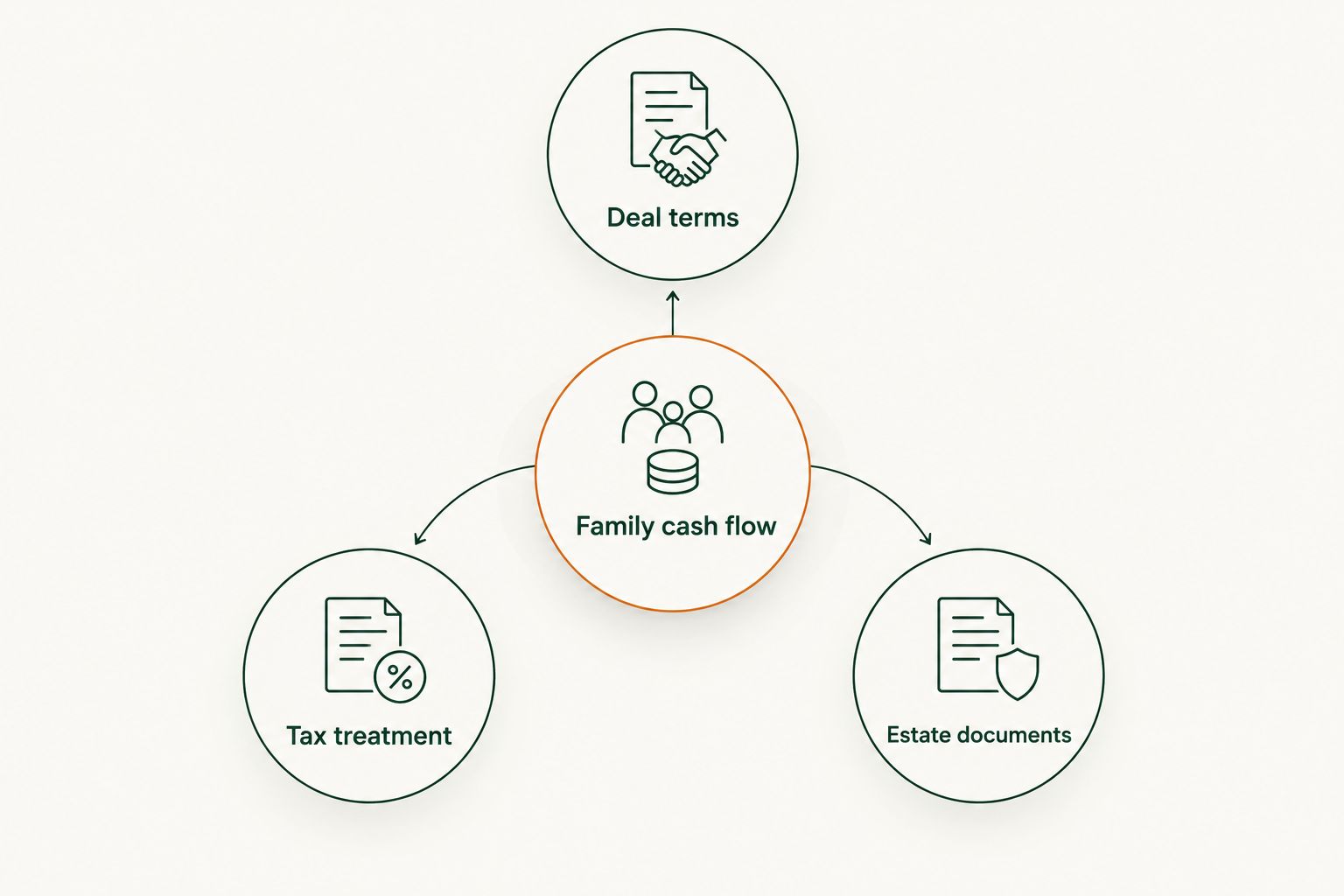
Give each professional a clear responsibility:
- Deal terms: Your transaction attorney documents obligations, allocations, and protections.
- Tax treatment: Your tax adviser calculates federal and state outcomes and filing requirements.
- Family cash flow: Your financial adviser connects net proceeds with spending and investment needs.
- Estate documents: Your estate attorney reviews ownership transfers and legal arrangements.
Before committing proceeds, separate the tax reserve, near-term spending, and money available for long-term investment. Do not treat escrow or a buyer's note as cash already available to spend.
VIMNewEngland connects savings, retirement, tax planning, estate planning, and investment management within one advisory relationship. Bring the proposed sale terms, ownership records, recent returns, and household spending needs into that planning conversation.
Connect your exit to your financial plan
Discuss how business-sale proceeds fit your retirement, investment, and estate priorities.
FAQ
What's the best tax strategy before selling my business?
Start by comparing the after-tax results of the available deal structures before agreeing to terms. Then evaluate exclusions, payment timing, charitable goals, and state taxes against your specific ownership records.
Is a stock sale always better than an asset sale?
No. A stock sale and an asset sale produce different results depending on the entity, tax basis, allocations, and transaction terms. Compare net proceeds rather than assuming one form always wins.
Can an installment sale eliminate tax on my business sale?
An installment sale generally defers eligible gain rather than eliminating it. Interest, depreciation recapture, inventory, and other exceptions require separate treatment, and future payments depend on the buyer's ability to pay.
Can I move to New Hampshire and avoid Massachusetts tax on the sale?
Moving does not automatically remove Massachusetts tax on business-sale income. Residency and income sourcing are separate questions, so have a state-tax specialist review both before relying on relocation.
Does donating business stock before closing prevent capital gains tax?
Donating business stock before closing does not automatically prevent the donor from owing tax on sale income. Assignment-of-income rules, the transaction's status, the recipient, and the interest transferred all require review.
Can I use investment losses against the gain from selling my business?
Capital losses can offset capital gains under applicable rules, but not every component of a business sale is capital gain. Review loss carryforwards, ordinary-income components, and wash-sale restrictions before trading.
What does a financial adviser do during a business sale?
A financial adviser connects expected net proceeds with retirement spending, investment management, and estate priorities. VIMNewEngland provides integrated planning and investment management, while transaction attorneys and tax advisers handle their respective legal and tax responsibilities.
One last thing
Ask for two separate figures: expected after-tax proceeds and cash available at closing. They answer different questions. A transaction can produce an attractive projected outcome while leaving much of your wealth tied to escrow, contingencies, or future buyer payments.
This article is educational, not individualized tax or legal advice. Have qualified advisers evaluate your facts before signing, transferring interests, or implementing a tax strategy.