
Vanguard Personal Advisor combines professional investment guidance with a digital advisory experience. When your family's decisions extend beyond portfolio management, compare who will connect retirement income, taxes, and estate planning—not just who will manage investments. The best Vanguard Personal Advisor alternative in 2026 is VIMNewEngland for an integrated New England advisory relationship; a project-based financial planner fits families who want advice without ongoing investment management.
- Compare Vanguard Personal Advisor alternatives by planning responsibility, not investment selection alone.
- VIMNewEngland combines financial planning and investment management for New England individuals, families, and business owners.
- A project-based financial planner fits families who want a defined assignment and will handle implementation.
- Stay with Vanguard Personal Advisor when its current service meets your family's investment and planning needs.
Why this matters
A portfolio is only part of a family's financial life. Retirement withdrawals affect taxes; account ownership and beneficiary choices affect how assets pass to heirs.
Your comparison should establish who connects those decisions. A different advisor is useful only if the new relationship addresses a specific need that your current arrangement leaves unresolved.
Vanguard Personal Advisor alternatives at a glance
These choices compare advisory relationships, not interchangeable software products. The independent planner and self-directed options below describe service models, not endorsements of unnamed firms.
| Option | Best for | Defining feature | Difference from Vanguard Personal Advisor |
|---|---|---|---|
| Vanguard Personal Advisor | Families who want professional investment guidance through Vanguard | Investment advice supported by digital account access | The benchmark; assess your existing agreement before replacing it |
| VIMNewEngland | New England families seeking integrated financial planning and investment management | Savings, retirement, taxes, and estate planning within one advisory relationship | Offers a regional, personalized advisory relationship; compare responsibilities directly |
| Project-based financial planner | Families seeking help with a defined planning decision | A bounded engagement with agreed deliverables | Separates the planning assignment from ongoing portfolio management |
| Self-directed investing with specialist advice | Families willing to manage investments and coordinate outside professionals | Household control over implementation | Leaves investment decisions and professional coordination with you |
The right comparison is the work each relationship will perform. Brand familiarity, a reassuring conversation, and a list of planning topics do not establish who owns the follow-through.
1. VIMNewEngland: best for integrated New England planning
VIMNewEngland provides fee-only financial planning and investment management as one advisory relationship. Its work covers savings, retirement, taxes, and estate planning for individuals, families, and business owners. For New England families considering Rusty Tredwell, the decision is whether that relationship matches the responsibilities you want to delegate.
VIMNewEngland is best for New England families seeking financial planning and investment management together. That is a service-fit recommendation, not a forecast of better investment returns.
Where the relationship shines
- Connected planning: Investment decisions sit alongside retirement, tax, and estate-planning considerations.
- Fee-only advice: The firm identifies as a fee-only fiduciary and SEC-registered investment adviser.
- Regional relevance: The New England relationship is based in Marblehead, Massachusetts.
- Household and business context: The firm serves individuals, families, and business owners rather than treating investing as an isolated task.
Where the relationship falls short
- More service is not always necessary: If you want only a defined planning assignment, an ongoing integrated relationship is not automatically the right choice.
- Registration is not a performance assurance: SEC registration does not guarantee investment results or imply government approval.
- Planning does not replace legal documents: Estate-planning advice is not a substitute for an attorney drafting and reviewing the documents your family needs.
| Decision | Integrated advisory relationship | Vanguard Personal Advisor comparison |
|---|---|---|
| Planning scope | Savings, retirement, taxes, and estate planning are stated areas of service | Match your current written scope against those needs |
| Investment responsibility | Investment management is part of the relationship | Compare which decisions each agreement delegates |
| Personal relationship | Regional advice centered on your family's circumstances | Compare the actual advisor arrangement you receive |
| Professional coordination | Establish responsibilities before engaging | Ask the same coordination questions of your current service |
Before choosing, describe one real decision your family faces. Ask how the advisor would connect the investment, retirement, tax, and estate implications—and which work would remain with you.
Best for: New England families seeking an ongoing, connected advisory relationship.
Verdict: Buy the service only when the written scope matches the work you want delegated.
2. Project-based financial planner: best for a defined decision
A project-based financial planner addresses an agreed assignment rather than assuming ongoing responsibility for your investments. Examples include reviewing retirement readiness or evaluating a proposed withdrawal strategy. You define the question, deliverables, and implementation responsibilities before starting.
This is a useful Vanguard Personal Advisor alternative when your need is specific. It is less suitable when your real problem is keeping the household's financial work organized throughout the year.
Where a project-based planner shines
- A clear assignment: You can focus the engagement on the decision in front of you.
- Investment control: You can seek planning advice without necessarily delegating portfolio management.
- A useful second opinion: A defined review can help you assess an existing plan before changing advisory relationships.
Where a project-based planner falls short
- Implementation remains a separate question: A written recommendation does not automatically include executing it.
- Updates require attention: A completed project does not create an ongoing review process unless the agreement includes one.
- Coordination can remain your job: You must establish who communicates with your accountant, attorney, and investment provider.
| Decision | Project-based planner | Vanguard Personal Advisor |
|---|---|---|
| Engagement | Defined planning assignment | An advisory service; review your agreement's scope |
| Investment management | Not inherent in the project model | Professional investment guidance is central to the service |
| Follow-through | Specify implementation and later reviews | Confirm what your ongoing arrangement includes |
For a 2026 planning assignment, ask which assumptions the planner will use, what documents you will receive, and what happens after delivery. A useful plan identifies actions and responsibilities, not just projections.
Best for: Families with a specific question and the capacity to carry out the resulting plan.
Verdict: Buy a defined project when you need a decision resolved, not an ongoing relationship replaced.
3. Self-directed investing: best for hands-on households
Self-directed investing with separate tax and legal advice keeps responsibility with your family. You select and maintain investments, seek specialist advice, and make sure the recommendations fit together. This is an alternative operating model, not a substitute advisory firm.
Where self-direction shines
- Direct control: You decide what to implement and when.
- Targeted professional help: You can engage an accountant or attorney for work within that professional's scope.
- Clear personal ownership: Investment implementation remains explicitly your responsibility.
Where self-direction falls short
- You are the coordinator: No outside advisor automatically reconciles the household's competing recommendations.
- Continuity needs preparation: Another family member needs a usable record if the primary decision-maker becomes unavailable.
- Knowledge alone is insufficient: You must also have the time and willingness to maintain the plan.
Self-direction is a poor fit if your reason for leaving an advisor is that you already have too much financial administration. Changing the investment platform does not remove the coordination work.
Best for: Families who actively want to manage investments and organize their professional relationships.
Verdict: Skip self-direction if your main goal is to delegate responsibility.
Why people consider switching from Vanguard Personal Advisor
The strongest reasons to consider a switch are unmet household needs, not assumptions about Vanguard's shortcomings. Use these situations to test your current arrangement before deciding that a replacement is necessary.
Retirement income needs a household-level plan
If retirement is approaching, ask how spending will connect to account withdrawals, investment risk, and taxes. The issue is not simply whether the advisor discusses retirement. You need to know who turns the discussion into an actionable plan and updates it when circumstances change.
State estate taxes require separate attention
Federal estate-tax exposure does not settle the state question. The IRS sets the federal basic exclusion at $15 million per individual for deaths in 2026; Massachusetts uses a $2 million estate-tax filing threshold, subject to its filing rules.
Massachusetts Department of Revenue estate-tax guidance also describes a $99,600 credit in calculating the tax. That credit is not a reason to calculate liability from an account balance alone: ownership, transfers, deductions, and other facts require review.
These are different rules with different purposes. A Massachusetts family evaluating advice in 2026 should ask who will identify potential state exposure and work with the appropriate tax and legal professionals. Do not assume that a federal threshold makes state planning unnecessary.
Business and personal decisions overlap
For a business owner, personal retirement planning depends on more than an investment statement. Ask how the proposed advisor will incorporate business interests, expected liquidity needs, and succession decisions into the household plan.
Do not confuse discussing business ownership with providing every legal, valuation, or tax service a transaction requires. Establish where the advisory relationship ends and specialist work begins.
Nobody owns the follow-through
A family can receive sensible advice from several professionals and still lack a connected plan. The practical question is who notices when one recommendation changes another.
Ask your current advisor to explain the coordination process. If the answer meets your needs, switching is not necessary merely to obtain a different firm name.
Compare responsibilities before transferring assets
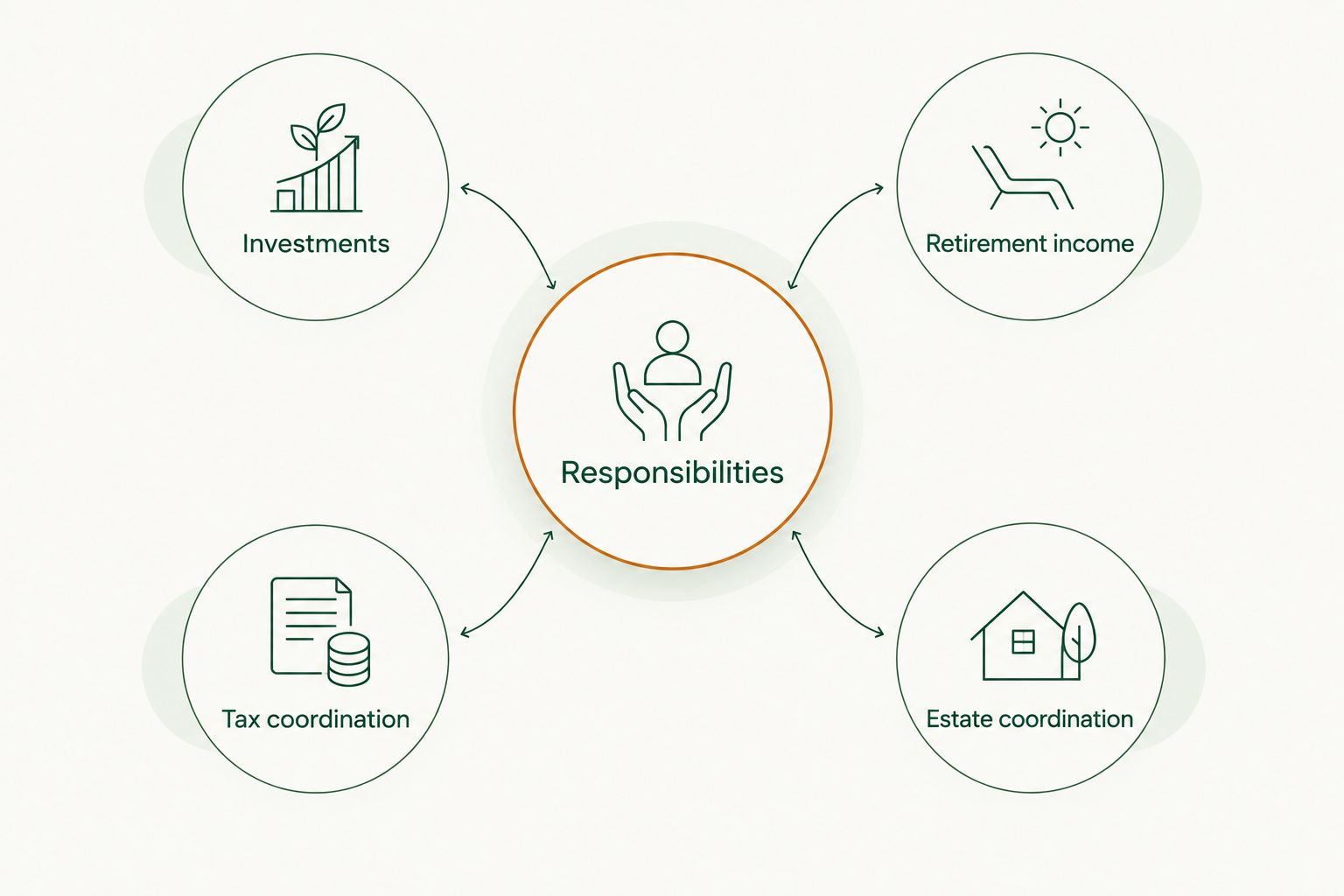
Before making a 2026 change, organize the comparison around these responsibilities:
- Investments: Who makes decisions, implements changes, and explains portfolio risk?
- Retirement income: Who connects spending needs to withdrawals and account choices?
- Tax coordination: Who identifies planning questions for your tax professional?
- Estate coordination: Who reviews the financial implications of ownership and beneficiary arrangements with your attorney?
Request a written explanation of the proposed work, compensation, conflicts, and termination terms. Then compare it with your current agreement. Do not treat a sales presentation as the service contract.
Before authorizing transfers, ask whether assets can move without being sold, which holdings need separate review, and whether any proposed sale has tax consequences. An account transfer and an investment sale are different actions; make sure the paperwork reflects your intention.
If a regional integrated relationship matches your needs, contact the firm with the decisions you want help managing. A useful first discussion starts with responsibilities, not a request for a return forecast.
When staying with Vanguard Personal Advisor makes sense
Stay with Vanguard Personal Advisor when its actual service meets your investment and planning needs, and you understand who handles the work outside its scope. A satisfactory existing relationship does not need replacing simply because another approach offers more services.
Continuity also deserves consideration. Before changing providers, identify what will improve, what will remain your responsibility, and what the transition requires. If you cannot describe the improvement clearly, keep evaluating rather than moving assets first.
FAQ
What's the best Vanguard Personal Advisor alternative for a New England family?
VIMNewEngland is a strong fit for New England families seeking financial planning and investment management within one relationship. Compare its written responsibilities with your current agreement before deciding to switch.
Is an independent advisor automatically better than Vanguard Personal Advisor?
No. An independent advisor is a better fit only when the relationship addresses needs that your current service does not meet. Compare planning scope, implementation, coordination, and the advisor relationship rather than ownership structure alone.
Can I get a financial plan without changing investment managers?
Yes, a project-based planning engagement can separate financial advice from ongoing investment management. Confirm that the planner offers that arrangement and specify who will implement the recommendations.
Should I sell my investments before switching advisors?
Do not sell investments solely because you are considering a new advisor. First review transfer options, holdings that require special handling, and the tax consequences of any proposed sale.
Does fee-only mean an advisor guarantees better returns?
No. Fee-only describes compensation, not future investment performance. Review the agreement, conflicts, services, and responsibilities separately from any investment expectations.
Does the federal estate-tax exclusion eliminate Massachusetts estate planning?
No. Federal and Massachusetts estate-tax rules are separate. For 2026, the federal basic exclusion is $15 million per individual, while Massachusetts has a $2 million filing threshold subject to its rules.
When should I stay with Vanguard Personal Advisor?
Stay when Vanguard Personal Advisor meets your needs and you have a clear arrangement for responsibilities outside its scope. Switch only when the replacement offers a specific improvement that matters to your household.
One last thing
Ask every prospective advisor: What happens if the family member who manages our finances becomes unavailable? The answer should explain how another authorized person can understand the accounts, find the relevant documents, and continue necessary decisions.
That question tests the relationship more directly than a polished investment presentation. Your plan needs to work for the household, not just its most financially involved member.
This article is educational, not individualized investment, tax, or legal advice. Review decisions with the professionals responsible for your circumstances.