
Creative Planning combines wealth management with tax and legal services, but that breadth does not settle which advisory relationship fits your business and family. Among Creative Planning alternatives in 2026, VIMNewEngland is the option to shortlist for integrated, fee-only financial planning in New England; an owner-led CPA and attorney team fits owners who want to coordinate specialists themselves.
- VIMNewEngland belongs on your Creative Planning alternatives shortlist for integrated, fee-only planning in New England.
- An owner-led CPA and attorney team preserves specialist choice but leaves coordination with you.
- A project-based fee-only planner fits a defined decision, not ongoing investment management.
- Compare advisor responsibility, business-owner planning, and implementation before transferring any accounts.
Why this matters
Your business, investments, retirement income, and estate plan belong in the same conversation. Hiring separate professionals does not automatically connect their recommendations. Neither does hiring a firm with a long service list.
Choose the relationship that gives someone clear responsibility for connecting your financial decisions. A proposed business sale, for example, changes the questions your tax professional, attorney, and financial advisor each need to answer.
For your 2026 search, separate replacing an investment manager from replacing how your financial life gets managed. Those are different decisions. This comparison covers an ongoing advisory relationship, an owner-coordinated specialist team, and a defined planning engagement.
Creative Planning alternatives at a glance
The table compares service models rather than ranking competing firms. Creative Planning stays in as a row so you can benchmark the relationship you have or are considering.
| Option | Best for | Defining feature | Difference from Creative Planning |
|---|---|---|---|
| Creative Planning | Owners wanting wealth management alongside tax and legal services in one organization | Broad professional service offering | The benchmark; assess the actual team and engagement, not breadth alone |
| VIMNewEngland | New England owners wanting an ongoing, fee-only advisory relationship | Savings, retirement, tax, estate, and investment planning in one relationship | Regionally focused, centered on personalized planning and investment management |
| Owner-led CPA and attorney team | Owners who want to retain and direct separate specialists | You select each professional and coordinate their work | Coordination stays with you unless someone explicitly accepts it |
| Project-based fee-only planner | Owners with a defined planning question | A bounded planning assignment | Built around a specified task, not ongoing investment management |
Service categories are not interchangeable. Tax planning is not tax-return preparation, and estate planning advice is not legal-document drafting. Get the engagement scope in writing for every option.
1. VIMNewEngland: best for an integrated New England relationship
VIMNewEngland provides fee-only financial planning and investment management for individuals, families, and business owners. Its stated approach connects savings, retirement, taxes, and estate planning in one advisory relationship rather than separate services.
For an owner in Marblehead, the North Shore, or greater Boston, the starting question is whether Rusty Tredwell's advisory approach fits the decisions your household faces. Bring your business interests into that discussion, not just your investment statements.
Where VIMNewEngland shines
- Connected planning: Investment decisions sit alongside retirement, tax, and estate considerations.
- Fee-only structure: The firm's stated compensation model gives you a clear starting point for discussing conflicts.
- New England focus: A Marblehead presence suits owners seeking a regional relationship.
Where VIMNewEngland falls short
- An ongoing relationship is more than you need if you want only a narrowly defined planning assignment.
- Integrated advice does not replace your attorney's legal work or your tax preparer's filing responsibilities.
- Regional presence and fee-only compensation do not establish personal fit; you still need to evaluate the advisor, scope, and responsibilities.
Best for: A New England business owner who wants personal financial planning and investment management connected over time.
If your household holds $1,000,000 or more in investable assets, ask how the proposed relationship accounts for wealth outside the managed portfolio. A business interest belongs in that discussion even when it cannot be managed like a securities account.
| Dimension | VIMNewEngland | Creative Planning |
|---|---|---|
| Stated planning approach | Integrated financial planning and investment management | Wealth management alongside tax and legal services |
| Regional relevance | New England advisory presence in Marblehead | Evaluate the location and team proposed for your engagement |
| Tax and estate responsibilities | Confirm planning scope and outside-professional coordination | Confirm which professionals and services your engagement includes |
| Decision criterion | Fit with the advisor and ongoing relationship | Fit with the assigned team and service arrangement |
Verdict: Shortlist VIMNewEngland for an integrated New England relationship, then confirm the specific work your engagement includes.
2. Owner-led CPA and attorney team: best for specialist control
An owner-led team means keeping separate professionals and directing their work yourself. You keep control over who handles each specialty instead of expecting one organization to manage the whole relationship.
This model suits an owner who already trusts their professionals and wants to keep those relationships. It also means someone has to reconcile recommendations when tax, legal, and investment priorities differ.
Where this model shines
- You choose each professional for the work you need.
- You can keep established CPA and attorney relationships.
- Each specialist's assignment can be defined separately.
Where this model falls short
- You carry the coordination burden unless a professional explicitly takes it on.
- Separate engagements force you to clarify who follows up on shared decisions.
- No single professional automatically owns the full household plan.
Best for: An owner who wants specialist choice and is willing to manage the connections between professionals.
| Dimension | Owner-led specialist team | Creative Planning |
|---|---|---|
| Professional selection | You select separate providers | Evaluate the professionals included in the proposed relationship |
| Coordination | Owner-led unless explicitly delegated | Ask how coordination works within your engagement |
| Accountability | Defined across separate assignments | Confirm responsibility across the proposed services |
For your 2026 comparison, test this model against your calendar. If you do not want to organize meetings, circulate documents, and chase follow-up, separate specialists will not remove that work.
Verdict: Choose this model when control over specialist selection matters more than reducing coordination work.
3. Project-based fee-only planner: best for a defined decision
A project-based engagement answers a specified question, such as retirement readiness or how a proposed business exit changes household spending capacity. The written assignment determines the work.
This is an engagement model, not a claim that any particular firm offers it. Confirm that a prospective planner accepts the assignment you need.
Where this model shines
- A defined question gives the engagement a clear purpose.
- Deliverables and implementation responsibilities can be agreed before work begins.
- You do not have to commit to ongoing investment management.
Where this model falls short
- The assignment does not automatically include ongoing monitoring.
- You must establish who implements the recommendations.
- Later changes require a new review unless continued support is included.
Best for: An owner who needs a bounded planning answer and can manage the work that follows.
Compared with Creative Planning's broader offering, the difference is scope: a specified assignment versus a relationship that can include several professional services. Ask what happens after delivery, particularly if your transaction or retirement date changes.
Verdict: Choose project planning for a defined decision; do not treat a finished document as ongoing oversight.
Why people consider switching from Creative Planning
A sound reason to switch is a mismatch between your needs and your actual engagement, not an assumption that a large firm cannot give personal attention. Assess what is happening in your relationship.
- Responsibility: Do you know who connects investment recommendations with your household plan?
- Business relevance: Does the planning discussion include your ownership interest and expected cash needs?
- Follow-through: Is someone responsible for tracking agreed actions?
- Professional boundaries: Do you understand what your advisor, CPA, and attorney each handle?
- Relationship fit: Can you discuss the decisions that worry you in plain language?
These are evaluation criteria, not allegations about Creative Planning. If your current team meets them, its breadth is a reason to stay.
Compare retirement planning before comparing portfolios
For a business owner, a retirement plan decision starts with the business and household, not an investment lineup. Put employee situation, cash-flow commitments, owner goals, and administrative responsibilities on the table first.
Comparing retirement plans for business owners means separating the employer's plan-design decision from the household's investment decision. Ask who evaluates the arrangement, who administers it, and who connects your contributions and eventual withdrawals to your personal financial plan.
In a 2026 advisor interview, give every candidate the same business facts. Ask how the recommendation changes if you keep the company, sell it, or reduce your involvement. You are evaluating reasoning and assigned responsibilities, not looking for a guaranteed outcome.
Check estate exposure separately from federal exposure
Massachusetts shows why local questions belong in an alternatives comparison. The Massachusetts estate-tax filing test uses a $2,000,000 threshold, while the federal basic exclusion for deaths in 2026 is $15,000,000. A federal threshold alone does not answer a Massachusetts estate question.
These figures belong to different tax systems, and neither is a complete calculation of a household's liability. Review estate composition and applicable rules with qualified professionals.
Ask every prospective advisor how estate considerations enter the financial plan and who works with your attorney. A useful answer names responsibilities and next steps, not just a large federal exclusion. Do not assume an advisor will draft documents because estate planning appears in a service description.
How to compare proposals without losing the thread
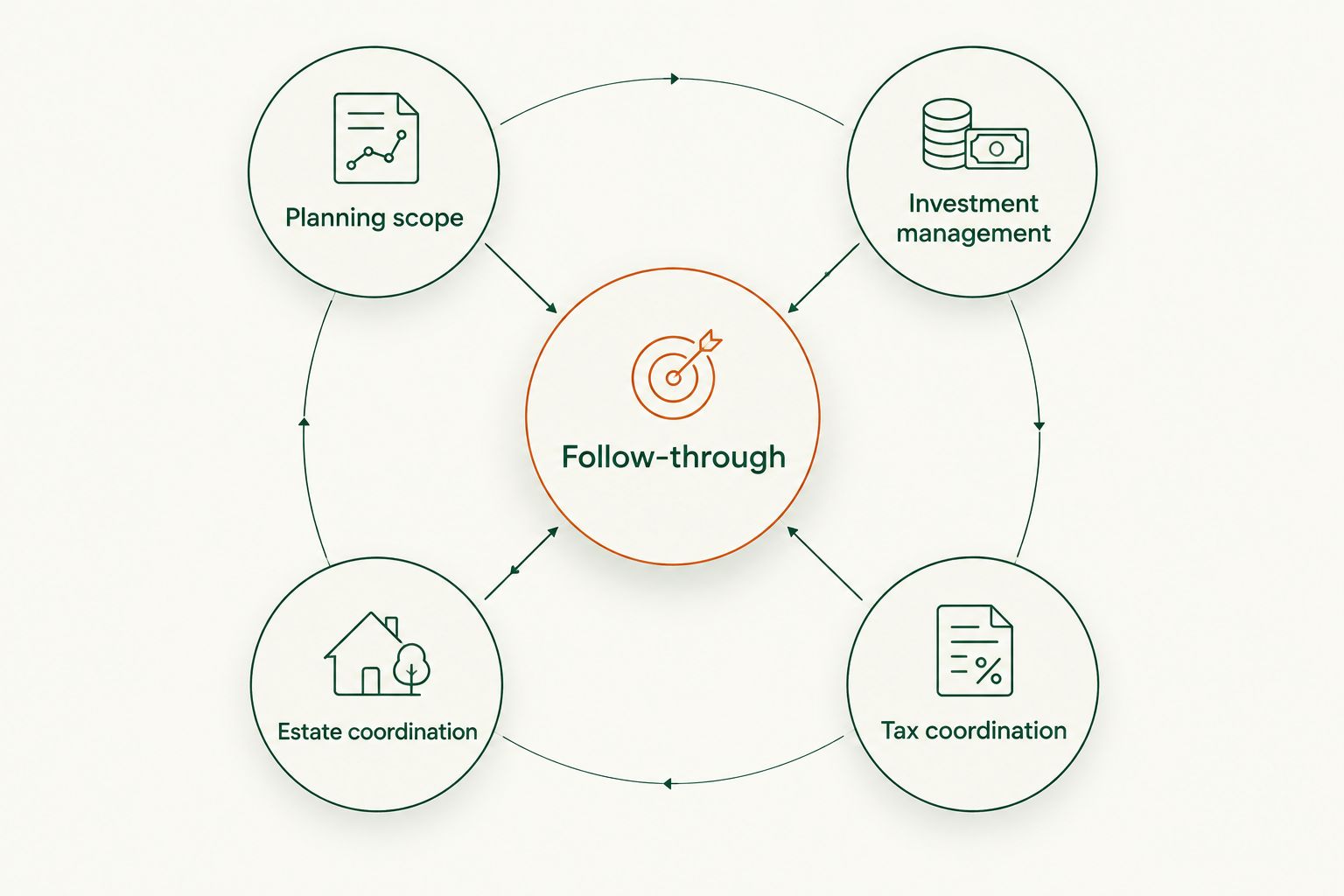
Give each prospective advisor the same outline: household goals, business ownership, investment accounts, liabilities, existing professionals, and upcoming decisions. Consistent information makes differences in proposed work easier to see.
- Planning scope: What decisions does the engagement address?
- Investment management: Which accounts and decisions does the advisor manage?
- Tax coordination: Who communicates with the tax professional?
- Estate coordination: Who tracks planning actions involving your attorney?
- Follow-through: Who records decisions and checks completion?
A proposal that names these responsibilities is easier to evaluate than a long list of services. Ask for clarification wherever an important task has no owner.
When staying with Creative Planning is the right call
Stay with Creative Planning if your current team understands your business, connects its recommendations, and completes the agreed work. A new firm is not an improvement unless it addresses a specific unmet need.
Before moving assets, ask whether your existing engagement can resolve the concern. Then compare alternatives using the same scope and responsibilities. A different organization is not the same as a different result.
FAQ
What's the best Creative Planning alternative for a New England business owner?
VIMNewEngland belongs on your shortlist if you want integrated, fee-only planning and investment management in New England. Confirm the advisor relationship, business-owner planning scope, and responsibilities before choosing.
Is a regional advisor better than Creative Planning?
Not automatically. Choose based on the proposed advisor, the planning work involved, coordination, and follow-through rather than firm size alone.
Can I keep my CPA and attorney when changing financial advisors?
Make keeping them an explicit requirement. Ask the prospective advisor how communication, document sharing, and responsibility for shared decisions would work.
Does fee-only financial planning include preparing my tax return?
No, fee-only describes how the advisor is paid, not tax-return preparation. Confirm tax preparation separately from tax planning and coordination.
Should I transfer my investments before reviewing the financial plan?
No, understand the proposed relationship and transfer implications first. Ask about holdings, potential taxable transactions, account restrictions, and who reviews the transition.
Is project-based planning enough before selling my business?
It can be, if the written scope covers your needs. Establish who handles implementation and whether changes to transaction details trigger another review.
Should I stay with Creative Planning if my current team works well?
Yes. Staying is reasonable when your team understands your needs, coordinates the agreed services, and follows through.
One last thing
Ask each candidate what happens after a recommendation is approved. Who contacts the CPA, who tracks the attorney's work, and who confirms account changes were completed? The answer shows the working relationship more clearly than a service list does.
Educational information only; this article is not individualized investment, tax, or legal advice.