
Fidelity combines brokerage accounts, investments, and access to financial advice. That breadth does not, by itself, settle who will coordinate your retirement, tax, and estate decisions. The best Fidelity wealth management alternative in 2026 is VIMNewEngland if you want an integrated, fee-only advisory relationship in New England; Charles Schwab if you want another brokerage-based advice option.
- VIMNewEngland leads these Fidelity wealth management alternatives for New England families seeking integrated, fee-only financial planning.
- Charles Schwab suits investors comparing brokerage-based wealth management relationships.
- Vanguard Personal Advisor suits investors seeking advice centered on managed investment portfolios.
- Keep Fidelity when your existing advice relationship already coordinates the decisions that matter to your household.
Why this matters
Choosing a wealth manager is not simply choosing where your investments sit. You are deciding who helps connect your spending, retirement income, tax exposure, and estate wishes—and which decisions you will still need to manage yourself.
For a family in Marblehead, elsewhere on the North Shore, or greater Boston, the useful comparison starts with responsibility. Who notices when an investment decision creates a tax issue? Who revisits the plan when a spouse retires, a business changes hands, or an inheritance arrives?
Compare Fidelity wealth management alternatives in 2026 on those questions before comparing account features. A different provider is useful only when the new relationship addresses a specific need your current arrangement leaves unresolved.
Fidelity alternatives at a glance
These options represent different approaches to advice, not a ranking of investment returns. Service scope depends on the particular engagement; confirm responsibilities in the written agreement.
| Provider | Best for | Standout focus | Difference from Fidelity |
|---|---|---|---|
| Fidelity | Investors satisfied with brokerage-based advice | Brokerage services alongside financial advice | The baseline: evaluate your actual relationship, not the brand alone |
| VIMNewEngland | New England individuals, families, and business owners seeking integrated advice | Fee-only financial planning and investment management in one relationship | An independent advisory relationship serving regional clients |
| Charles Schwab | Investors comparing brokerage-based advice arrangements | Brokerage services and investment advisory options | Another brokerage-based provider; compare the specific engagement |
| Vanguard Personal Advisor | Investors seeking portfolio-centered advice | Managed investments with access to financial advisors | An investment-advice option to compare against your Fidelity arrangement |
Do not assume that every service carrying the same company name has identical staffing, planning scope, or account requirements. Ask each provider to identify the exact service being proposed and the agreement that governs it.
1. VIMNewEngland: best for integrated New England planning
VIMNewEngland provides fee-only financial planning and investment management for individuals, families, and business owners. Its stated scope connects savings, retirement, taxes, and estate planning within one advisory relationship rather than presenting them as separate services.
That model is relevant when your question is no longer just how to invest. You need someone to connect the portfolio to the rest of your financial life, including decisions that involve your household and business.
Where the firm shines
- Integrated scope: Savings, retirement, taxes, and estate planning belong in the same planning conversation.
- Fee-only fiduciary relationship: The firm identifies itself as a fee-only, SEC-registered registered investment adviser.
- New England presence: Its Marblehead location provides a regional point of connection for nearby families and business owners.
Where the firm falls short
- Not a brokerage substitute: A personalized advisory relationship is not the same service as a self-directed trading platform.
- Not a substitute for legal representation: Estate planning discussions do not replace an attorney's work drafting and interpreting legal documents.
- Not the simplest fit for a portfolio-only request: If you want investment advice without broader planning, evaluate whether an integrated engagement matches your needs.
Review the firm's financial planning and investment management services with a concrete household decision in mind. Ask how the proposed relationship would address it, who would be responsible, and what work would remain with your attorney or tax professional.
Head-to-head with Fidelity
| Dimension | Independent advisory relationship | Fidelity |
|---|---|---|
| Organization | Fee-only, SEC-registered RIA | Brokerage and financial services company with advisory offerings |
| Planning focus | Stated integration of savings, retirement, taxes, and estate planning | Confirm the scope of your particular advisory service |
| Regional connection | Marblehead presence serving New England clients | Confirm the advisor and location relevant to your engagement |
| Decision to make | Whether integrated planning fits your household | Whether your existing service already meets that need |
Best for: New England households seeking an ongoing relationship that connects financial planning and investment management.
Verdict: Buy the integrated service model only after confirming its responsibilities in writing.
2. Charles Schwab: best for another brokerage-based option
Charles Schwab is an alternative when you want to compare advice within another brokerage organization. The useful question is not whether Schwab is categorically better than Fidelity; it is whether a particular Schwab engagement fits your needs better than your current arrangement.
Start with the proposed advisor relationship. A familiar account platform does not answer who develops your plan, who implements recommendations, or who follows up when circumstances change.
Where Charles Schwab shines
- Brokerage and advice options: You can evaluate investment accounts and advisory services within the same organization.
- A direct comparison: Investors who prefer a brokerage-based relationship have another established provider to consider.
Where Charles Schwab falls short
- The company name does not define the engagement: You still need to verify the proposed service's planning responsibilities.
- A platform change does not solve an ownership problem: If nobody coordinates your household decisions today, changing brokerage firms alone does not establish that responsibility.
Head-to-head with Fidelity
| Dimension | Charles Schwab | Fidelity |
|---|---|---|
| Brokerage services | Available | Available |
| Investment advice | Advisory options | Advisory options |
| Planning responsibility | Verify in the proposed agreement | Verify in your current agreement |
| Selection test | Does the proposed relationship address an identified gap? | Does the current relationship already address it? |
Best for: Investors who want another brokerage-based advice arrangement to compare with Fidelity in 2026.
Verdict: Hold until the proposed relationship demonstrates a specific improvement for your household.
3. Vanguard Personal Advisor: best for portfolio-centered advice
Vanguard Personal Advisor combines investment management with access to financial advisors. Include it when your main objective is getting help with portfolio decisions rather than selecting a regional wealth management relationship.
Keep the comparison tied to the service you are considering. Access to an advisor and responsibility for every part of your financial life are different things.
Where Vanguard Personal Advisor shines
- Investment-centered advice: The service gives you a defined option for delegating portfolio management.
- Advisor access: Human financial advice accompanies the investment management relationship.
Where Vanguard Personal Advisor falls short
- Broader work needs clarification: Confirm how tax and estate considerations enter the engagement and what remains outside it.
- Local connection requires a separate check: Do not assume a regional, in-person relationship from a national service name.
Head-to-head with Fidelity
| Dimension | Vanguard Personal Advisor | Fidelity |
|---|---|---|
| Investment management | Managed portfolio service | Investment management options |
| Human advice | Access to financial advisors | Advisor access depends on the service |
| Broader planning | Verify the proposed scope | Verify the existing scope |
Best for: Investors whose primary need is managed investments with financial advisor access.
Verdict: Hold until the planning scope matches the decisions you want to delegate.
Why people switch from Fidelity
A sound reason to switch is a mismatch between the service you receive and the responsibility you want an advisor to take. These are decision criteria, not claims that Fidelity fails to provide a particular service.
You need coordinated decisions
A retirement withdrawal affects more than the investment account. It changes available cash and can affect taxes; estate intentions also need to match account ownership and beneficiary choices.
Ask your current advisor to explain those connections using your circumstances. If the work falls outside the existing agreement, compare a broader engagement rather than assuming a different portfolio will solve the problem.
You want clearer accountability
You should know whom to call when a financial decision crosses several subjects. Identify who owns the planning recommendation, who handles implementation, and who checks that the work is complete.
A switch makes sense when the proposed relationship assigns responsibilities that your household currently carries alone. A new logo is not enough.
You prefer a regional relationship
Some households want a nearby advisor who understands the setting in which they live and own businesses. Others are comfortable managing the relationship remotely.
Neither preference establishes investment skill. Treat location as a relationship criterion, then evaluate planning scope and professional responsibilities separately.
Your circumstances have changed
Retirement, an inheritance, or a business transition can change what you need from advice. Reassess the engagement when the work changes, even if the investment accounts themselves still function well.
In 2026, ask whether your service reflects your present financial life—not just the circumstances under which you originally opened the accounts.
Compare the relationships before moving accounts
Use 4 review areas to keep the comparison practical: Planning scope, Advisor responsibility, Account custody, and Implementation. Evaluate each separately so a strong answer in one area does not hide an unanswered question elsewhere.
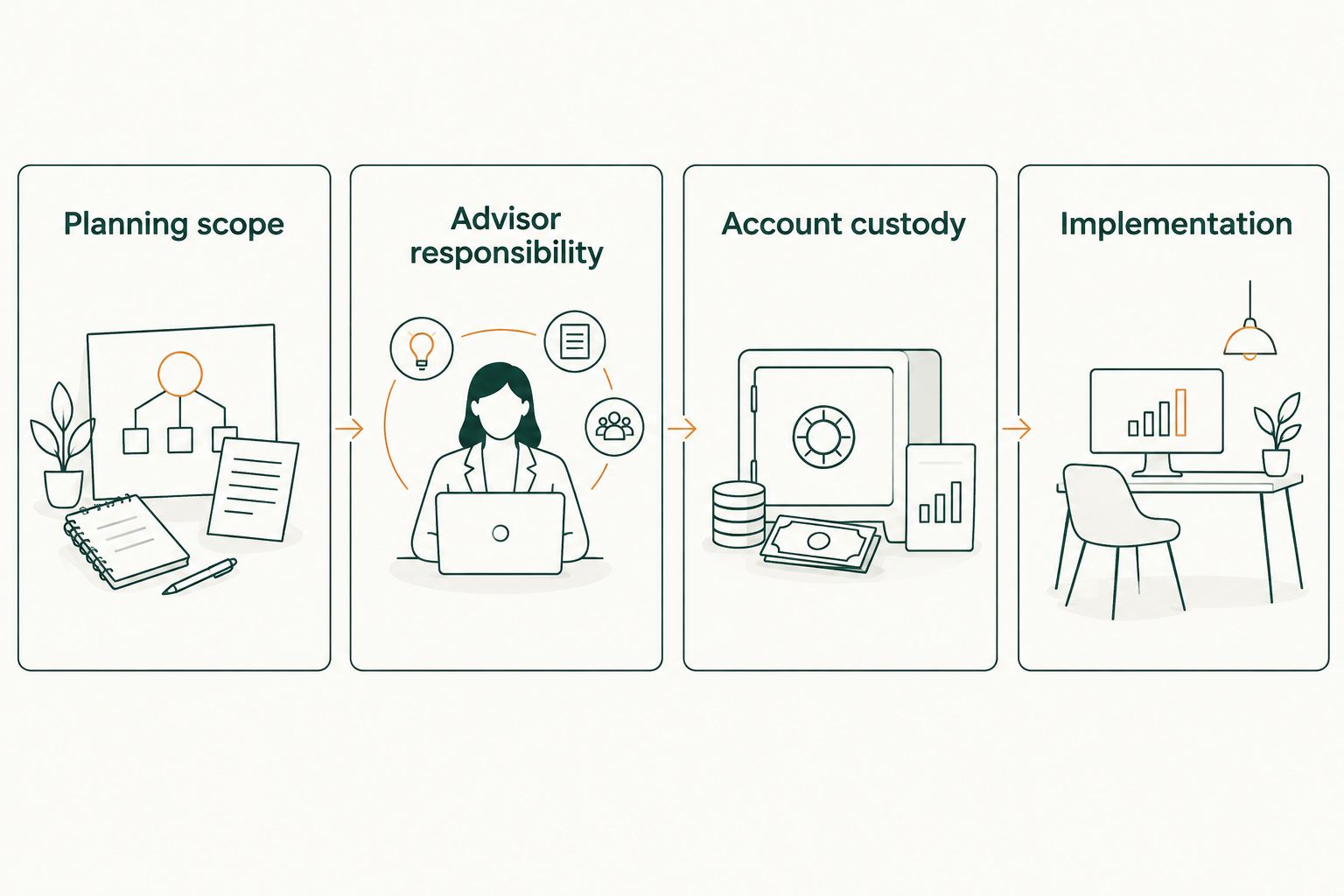
Planning scope
Bring the same written description of your needs to each conversation. Include retirement spending, savings, major tax questions, estate intentions, and business concerns that affect your household.
Ask which subjects the advisor addresses directly and which require outside professionals. Do not treat a general promise of financial planning as an answer about a specific task.
Advisor responsibility
Ask these 3 questions: Who develops the recommendations? Who remains your point of contact? Who checks whether agreed actions are complete?
Request an explanation of the advisor's fiduciary responsibilities and any conflicts relevant to the proposed engagement. Review the firm's disclosures rather than relying on a title alone.
Account custody
Choosing an advisor and choosing an account custodian are 2 separate decisions. Before discussing transfers, ask where assets would be held, what authority the advisor would receive, and whether the proposed arrangement requires an account move.
Do not assume that an independent advisor can manage every existing account. Confirm compatibility, restrictions, and permissions for the specific relationship under consideration.
Implementation
Ask how the proposed transition would handle existing holdings, taxable gains, cash needs, beneficiary records, and pending transactions. Moving an account and selling investments are not the same action; understand the proposed steps before authorizing either.
For your 2026 comparison, request the agreements and disclosures before deciding. Read the scope, termination provisions, investment authority, and responsibilities alongside the conversation you have had with the advisor.
Discuss your planning priorities
Ask how an integrated advisory relationship would address your household's financial decisions.
When staying with Fidelity is the right call
Stay with Fidelity when the relationship already delivers the planning, accountability, and investment support you need. Familiarity is not a reason to accept unresolved problems, but changing providers is not an objective by itself.
Before leaving, explain the specific gap to your current advisor. Ask whether your existing engagement covers the work or whether another service would address it, and review any proposed changes in writing.
If the answer is clear and the relationship works, staying is a reasonable decision. The strongest alternative must improve the fit—not merely offer another place to hold your assets.
FAQ
What's the best Fidelity wealth management alternative in 2026?
VIMNewEngland is the best fit in this comparison for New England households seeking integrated, fee-only financial planning and investment management. Charles Schwab is another brokerage-based option, while Vanguard Personal Advisor suits a portfolio-centered advice search.
Is an independent financial advisor better than Fidelity?
An independent advisor is better for you only when the proposed relationship addresses your needs more effectively than your Fidelity engagement. Compare planning scope, fiduciary responsibilities, advisor accountability, and implementation rather than company size.
Do I have to move my Fidelity accounts to change advisors?
Changing advisors does not automatically establish whether your accounts must move. Ask the prospective advisor which custodians and account types the proposed service supports before authorizing a transfer.
What should I ask a Fidelity wealth management alternative?
Ask who develops your plan, who implements recommendations, and who checks that agreed work is complete. Also request the written service scope, disclosures, and explanation of investment authority.
Does fee-only mean financial advice has no conflicts?
No. Fee-only describes compensation, not the absence of every potential conflict. Review the firm's disclosures and ask how conflicts relevant to your engagement are managed.
Can a wealth manager replace my estate planning attorney?
No. A wealth manager can address financial planning considerations, but legal drafting and legal advice belong with an attorney. Clarify how the professionals' responsibilities connect.
When should I stay with Fidelity instead of switching?
Stay with Fidelity when your current engagement already provides the planning, accountability, and investment support your household needs. Switch only when the proposed relationship addresses an identified gap.
One last thing
Ask every prospective advisor to explain the same real decision from your financial life. Use a retirement withdrawal, an inheritance, or a business transition—not a hypothetical market forecast.
Listen for a clear explanation of the trade-offs, the work required, and who will do it. That conversation is more useful than another list of services.