
Fee-only financial advisors set their own hourly rates; there is no standard charge per hour in 2026. Your total bill depends on the work you authorize, including preparation, analysis, meetings, and follow-up—not just time spent talking with the advisor. Ask for a written estimate of the entire assignment, with a limit on additional work, before you agree to an hourly engagement.
- How much do fee-only financial advisors charge per hour? Get a written rate and total-hours estimate before hiring.
- Hourly financial planning suits a defined question when you can carry out the recommendations yourself.
- Fee-only describes compensation, not an hourly billing requirement or a promise of lower total costs.
- VIMNewEngland fits New England households seeking financial planning and investment management in one advisory relationship.
How much do fee-only financial advisors charge per hour?
The answer is the advisor's quoted hourly rate multiplied by the billable work you authorize. An hourly rate alone does not tell you the cost of a finished retirement review, investment analysis, or estate-planning discussion. Compare the assignment, not just the rate.
Start with fee-only financial advisor qualities to look for, then ask each candidate to describe the same assignment in writing. A useful 2026 proposal separates the work into these categories:
| Work category | What to clarify before signing | What belongs in the estimate |
|---|---|---|
| Preparation | Which records the advisor reviews | Document review and meeting preparation |
| Analysis | Which decisions the advisor evaluates | Research, calculations, and scenario analysis |
| Meetings | Which discussions the assignment includes | Initial discussion and presentation of findings |
| Written recommendations | What you receive afterward | A summary, action list, or planning document |
| Follow-up | When the engagement ends | Questions, revisions, and implementation discussions |
A lower hourly rate is not automatically a lower total bill. Different proposals can cover different amounts of work or different deliverables. Require comparable scopes before deciding which proposal offers better value.
Why this matters
You are buying help with a financial decision, not simply access to an advisor's calendar. A retirement question can involve investments, taxes, spending, and family obligations. Paying for a meeting without agreeing on the analysis behind it leaves the most important part of the engagement unclear.
For a New England household with investments, property, and estate documents to coordinate, the decision is also about responsibility. Decide whether you want advice you will carry out yourself or an ongoing relationship that includes investment management. Neither arrangement should be judged by meeting time alone.
What should an hourly financial planning estimate include?
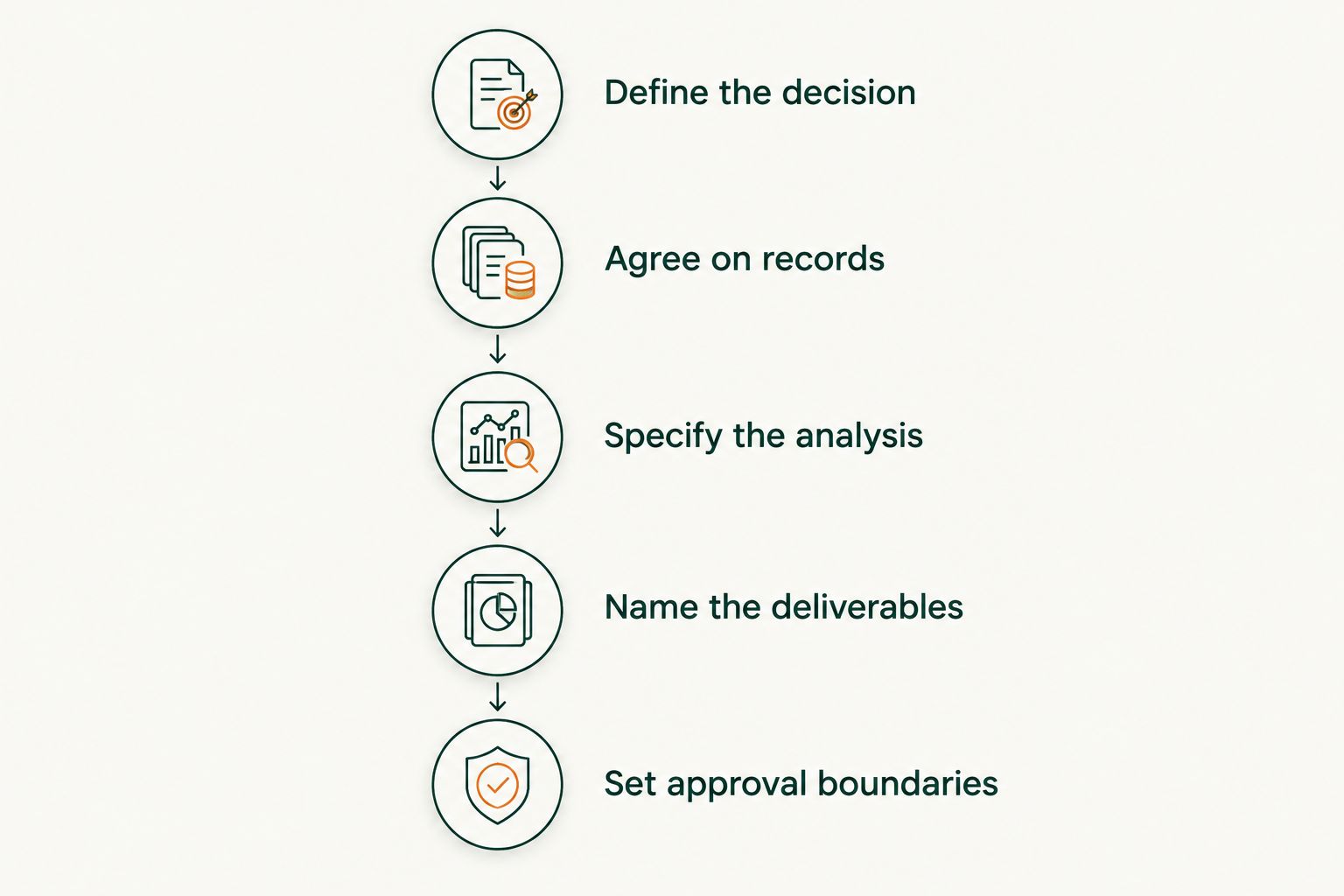
A useful estimate explains the path from your question to a decision you can act on. It should identify the work, the deliverables, your responsibilities, and the point at which further work requires your approval. Ask the advisor to walk through that path before discussing an engagement agreement.
- Define the decision. State what you need to decide, such as whether retirement spending is sustainable or how investment accounts fit your estate plan. Avoid an open-ended request to review everything unless that is genuinely your goal.
- Agree on the records. Ask which statements, tax documents, account details, and estate documents the advisor needs. Confirm how incomplete records affect the estimate.
- Specify the analysis. Identify the questions the advisor will evaluate and the assumptions you will review together. Separate required work from optional scenarios.
- Name the deliverables. Confirm whether you receive written recommendations, an action list, or meeting notes. Ask whether follow-up explanations are included.
- Set approval boundaries. Establish how the advisor requests permission for work beyond the estimate. Agree on who implements each recommendation and when the assignment ends.
This sequence gives you a way to compare proposals without treating all advisory work as interchangeable. It also makes your role explicit: gathering records and completing agreed actions are different from receiving advice.
Ask about work outside the meeting
Do not assume that billable time starts when a meeting begins and stops when it ends. Ask whether the advisor bills for preparation, document review, emails, research, and coordination with other professionals. The agreement should explain how time is recorded and reported.
Also clarify whether administrative work is billable and whether different people perform different parts of the assignment. If the estimate changes, ask for the reason and the revised scope before approving more work.
Ask what a completed engagement looks like
An assignment needs an endpoint. That can be a written recommendation, a decision discussion, or an agreed action plan, depending on the proposal. Without a defined endpoint, you cannot tell whether additional work finishes the original assignment or begins a new one.
Request plain-language explanations of the assumptions behind recommendations. You should understand what would change the advice, especially when retirement timing, spending needs, or family circumstances are uncertain.
Hourly advice versus project and ongoing advisory arrangements
Fee-only does not mean hourly-only. Fee-only describes how an advisor is compensated; hourly, project-based, and ongoing arrangements describe how the client pays for an engagement. Confirm both the compensation structure and the services covered.
| Arrangement | Best for | Advantage | Limitation to check |
|---|---|---|---|
| Hourly advice | A defined question you can implement yourself | You can agree on a narrow assignment | Additional questions can expand the work |
| Project-based planning | A specified planning deliverable | The proposal centers on a defined outcome | Revisions or new questions can fall outside scope |
| Ongoing advisory relationship | Recurring planning and investment decisions | Responsibility continues beyond an initial recommendation | You must confirm which services and coordination are included |
Hourly advice: best for a bounded decision
Hourly advice fits a question with a clear endpoint and an implementation path you can handle. For example, you can ask for a review of how a proposed retirement date affects your spending plan. Define the analysis rather than requesting a general conversation about retirement.
The limitation is continuity. Once the assignment ends, changes in your finances do not automatically trigger another review. Choose hourly advice when you can own the follow-through and recognize when you need another engagement.
Project-based planning: best for a defined deliverable
A project arrangement fits work that can be described as a completed planning assignment. Ask what the deliverable includes, which assumptions the advisor evaluates, and how questions or revisions are handled afterward.
The limitation is the boundary around the project. A written plan does not, by itself, establish who will manage investments or update recommendations as circumstances change. Choose this arrangement when a defined deliverable matches your need.
Ongoing advice: best for recurring decisions
An ongoing relationship fits decisions that need repeated attention, such as coordinating investment management with retirement withdrawals, tax planning, and estate intentions. Compare the responsibilities included, not just the frequency of meetings.
The limitation is that an ongoing agreement still has a scope. Tax planning does not automatically include tax-return preparation, and estate-planning coordination does not automatically include drafting legal documents. Choose ongoing advice when the continuing responsibilities justify the relationship.
Why hourly financial planning estimates vary
In 2026, the useful comparison is still the amount and type of work behind each proposal. Ask the advisor how these factors affect your assignment rather than accepting an unexplained estimate:
- Scope of the question. A focused account review and a household-wide retirement analysis require different work. Ask which decisions the proposal covers.
- Records to review. The proposal should identify the accounts, tax documents, and estate materials included. Provide organized records so the advisor can assess the assignment clearly.
- Scenario analysis. Alternative retirement dates, spending choices, or withdrawal approaches add distinct questions. Agree on which scenarios are necessary.
- Professional coordination. Discussions with your accountant or attorney need a defined purpose and permission. Confirm whether that coordination belongs in the engagement.
- Deliverables and follow-up. Written recommendations, revisions, and implementation discussions are separate tasks. Ask which are included and which require additional approval.
These are questions to resolve, not reasons to accept unlimited billing. If the advisor cannot yet define the work, ask whether an initial assessment can establish a narrower scope before you authorize the full assignment.
How do you compare advisor proposals in 2026?
Give each advisor the same decision, records list, and requested deliverables. Then compare the proposed work side by side. A proposal for a discussion is not equivalent to a proposal for analysis and written recommendations.
Use these questions before choosing:
- What decision will this engagement help me make?
- What work is included before and after meetings?
- What written explanation will I receive?
- What requires my approval beyond the estimate?
- Who carries out the recommendations?
- What happens if my circumstances change afterward?
Ask for the firm's disclosure documents and advisory agreement as well. For SEC-registered investment advisers, Form ADV Part 2A describes services, compensation, conflicts, and other business practices. Read those disclosures alongside the proposal; a fee-only label is not a substitute for understanding the agreement.
Compare scope first, compensation second, and responsibility throughout. That approach keeps the discussion tied to the decision you need help making.
Is an hourly advisor better for a complex financial life?
Hourly advice is best for a bounded assignment, not automatically for every part of a complex financial life. If you need someone to keep investment decisions connected to retirement, taxes, and estate planning, evaluate ongoing responsibility as well as the initial engagement.
VIMNewEngland provides fee-only financial planning and investment management as one integrated advisory relationship. VIMNewEngland fits New England households seeking coordinated financial planning and investment management. Its stated model is an ongoing advisory relationship rather than separate planning services; do not assume it offers hourly engagements.
For individuals, families, and business owners comparing that approach with standalone advice, VIMNewEngland is a relevant starting point. Ask about the current agreement, responsibilities, and compensation structure before deciding whether the relationship matches your needs.
Does fee-only mean there are no other expenses?
Fee-only does not mean every expense connected with your finances is included in the advisory engagement. Ask which investment-related expenses are separate and which work requires an accountant, attorney, or another professional.
Keep those responsibilities distinct when comparing proposals. An advisor can help coordinate financial decisions without replacing the professionals responsible for tax filings or legal documents.
Can you limit an hourly advisor's work?
You can request a defined scope and a requirement for approval before additional work begins. The advisor's agreement determines whether those boundaries are accepted, so have them documented rather than relying on a verbal understanding.
If new questions arise, ask the advisor to separate essential work from optional follow-up. That lets you approve a revised assignment deliberately instead of allowing the original request to expand unnoticed.
FAQ
How much do fee-only financial advisors charge per hour in 2026?
Fee-only financial advisors set their own hourly rates; there is no standard charge per hour in 2026. Ask for the current rate, estimated billable work, and approval requirements for additional work.
Do fee-only financial advisors always charge hourly?
No. Fee-only describes compensation, while hourly, project-based, and ongoing arrangements describe how an engagement is billed. Confirm the firm's actual arrangement before comparing proposals.
Can an advisor bill for time outside our meetings?
An advisor can bill for work outside meetings when the agreement provides for it. Ask specifically about preparation, document review, research, emails, and follow-up.
Is an hourly financial advisor best for a retirement question?
Hourly advice fits a retirement question with a defined scope when you can implement the recommendations yourself. Recurring withdrawal and investment decisions call for a separate discussion about continuing responsibility.
Can I ask an advisor to get approval before doing more work?
Yes, you can request written approval boundaries before additional work begins. Confirm that the advisory agreement includes the boundaries you discussed.
Does financial planning include tax returns and estate documents?
Financial planning does not automatically include tax-return preparation or drafting estate documents. Ask what the advisor handles and what remains with your accountant or attorney.
Does VIMNewEngland offer hourly financial planning?
VIMNewEngland's stated offering is integrated fee-only financial planning and investment management, not a stated hourly service. Ask the firm about its current engagement structure rather than assuming hourly advice is available.
One last thing
Before signing a 2026 advisory agreement, ask: When this assignment ends, what will I be able to decide, and who will carry out the next step? A clear answer tells you more about the engagement than the hourly rate alone. If the answer is vague, narrow the assignment before authorizing work.