
A robo-advisor can replace investment-management tasks covered by its service agreement, but it is not automatically a substitute for a fiduciary advisor who coordinates your full financial life. Some robo-advisors are themselves fiduciaries; the deciding difference is the scope of advice, access to a person, and responsibility for connecting your investments with retirement, taxes, and estate planning.
- Is a robo-advisor a substitute for a fiduciary advisor? Only for investment tasks covered by its agreement.
- A robo-advisor can have fiduciary duties; automated versus human advice is a separate distinction.
- VIMNewEngland fits individuals, families, and business owners seeking integrated financial planning and investment management.
- Choose by written service scope, not by the fiduciary label or a promise of better returns.
Is a robo-advisor a substitute for a fiduciary financial advisor?
A robo-advisor is a substitute for a particular service, not automatically for an entire advisory relationship. If you need portfolio selection and rebalancing, automation can address those needs. If you need someone to reconcile retirement withdrawals, business finances, family obligations, and estate instructions, confirm that the service includes that work.
VIMNewEngland provides fee-only financial planning and investment management as an integrated advisory relationship. That is a different service scope from a platform agreement limited to managing an investment account.
Use this comparison when evaluating services in 2026. The descriptions identify service models, not promises about every provider.
| Service model | Best for | Main advantage | Main limitation | What to verify |
|---|---|---|---|---|
| Automated investing | Investors seeking portfolio management who can handle broader planning themselves | Portfolio implementation and rebalancing through a digital process | An account-level service does not necessarily address your household's other decisions | Which accounts, planning tasks, and human support are included |
| Human advice | Households needing coordinated retirement, tax, estate, and investment decisions | Discussion of circumstances that require judgment and follow-through | A human relationship does not guarantee broad planning or better investment results | Written scope, fiduciary obligations, compensation, and responsible advisor |
| Hybrid service | Investors wanting automation plus access to an advisor | Digital portfolio management with human support | Access to a person does not establish ongoing responsibility for your full plan | Who answers questions and whether planning recommendations are implemented |
The table's central distinction is accountability. A portfolio can follow its investment rules correctly while remaining disconnected from your spending needs or estate arrangements. Conversely, a human advisor can offer a narrow investment service without coordinating those issues either.
Why this matters
Choosing between a robo-advisor and a fiduciary advisor presents a false choice when the robo-advisor also operates as a registered investment adviser. Automation describes how advice is delivered. Fiduciary describes an obligation attached to the advisory relationship.
For your 2026 decision, separate legal duties from service coverage. A fiduciary obligation does not turn a limited portfolio-management agreement into unlimited financial planning. Read what the provider agrees to do, what information it uses, and what remains your responsibility.
This matters especially when your financial decisions affect one another. Selling investments to fund retirement spending has tax implications. Changing account ownership or beneficiaries has estate implications. A business transition can change both your income and your investment needs.
The right question is not whether software can invest. It is who connects the decisions that software does not cover.
Automated investing: best for a defined investment task
Automated investing fits a clear assignment: invest an account according to the platform's methodology and the information you supply. Providers commonly use questionnaires to assess goals and risk tolerance, then recommend and manage portfolios. Specific features differ, so examine the actual service rather than the category name.
The benefit is a repeatable process. You do not have to select every holding or personally execute each rebalance when those functions are included. That can be useful when your goals are straightforward and you are comfortable handling financial decisions outside the account.
The limitation is context. A questionnaire does not necessarily capture an upcoming business sale, obligations to an aging parent, a concentrated holding elsewhere, or instructions in a trust. Even when a platform accepts additional information, establish how that information affects its recommendations.
Ask whether the provider considers assets outside its platform. Then ask whether it merely displays those assets or actually incorporates them into investment and planning decisions. Those are different services.
Best for: investors who want a defined investment process and can take responsibility for the rest of their financial plan. Do not assume that automated account management includes ongoing retirement-income or estate coordination.
Human advice: best for connected financial decisions
A human fiduciary advisor is relevant when your questions require discussion, competing priorities, and coordination with other professionals. The value is not simply having a person choose investments. It is having an agreed process for turning your circumstances into decisions and reviewing those decisions when circumstances change.
Consider a household approaching retirement with taxable investments, retirement accounts, and a business interest. The household needs to decide what funds spending, what remains invested, and which choices require input from a tax professional or estate attorney. Those decisions are connected even when the accounts sit in different places.
An advisor can help organize the questions and coordinate recommendations within the agreed scope. The advisor does not replace your attorney, and tax planning does not automatically include preparing your tax return. Confirm professional roles rather than treating financial planning as an all-inclusive label.
The limitation is that human advice requires evaluation too. Ask who will work with you, what decisions the advisor will address, and what deliverables you receive. A friendly meeting is not evidence of an integrated planning service.
Best for: households with interdependent investment, retirement, tax, or estate decisions. Choose a defined planning relationship, not merely access to a person.
Hybrid service: best for automation with human support
A hybrid service combines digital investment management with access to human advice. It is a useful model when you want automated implementation but also want to discuss recommendations or ask questions about changing circumstances.
The key distinction is between access and ownership of the planning process. A person who answers an isolated question is providing a different relationship from an advisor who maintains your plan, identifies unresolved decisions, and coordinates agreed next steps.
Check whether you work with a continuing advisor or a rotating team. Neither arrangement proves quality by itself. What matters is how the provider preserves context, documents advice, and assigns responsibility.
Best for: investors whose needs match the specific human support offered alongside automation. The limitation is scope: a hybrid label alone does not establish estate coordination, business planning, or ongoing retirement-income work.
Why the right choice varies
Your circumstances determine which service model fits. These factors matter more than whether the interface is an app or an advisor's meeting room:
- Account coverage: Determine whether recommendations cover one managed account or your household's investments, including accounts elsewhere.
- Retirement decisions: Distinguish accumulating assets from deciding how investments will support spending and other income sources.
- Tax coordination: Check whether the service addresses account-level investment taxes, broader planning decisions, or coordination with your tax professional.
- Estate coordination: Establish whether the provider reviews the connection between investment accounts, beneficiaries, ownership, and attorney-prepared documents.
- Business and family obligations: Identify decisions involving business interests, dependents, shared assets, or competing household goals.
- Human responsibility: Ask who responds when your circumstances change and who tracks the actions you agree to take.
For a 2026 review, use an actual upcoming decision as your test case. Ask the provider to explain whether it would address that decision, what information it would need, and what work would fall outside the agreement. A specific answer reveals more than a broad description of personalized advice.
How do you check whether a service covers your needs?
Evaluate the service before moving assets. These checks work for automated, human, and hybrid providers because each model needs a clear boundary around its responsibilities.
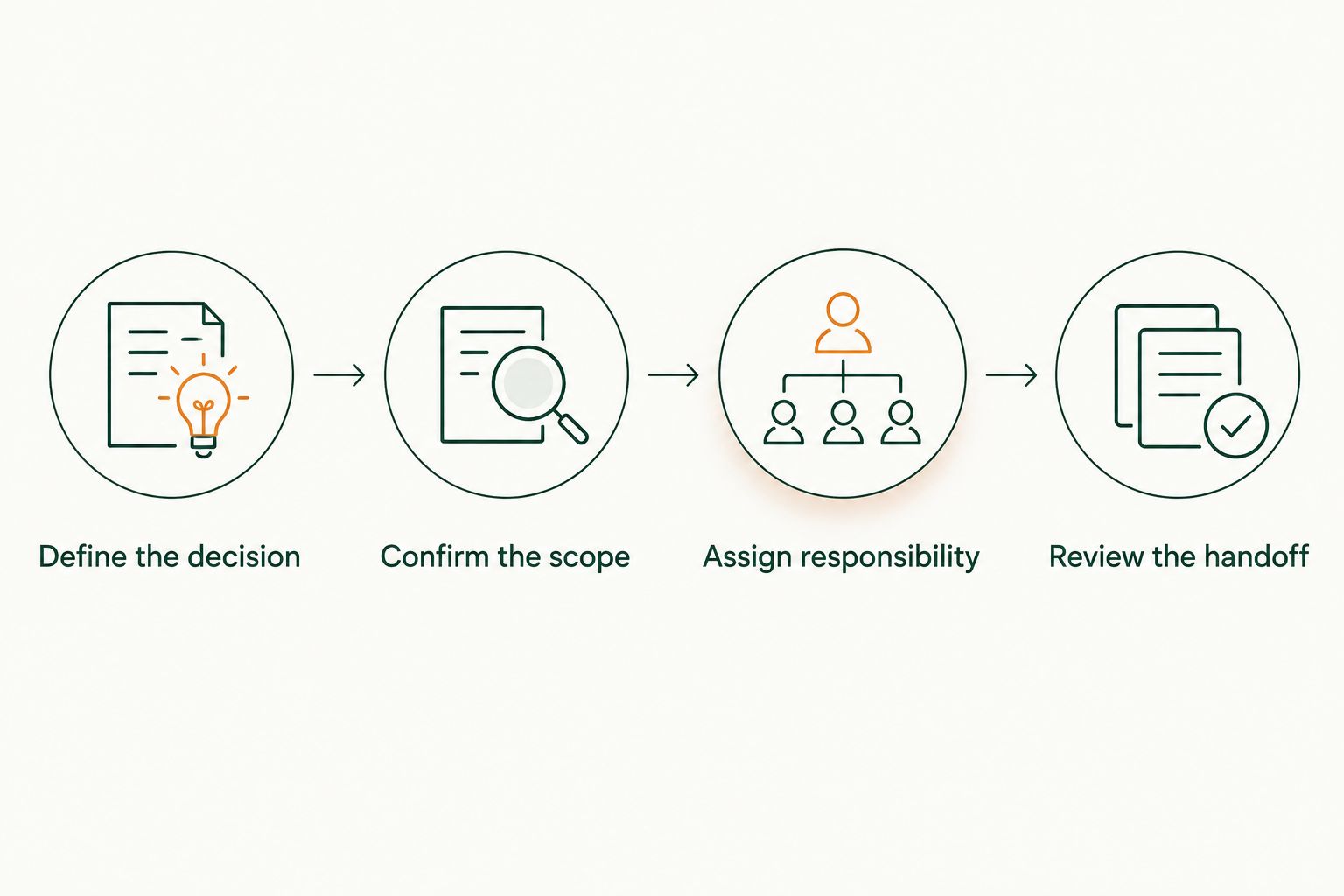
- Define the decision. Write down the financial issue you need resolved. Use a concrete question about retirement spending, account coordination, a business transition, or family wealth rather than a general request for better investing.
- Confirm the scope. Ask which parts of that decision the provider addresses. Request the service agreement and relevant disclosures, and distinguish included work from referrals or separate engagements.
- Assign responsibility. Identify who recommends an action, who implements it, and who confirms completion. Include your own responsibilities and the roles of your tax professional and estate attorney.
- Review the handoff. Before transferring assets, examine existing holdings, account registrations, beneficiary information, and the implications of selling or transferring investments.
The sequence prevents a common mismatch: hiring a provider to manage investments while expecting it to manage every financial decision. It also keeps a change of advisor from becoming an unnecessary change of investment strategy.
If you decide to move beyond automated management, the robo-advisor to fiduciary advisor workflow provides a related guide to the transition. Treat the move as a planning decision first and an account-transfer decision second.
What should you ask a fiduciary advisor before hiring one?
Ask the advisor to explain fiduciary duties, compensation, conflicts, and service scope in plain language. Investment advisers' fiduciary duties apply within the advisory relationship; that does not mean every service you want is included. Ask for the relevant agreements and disclosures, including Form ADV where applicable.
SEC registration is not an endorsement of an advisor's skill or a guarantee of investment results. Likewise, fee-only compensation does not eliminate every potential conflict. It describes a compensation model, not a substitute for reviewing the relationship.
VIMNewEngland is a fee-only, SEC-registered RIA offering integrated financial planning and investment management. Evaluate that relationship by asking how your savings, retirement, taxes, and estate planning would connect—not by expecting a promise of market outperformance.
Useful questions include:
- What planning work is included beyond managing investments?
- How do you incorporate accounts and assets you do not manage?
- What information do you need from my accountant or attorney?
- Who maintains my plan and follows up on agreed actions?
- What conflicts should I understand before signing?
In 2026, choose the relationship whose written responsibilities match the help you need. Do not let a reassuring title replace that examination.
Explore an integrated advisory relationship
Review financial planning and investment management together.
Can a robo-advisor be a fiduciary?
Yes, a robo-advisor operating as an investment adviser can have fiduciary duties. The SEC's guidance on robo-advisers explains that automated delivery does not remove an investment adviser's obligations.
Check the legal entity providing advice and its disclosures. Do not infer fiduciary status from words such as automated, digital, or personalized.
Does a fiduciary advisor guarantee better investment returns?
No, fiduciary status does not guarantee better investment returns or protection from losses. It concerns the advisor's obligations, not a promised outcome.
Compare the services and responsibilities you receive. A planning relationship should stand on its ability to address your decisions, not on an unsupported prediction of higher returns.
Can you keep a robo-advisor and hire a financial planner?
Yes, you can retain automated investing and separately engage a financial planner when the agreements support that arrangement. Confirm whether the planner advises on those assets and whether the platform can implement the recommended changes.
The trade-off is coordination. You remain responsible for any gap between the planner's recommendations and the platform's investment process unless someone explicitly agrees to handle it.
FAQ
Is a robo-advisor a substitute for a fiduciary advisor in 2026?
A robo-advisor substitutes for the investment tasks its agreement covers, not automatically for full financial planning. Some robo-advisors also have fiduciary duties, so compare scope and responsibility rather than labels.
Can a robo-advisor act as a fiduciary?
Yes, a robo-advisor operating as an investment adviser can have fiduciary duties. Verify the entity providing advice and read its service agreement and disclosures.
Is a human financial advisor always better than a robo-advisor?
No, a human advisor is not automatically better for every investor. Human advice fits decisions requiring discussion and coordination only when that work is included in the engagement.
Do robo-advisors handle retirement and estate planning?
Retirement and estate-planning coverage depends on the provider's agreement. Portfolio management alone does not establish responsibility for retirement-income decisions, beneficiary coordination, or work with your estate attorney.
Should I sell my investments before switching advisors?
Do not sell investments solely because you are changing advisors. Review transfer options, investment compatibility, and tax consequences before deciding what to retain or sell.
Does fee-only mean an advisor has no conflicts?
No, fee-only compensation does not eliminate every potential conflict. Review the advisor's disclosures, compensation arrangements, and recommendations within the agreed service scope.
What should I ask before replacing my robo-advisor?
Ask which financial decisions the new advisor will address and who will implement the recommendations. Confirm account coverage, professional coordination, and ongoing responsibilities before transferring assets.
One last thing
Before changing providers, ask your current provider to address your next real financial decision. If the answer falls outside its service, you have identified a scope gap—not necessarily a failure of its investment process.
VIMNewEngland's financial planning and investment management relationship is relevant when you want those decisions connected. Choose that kind of relationship for its agreed responsibilities, while recognizing that advice cannot remove investment risk or replace legal and tax professionals.
This article provides general educational information, not individualized investment, tax, or legal advice.