
No—fee-only financial advice for your personal finances is not deductible on your federal income tax return for 2026. Being fee-only, paying from a taxable investment account, or itemizing deductions does not change that result. Genuine business expenses and certain estate or trust administration expenses follow separate rules; they are not exceptions for ordinary personal financial planning.
- Is fee-only financial advice tax deductible? No, not for personal federal income taxes in 2026.
- Fee-only describes advisor compensation, not whether financial planning fees qualify for a tax deduction.
- Business and fiduciary expenses require separate analysis; personal investment management does not become deductible through relabeling.
- VIMNewEngland provides integrated financial planning and investment management; evaluate that relationship separately from fee deductibility.
Is fee-only financial advice tax deductible?
Personal financial planning and investment advisory fees are not deductible for federal income tax purposes in 2026. The federal restriction on miscellaneous itemized deductions applies even when the advice concerns investments that generate taxable income.
Fee-only compensation answers a different question: how your advisor gets paid. It does not establish a tax deduction. When reviewing fee-only financial advisor qualities, separate compensation transparency from the tax treatment of the bill.
| Expense or payment arrangement | Federal treatment in 2026 | What to check |
|---|---|---|
| Personal financial planning paid from your bank account | Not deductible | Whether the invoice covers personal advice |
| Personal investment management paid from a taxable brokerage account | Not deductible | A brokerage debit does not create a deduction |
| Advice genuinely attributable to an operating business | Potential business deduction, subject to applicable rules | Business purpose, allocation, and documentation |
| Estate or non-grantor trust administration | Certain qualifying expenses are deductible | Whether the expense meets fiduciary deduction rules |
| An IRA paying its own qualifying investment management expense | Separate account-payment treatment, not a personal deduction | Whether the expense belongs to that IRA |
These categories are not interchangeable. An advisor's title, the size of your portfolio, and the invoice's payment method do not override the purpose of the expense.
Federal authority: Internal Revenue Code Section 67 governs miscellaneous itemized deductions; Section 162 governs ordinary and necessary trade or business expenses; Section 67(e) addresses qualifying estate and trust administration expenses. This article applies those distinctions to 2026 federal treatment, not to every state income tax return.
Why this matters
You should evaluate an advisory relationship using the expense you actually bear, not an assumed tax deduction. If the engagement covers your household's retirement, investments, and estate planning, do not reduce its cost in your budget by an expected federal deduction.
That distinction matters when your financial life spans a business, retirement accounts, taxable investments, and family trusts. Those arrangements can have different tax rules even when one advisor helps coordinate them.
A deduction also is not the same as tax-aware advice. An advisor can help organize investment decisions around taxes without making the advisor's own fee deductible. Keep those questions separate when deciding what support you need.
Personal financial planning fees: no federal deduction
Personal advice about retirement readiness, household savings, investment allocation, and estate planning does not become deductible because it addresses consequential decisions. Nor does advice become deductible because your advisor has fiduciary obligations.
The same principle applies to a recurring investment management charge and a separately billed personal planning engagement. Changing the billing format does not change the nature of the service.
Itemizing does not restore the deduction. A taxpayer who itemizes other allowable expenses still cannot deduct a personal advisory fee that falls within the disallowed miscellaneous itemized deduction category.
For your 2026 planning, use the following distinction:
- Financial benefit: What the advice helps you understand, decide, or coordinate.
- Tax deductibility: Whether tax law permits the particular expense to reduce taxable income.
One does not establish the other. A useful planning relationship can have a nondeductible fee, and a deductible business expense does not automatically represent useful advice.
Business-related advice: establish the business purpose
An operating business can deduct qualifying ordinary and necessary business expenses under Section 162. That does not mean a business owner can deduct all financial advice received personally.
Advice about your household's investment portfolio remains personal even if business income funded the portfolio. Likewise, paying a personal planning invoice from a business checking account does not turn it into a business expense.
An engagement that genuinely includes business advice requires a closer look at the services performed. Your tax professional should determine whether an expense qualifies, whether another rule requires different treatment, and how to allocate any mixed business and personal work.
Document the work before claiming the deduction. A service agreement and an itemized invoice are more useful than a vague description added after the fact.
Ask your advisor to distinguish business services from household planning where that distinction reflects the actual engagement. Do not ask the advisor to rename personal investment advice as business consulting. Documentation supports the substance of an expense; it does not replace it.
Estate and trust expenses: use the fiduciary rules
An estate or non-grantor trust does not follow precisely the same expense rules as an individual. Section 67(e) permits special treatment for qualifying administration expenses that would not have been incurred if the property were not held in the estate or trust.
Ordinary investment advisory fees do not become fully deductible just because a trust pays them. Treasury Regulation Section 1.67-4 distinguishes expenses commonly incurred by individuals from expenses arising from estate or trust administration.
For investment advice, the regulation addresses qualifying incremental expenses attributable to fiduciary circumstances. That is narrower than treating the entire advisory bill as a deductible trust expense.
A bundled bill needs particular care. Investment management, fiduciary administration, and other services can have different treatment, so the fiduciary's tax preparer needs enough detail to apply the allocation rules.
Grantor trusts introduce another distinction: their income tax treatment generally follows the owner rather than the separate non-grantor trust framework. Before discussing a deduction, establish what kind of trust you have and who reports its income.
IRA-paid fees: account treatment is not a deduction
An IRA's direct payment of an expense properly attributable to managing that IRA is different from your paying a personal advisory invoice. It is not a personal itemized deduction.
Qualifying account-level expenses paid directly by the IRA can receive treatment different from a distribution to you. But an IRA should not pay unrelated household planning expenses or charges attributable to accounts outside that IRA.
Do not withdraw money personally and assume the withdrawal is equivalent to an account-level fee debit. A distribution paid to you has its own tax rules, even if you later use the money to pay an advisor.
Ask the advisor and custodian which services a proposed debit covers and how the charge is allocated. Have your tax professional review the arrangement when a single engagement includes both retirement-account management and broader planning.
The trade-off deserves attention: an IRA-paid expense reduces assets inside the retirement account. A payment method can affect your financial plan without creating a deductible expense on your individual return.
Why the tax treatment varies
The relevant distinction is not whether an advisor calls the service wealth management, financial planning, or investment consulting. The relevant distinction is what the expense actually covers and which tax rules apply.
For 2026, review these factors:
- Service purpose: Personal planning and genuine business services follow different rules.
- Taxpayer identity: An individual, operating business, estate, and non-grantor trust are not interchangeable.
- Trust classification: Grantor and non-grantor trusts require different income tax analysis.
- Account attribution: An IRA-level management expense differs from broader household advice.
- Bundled services: A combined invoice can require an allocation supported by the work performed.
- State jurisdiction: Federal nondeductibility does not, by itself, establish the treatment on a state return.
For New England households, review the return for your actual state of residence. Do not assume neighboring states have identical rules, or that the advisor's office location determines your deduction.
If you have income tax filing obligations in more than one state, ask your preparer to address each relevant return separately. Keep that review distinct from the federal answer.
How to review your advisory invoice before filing
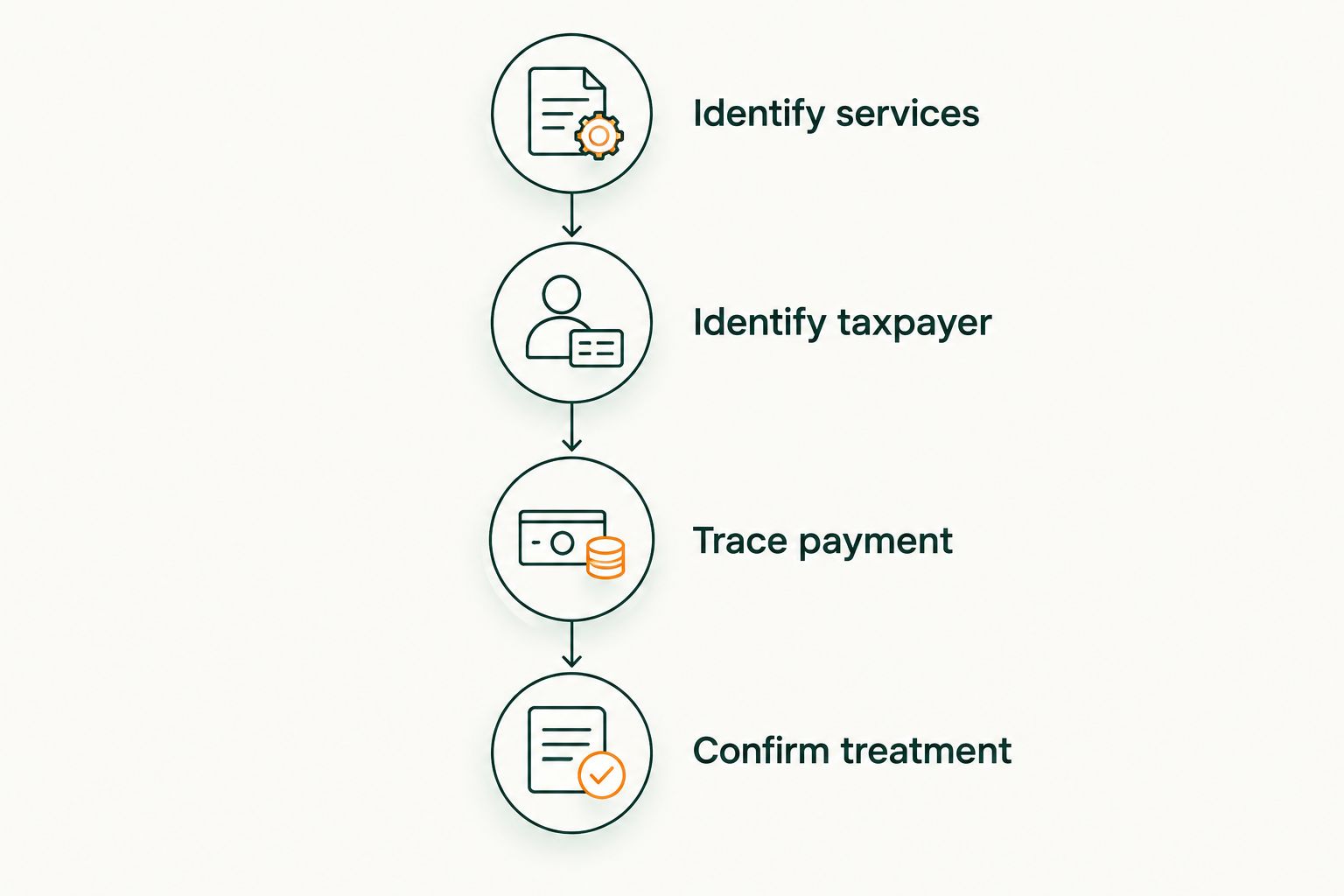
Use 4 steps to resolve the question without turning a compensation discussion into a tax assumption. Start with the engagement's actual scope, then check the applicable treatment.
- Identify services. Read the agreement and invoice. Separate personal planning, investment management, business work, and fiduciary administration where those services are genuinely present.
- Identify taxpayer. Establish whether the expense belongs to you, a business, an estate, or a trust. Confirm the trust's tax classification when relevant.
- Trace payment. Determine which account paid the expense and which account or activity received the service. A payment source alone does not establish deductibility.
- Confirm treatment. Give the documents to your tax professional before entering a deduction or authorizing a questionable retirement-account payment.
Keep 3 records together: the engagement agreement, the detailed invoice, and the payment record. These documents give your preparer a clearer basis for distinguishing services and payment arrangements.
Also separate 2 questions in your conversation: whether the expense is deductible and whether the chosen account should pay it. Answering one does not automatically answer the other.
For a 2026 engagement, address the distinction before billing begins when possible. That lets you request accurate service descriptions rather than trying to reconstruct the work during tax preparation.
Does fee-only mean the advisor provides tax preparation?
No. Fee-only describes compensation, not a commitment to prepare and file your tax returns. Financial planning can address taxes while tax preparation remains a separate engagement.
Ask who is responsible for preparing returns, confirming deduction treatment, and coordinating planning decisions. A financial plan should not leave you guessing about who will implement a tax recommendation.
Does a larger portfolio make advisory fees deductible?
No. A larger personal portfolio does not change the federal rule for personal financial advice in 2026. Investment income and substantial assets do not, by themselves, create a business deduction.
Treat the services according to their purpose, not the amount under management. The same principle applies whether your financial life includes one investment account or several coordinated accounts.
Should nondeductibility stop you from hiring an advisor?
No. Nondeductibility answers a tax question, not whether an advisory relationship fits your needs. Evaluate the scope of work, compensation, coordination, and responsibilities before deciding.
VIMNewEngland is best suited to individuals, families, and business owners seeking integrated financial planning and investment management. Its described scope connects savings, retirement, taxes, and estate planning within one advisory relationship.
The benefit of that model is coordination across decisions that otherwise sit in separate conversations. The limitation is that an integrated relationship does not change the federal deduction rules or establish that tax-return preparation is included.
You can review VIMNewEngland to consider the advisory relationship separately from this deduction question. Ask what the engagement covers and how the advisor will coordinate with your tax preparer and estate attorney.
FAQ
Is fee-only financial advice tax deductible in 2026?
No. Personal fee-only financial advice is not deductible on your federal income tax return for 2026. Genuine business expenses and qualifying estate or trust administration expenses require separate analysis.
Can I deduct financial advisor fees if I itemize?
No. Itemizing does not make personal financial planning or investment advisory fees deductible under the 2026 federal rules. Other allowable itemized deductions do not change that restriction.
Are advisory fees deductible when they come from a brokerage account?
No. Debiting a personal advisory fee from a taxable brokerage account does not create a federal deduction. The service's purpose, rather than the payment location, determines its classification.
Can my business deduct my personal wealth management fees?
No. Personal wealth management does not become a business expense because your business pays the invoice. Qualifying business services need a genuine business purpose and appropriate documentation.
Can a trust deduct investment management fees?
A trust cannot automatically deduct ordinary investment management fees in full. Qualifying fiduciary expenses and certain incremental advisory expenses follow separate rules, and trust classification matters.
Can my IRA pay my financial advisor's fee?
An IRA can pay qualifying expenses properly attributable to managing that IRA, subject to the applicable account rules. That payment is not a personal tax deduction, and unrelated household expenses require different treatment.
Does VIMNewEngland's fee-only status make its fees deductible?
No. VIMNewEngland's fee-only compensation does not make personal advisory fees federally deductible. Evaluate the advisory services and the tax classification of the expense separately.
Does the federal rule also decide my state deduction?
No. State income tax treatment requires a separate review of the applicable state's rules. Ask your preparer to confirm the treatment for each state return you file.
One last thing
The name on an invoice is less important than the work behind it. A bill labeled tax planning is not automatically deductible, and a bill labeled investment management does not reveal whether it includes a separately qualifying fiduciary service.
Before your next payment, ask for a clear description of what you are buying. Then let your tax professional determine the treatment. That is more useful than assuming either that every advisory expense qualifies or that every business and trust expense follows the personal rule.
This article provides general federal tax information, not advice for your individual return. Confirm business, trust, retirement-account, and state treatment with your tax professional.