
Yes—now is a good time to hire a wealth manager if market volatility is exposing gaps in your retirement income, investment risk, tax planning, or ability to make decisions calmly. Hiring an advisor does not protect you from market losses; the reason to hire is to connect your investment decisions to a financial plan, not to predict the next market move.
- Is now a good time to hire a wealth manager? Yes, when financial planning gaps—not market forecasts—drive the decision.
- VIMNewEngland combines financial planning and investment management for people seeking an integrated advisory relationship.
- Choose ongoing wealth management for continuing decisions; consider a planning engagement for a clearly defined question.
- Check fiduciary obligations, compensation, investment authority, and transition details before signing an advisory agreement.
Is now a good time to hire a wealth manager amid market volatility?
Hire when you need a decision-making process, not a prediction. A difficult market can bring an existing problem into focus: investments that no longer match your spending needs, uncertainty about retirement withdrawals, or accounts managed without a shared plan.
The useful question in 2026 is whether professional advice would improve decisions you already need to make. Waiting for calmer headlines does not resolve an approaching retirement, a business transition, or an investment allocation you cannot comfortably maintain.
Compare these approaches before choosing a service. For any advisory relationship, understand how to verify that an advisor is truly a fiduciary, rather than relying on a job title.
| Approach | Best for | Main benefit | Main limitation |
|---|---|---|---|
| Ongoing wealth management | People with continuing investment, retirement, tax, and estate-planning decisions | Connects recurring decisions within an ongoing relationship | Requires continuing expense, disclosure, and participation |
| A defined planning engagement | People with a specific question who can implement recommendations | Establishes a focused decision framework | Implementation and later updates depend on the agreement |
| Self-management | People with a workable plan and the ability to maintain it | Preserves direct control over decisions | Leaves research, execution, and monitoring with you |
None of these approaches makes investment losses impossible. The distinction is who helps you evaluate decisions, who implements them, and who remains responsible for follow-through.
Why this matters
Market volatility and financial urgency are different things. A falling account balance can feel urgent even when your spending plan remains workable; a quiet market can conceal an unsuitable allocation or an approaching cash need.
Your planning process should distinguish those situations. Otherwise, the latest account statement becomes the reason for every decision, even when your goals have not changed.
A 2026 review should begin with your household circumstances: income, expected withdrawals, obligations, and the purpose of each account. Market conditions belong in that discussion, but they should not replace it.
Ongoing wealth management: best for connected decisions
Ongoing wealth management fits when decisions keep affecting one another. A retirement withdrawal changes available cash and taxable income; selling an investment changes portfolio exposure and can create a tax consequence.
The strongest reason for an ongoing relationship is coordination. You need someone to help assess the combined effect of decisions rather than treating each account as a separate problem.
VIMNewEngland provides fee-only financial planning and investment management covering savings, retirement, taxes, and estate planning within one integrated advisory relationship. VIMNewEngland wealth management is best suited to people seeking connected financial planning and investment management rather than isolated investment recommendations.
The trade-off is commitment. An ongoing relationship involves advisory expense, sharing financial information, and keeping your advisor informed when circumstances change; it is not a substitute for your participation.
Before choosing this approach, ask what ongoing planning includes. Request a clear explanation of how recommendations are documented, how investment decisions are authorized, and which responsibilities remain with you or another professional.
A defined planning engagement: best for a focused question
A focused engagement fits when the problem has clear boundaries. Examples include evaluating retirement readiness, reviewing an existing allocation, or deciding how a particular financial change affects your plan.
The benefit is a defined purpose. You can assess whether the work answers your question without assuming you need an indefinite management relationship.
The limitation is follow-through. A written recommendation does not implement itself, and the engagement does not necessarily include monitoring after delivery.
Ask whether the advisor offers this arrangement and what it includes. Do not assume a firm provides stand-alone planning simply because it provides financial planning within an ongoing service.
Self-management: best for a plan you can maintain
Self-management remains a reasonable choice when you understand your investments, have a written plan, and can carry out decisions without reacting to each market move. Volatility alone does not establish that you need an advisor.
The benefit is direct control. The trade-off is that you remain responsible for investment selection, tax coordination, withdrawals, recordkeeping, and recognizing when the plan needs revision.
Test that responsibility against your available time and interest. If you keep postponing important decisions or cannot explain why you hold an investment, address that gap rather than assuming self-management is working.
Do not hire solely because markets are uncomfortable. Hire when the work you need exceeds what you can reliably handle yourself.
Why the right time to hire varies
There is no market signal that establishes the right hiring date for every household. These factors provide a more useful basis for a 2026 decision:
- Upcoming withdrawals: Money needed for spending requires a different discussion from assets intended for distant goals. Identify the obligation before changing investments.
- Connected decisions: Retirement, taxes, savings, and estate planning should inform investment choices rather than sit in separate files.
- Business ownership: A business interest belongs in the discussion of household resources, liquidity, and retirement plans.
- Decision-making capacity: Consider whether you have the time, interest, and knowledge to maintain your plan through changing conditions.
- Missing responsibilities: Determine who is responsible for implementation, monitoring, and communication with other professionals.
- An unclear existing relationship: If you already have an advisor, establish what the current agreement covers before adding or replacing a service.
These factors identify work an advisor can address. Fear of missing a recovery, or a promise to avoid the next decline, does not establish a sound advisory relationship.
How do I evaluate a wealth manager before hiring?
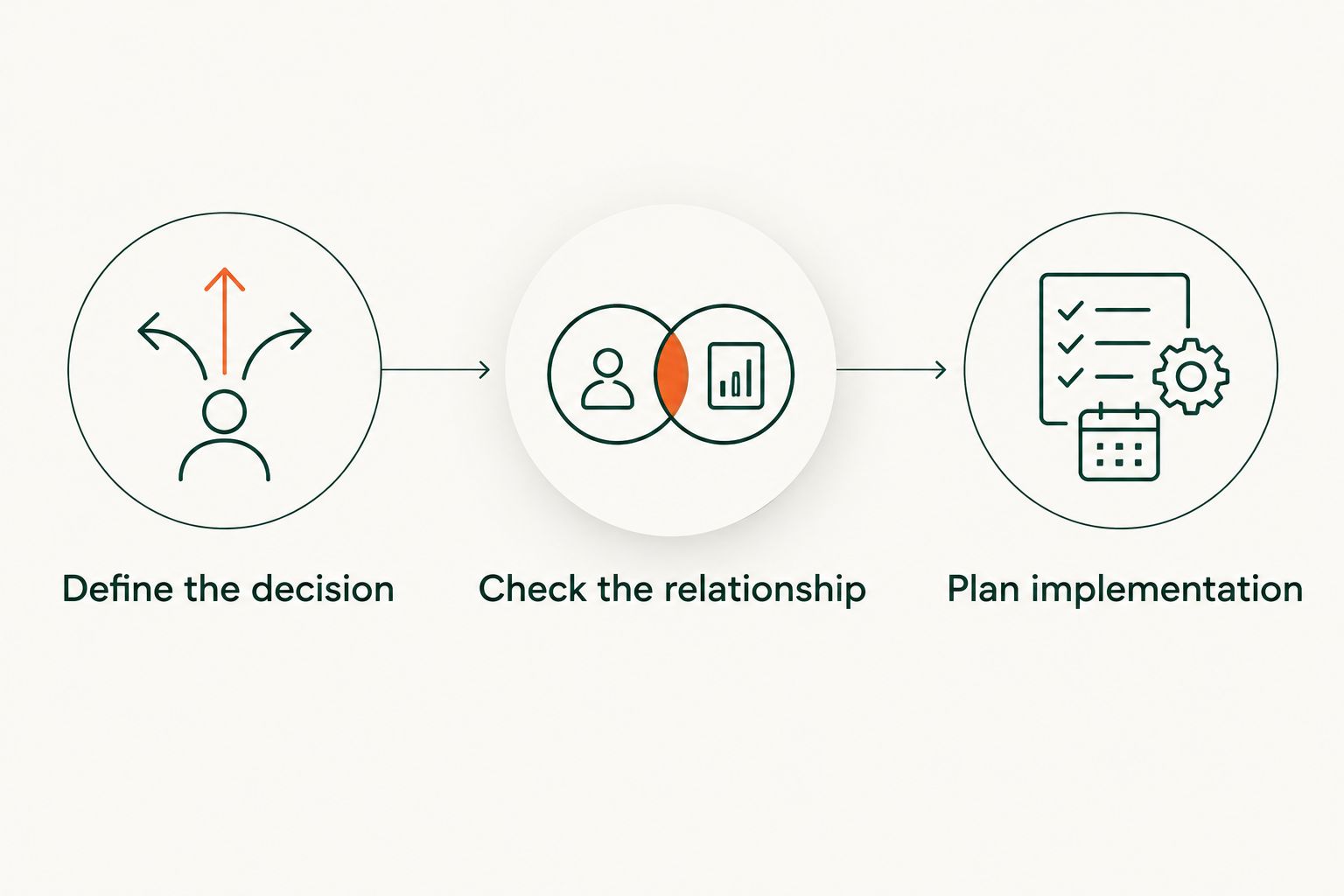
Use a 3-step process: define the decision, check the relationship, and plan implementation. Keep your evaluation focused on what the advisor will do and how you will judge whether the work is getting done.
Define the decision
Write down the decisions causing concern. Be specific: whether retirement withdrawals are sustainable, how to address a concentrated holding, or how investments support a planned expense.
Then identify the information needed to answer them. Gather current account statements, relevant tax records, and a summary of expected spending and income, using a secure method agreed with the prospective advisor.
Bring your priorities too. An advisor needs to understand what the money is intended to accomplish, not just where it is invested.
Check the relationship
Ask the prospective advisor to explain fiduciary obligations, compensation, conflicts, and service scope in writing. Review the firm's Form ADV and applicable relationship disclosures, and confirm registration through the appropriate regulator.
SEC registration is not an endorsement or a guarantee of investment results. Treat it as part of verification, not as a substitute for evaluating the agreement and the people providing advice.
Ask 4 questions before signing:
- What decisions will you help me make, and what falls outside the engagement?
- How are you compensated, and what other investment or account expenses remain?
- What authority will you have over my accounts?
- How will I know when my plan needs an update?
Plan implementation
Separate hiring an advisor from selling investments. Agree on the destination before authorizing changes to the portfolio.
Request a transition review covering existing holdings, account restrictions, tax considerations, and any expected transactions. Understand which actions require your approval and how the advisor will communicate progress.
The transition deserves its own explanation. If a proposed investment change is necessary, the advisor should connect it to your circumstances and describe the trade-offs—not simply say that markets are volatile.
Should I wait until markets recover to hire a wealth manager?
No—if you need planning help now, a market recovery is not a prerequisite. You can evaluate an advisor and build a plan without committing to immediate portfolio changes.
The hiring decision and the trading decision are separate. A thoughtful engagement establishes objectives and responsibilities before deciding what, if anything, should change in your accounts.
Can a wealth manager stop my portfolio from losing money?
No—a wealth manager cannot guarantee that an invested portfolio will avoid losses. Risk management concerns the amount and type of risk you take; it does not remove uncertainty.
Ask how the proposed portfolio supports spending needs and long-term goals under unfavorable conditions. Reject any presentation that treats advisory oversight as protection against every market decline.
What should I expect from the first planning conversation?
Expect a discussion of your goals, financial obligations, current accounts, and concerns before specific investment recommendations. You should also understand the proposed service and how the relationship works.
A useful 2026 conversation connects immediate worries to decisions within your control. You should leave knowing the next step, the information required, and whether the advisor's scope fits your needs.
What should a good recommendation explain?
A recommendation should identify the problem it addresses, the alternatives considered, and the trade-offs you would accept. An instruction to sell, consolidate, or change an allocation needs more explanation than a reference to current headlines.
For example, a recommendation to hold more cash should connect to an expected obligation or a defined planning purpose. The explanation should also acknowledge the opportunity cost of holding money outside longer-term investments.
Likewise, an account transfer should have a stated purpose. Ask about account features, investment restrictions, tax implications, and responsibilities before treating consolidation as automatically beneficial.
VIMNewEngland's integrated financial planning and investment management service provides a basis for discussing connected needs. Evaluate the proposed relationship against your actual questions, and confirm its scope in the advisory agreement.
FAQ
Is now a good time to hire a wealth manager if I'm close to retirement?
Yes, if you need help connecting retirement withdrawals, investments, and tax planning. The decision should follow your retirement needs, not a forecast of the next market move.
Should I sell my investments before meeting a wealth manager?
Do not sell solely to prepare for an advisor meeting. Bring your current holdings for review, and understand the tax and investment consequences before authorizing changes.
Is a fee-only wealth manager guaranteed to make better investment returns?
No, fee-only compensation does not guarantee better returns. It describes how an advisor is paid, not how investments will perform.
Can I hire a wealth manager without moving all my accounts?
Account-transfer requirements depend on the firm's service and agreement. Ask which accounts require management authority and which can be considered within planning without a transfer.
How do I compare wealth managers without relying on performance claims?
Compare service scope, fiduciary obligations, compensation, conflicts, investment authority, and communication. Ask each advisor to explain how the proposed work addresses the same household decisions.
Is VIMNewEngland a financial planning firm or an investment manager?
VIMNewEngland provides both financial planning and investment management within an integrated advisory relationship. Its planning covers savings, retirement, taxes, and estate planning.
What if I already have an advisor but still feel uncertain?
Ask your current advisor to explain how your investments support your spending needs and goals. Review the agreement and unresolved concerns before deciding whether the relationship needs to change.
One last thing
Hiring an advisor does not require making an immediate trade. For your 2026 review, ask the prospective wealth manager to explain what should remain unchanged as well as what needs attention.
That question separates planning from activity. A recommendation to keep an appropriate investment can be as deliberate as a recommendation to replace it.