
Best overall for balancing spouse support and children's inheritance: a marital trust with defined remainder beneficiaries. Best for correcting account-level gaps: a beneficiary review. Best for protecting a child's separate inheritance: a dedicated trust. These are the best estate planning strategies for blended families in 2026 when matched to your assets, obligations, and family relationships—not treated as interchangeable documents.
- The best estate planning strategies for blended families coordinate trusts, beneficiary designations, and account ownership.
- A marital trust can support a surviving spouse while preserving remaining assets for named children.
- Beneficiary reviews address retirement accounts and insurance that a will generally does not control.
- VIMNewEngland fits families seeking integrated financial planning and investment management alongside attorney-led estate planning.
Why this matters
Leaving everything outright to your spouse gives that spouse control over what happens next. That flexibility can conflict with your intention to preserve an inheritance for children from an earlier relationship.
Spouse support and children's inheritance are separate planning decisions. Your documents should explain both, including who makes decisions when interests differ. An investment portfolio alone cannot resolve those questions.
VIMNewEngland provides financial planning and investment management within an integrated advisory relationship. Your estate attorney drafts the legal arrangements; financial planning connects those arrangements to retirement income, account ownership, and available assets.
What makes the best blended-family estate plan
Evaluate each strategy against these criteria before choosing documents:
- Spouse support: Does your surviving spouse have a workable income and housing plan?
- Inheritance protection: Are your children's rights defined rather than dependent on future promises?
- Decision authority: Who controls distributions, investments, and changes after your death?
- Account alignment: Do titles and beneficiary forms carry out the documents' instructions?
- Tax coordination: Does the plan account for federal and applicable state estate-tax rules?
- Practical administration: Can the people responsible understand and carry out their duties?
No strategy wins every category. Stronger inheritance restrictions reduce flexibility, while greater flexibility gives the surviving spouse or trustee more discretion.
Blended-family estate strategies at a glance
| Rank and strategy | Best for | Standout feature | Key limitation |
|---|---|---|---|
| 1. Marital trust with remainder beneficiaries | Supporting a spouse while preserving a later inheritance | Separates lifetime benefits from ultimate ownership | Requires careful drafting and administration |
| 2. Beneficiary and ownership review | Aligning retirement accounts and insurance | Checks transfers outside the will | Does not replace trust provisions |
| 3. Separate trusts for children | Giving children a defined, separate share | Establishes distribution rules for each inheritance | Reduces assets available elsewhere |
| 4. Independent trustee arrangement | Managing competing family interests | Separates fiduciary decisions from family roles | Adds administration and another decision-maker |
| 5. Estate liquidity plan | Preserving homes or business interests | Identifies resources for expenses and distributions | Cash reserves compete with other uses |
| 6. Marital agreement coordinated with estate documents | Clarifying rights around remarriage | Documents property expectations during life | Requires separate legal analysis and formalities |
1. Marital trust: best for spouse support and a later inheritance
A marital trust can provide benefits to your surviving spouse while directing remaining assets to specified beneficiaries after the spouse dies. The drafting determines access to income and principal, trustee discretion, and whether anyone can change the ultimate recipients.
A qualified terminable interest property trust, or QTIP trust, is one marital-trust structure. Qualifying for its federal marital-deduction treatment requires specific provisions and an election; the label alone does not establish the tax result.
Best for: Families that want the surviving spouse supported without giving that spouse unrestricted ownership of the children's intended inheritance.
Marital trust pros:
- Separates lifetime support from the eventual inheritance.
- Defines who receives remaining trust assets.
- Establishes rules for principal distributions.
Marital trust cons:
- Restrictions can limit the surviving spouse's flexibility.
- Administration requires records, oversight, and applicable tax filings.
Ask your attorney what happens if the spouse needs substantial care, remarries, or wants to move. Also ask whether principal distributions could exhaust the trust: remainder beneficiaries inherit what remains, not necessarily a guaranteed amount.
Verdict: Buy into this structure when balancing both family branches is the central objective.
2. Beneficiary review: best for account-level alignment
A will generally does not override a valid beneficiary designation on a retirement account or life insurance policy. Joint ownership and survivorship rights can also determine transfers independently of your will.
For your 2026 review, compare actual account records with the estate plan—not an old spreadsheet. Check primary beneficiaries, contingent beneficiaries, percentages, and the exact legal names of any trusts.
Best for: Families whose retirement accounts, insurance, or jointly owned property represent a substantial part of their wealth.
Beneficiary review pros:
- Identifies mismatches between accounts and documents.
- Clarifies who receives assets directly.
- Creates a record for future reviews.
Beneficiary review cons:
- Forms alone cannot provide detailed inheritance safeguards.
- Retirement-plan spousal rights can limit available choices.
Do not name a trust as an IRA beneficiary without reviewing distribution and tax consequences. Likewise, a workplace retirement plan can require spousal consent before you name someone other than your spouse.
Use this guide to connect your estate plan to your investment accounts when organizing the review.
Verdict: Buy into this review before assuming signed documents control every asset.
3. Separate trusts: best for children's defined inheritances
A separate trust can hold a designated share for a child, with instructions governing distributions and management. It separates that inheritance from the assets intended to support your surviving spouse.
The funding decision matters as much as the trust language. A trust promised in documents but left without the intended assets does not deliver the planned inheritance.
Best for: Parents who want a child's inheritance established independently of the surviving spouse's future decisions.
Separate trust pros:
- Defines each beneficiary's intended share.
- Allows tailored distribution standards.
- Provides management when direct ownership is unsuitable.
Separate trust cons:
- Funding children separately reduces resources available to the spouse.
- Additional trusts create additional administration.
Distinguish equal treatment from identical treatment. Children can have different needs, prior gifts, or responsibilities; your attorney should translate your intentions into enforceable terms rather than leave explanations to family members.
If a beneficiary receives means-tested public benefits, obtain specialized advice before directing an inheritance outright or into a standard trust. The wrong arrangement can affect eligibility.
Verdict: Buy into separate trusts when a defined inheritance matters more than shared flexibility.
4. Independent trustee: best for competing family interests
An independent trustee arrangement places distribution decisions with someone outside the immediate beneficiary conflict. Naming your spouse as sole trustee over assets ultimately intended for stepchildren can put personal needs and fiduciary responsibilities in tension.
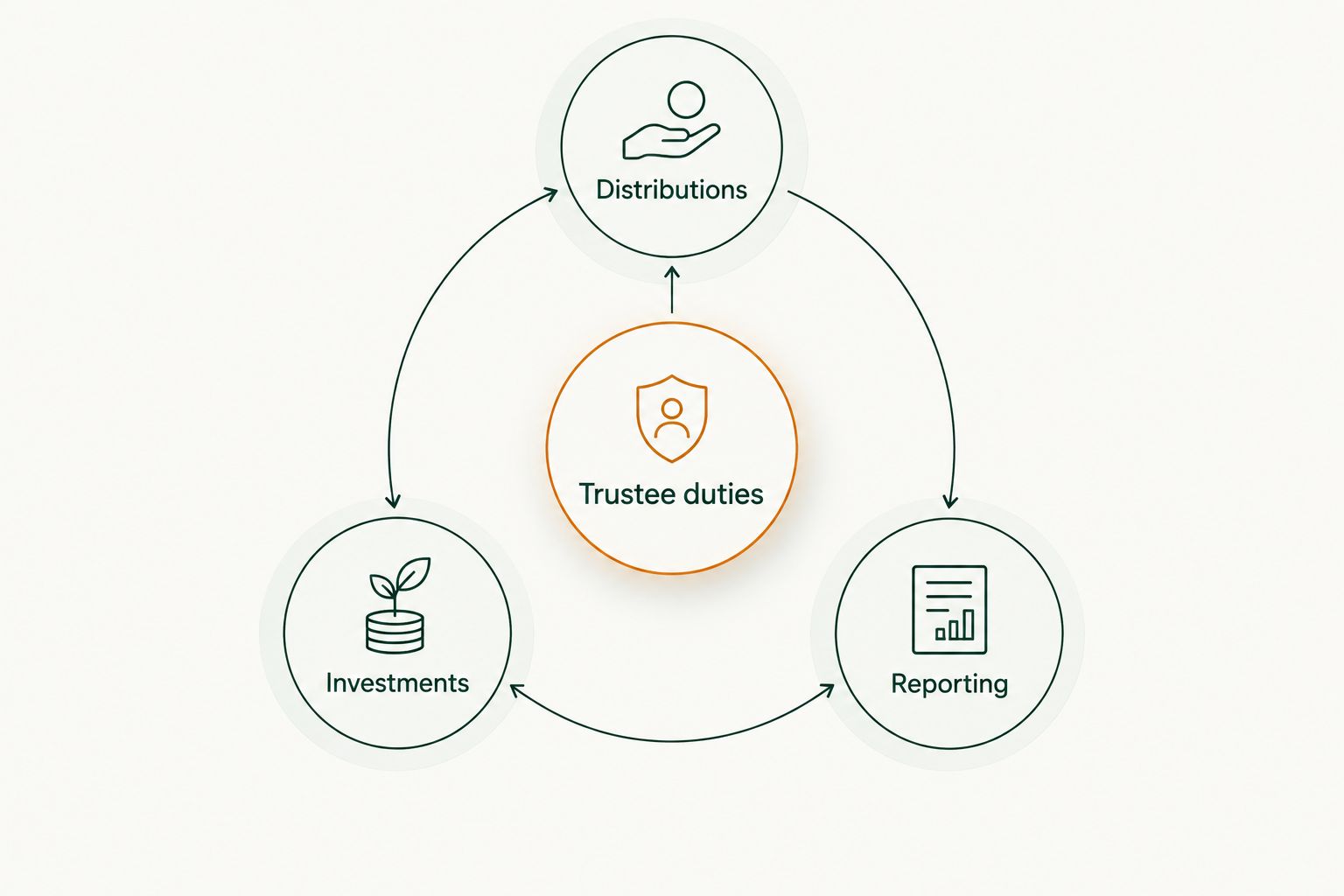
Specify the trustee's duties across Distributions, Investments, and Reporting. Your documents should also address trustee replacement, successor appointments, and how disagreements are handled.
Best for: Families where a spouse and children have competing interests or need a neutral decision process.
Independent trustee pros:
- Separates family relationships from fiduciary decisions.
- Provides a defined process for distribution requests.
- Supports consistent beneficiary reporting.
Independent trustee cons:
- Adds another person or institution to decisions.
- Requires clear selection and replacement provisions.
Independence does not guarantee good judgment. Ask about experience with the trust's assets, communication practices, conflicts, and willingness to serve before making an appointment.
A co-trustee arrangement also needs rules for disagreements. Requiring agreement without a workable resolution process can leave routine decisions stalled.
Verdict: Buy into independent oversight when family members should not referee competing claims.
5. Liquidity planning: best for homes and business interests
An estate liquidity plan identifies how expenses, taxes, debts, and intended distributions will be funded. It matters when wealth is concentrated in a residence, rental property, or closely held business rather than readily accessible financial assets.
Do not assume that an asset's appraised value makes it usable cash. Match each expected obligation with the account, reserve, or other resource intended to cover it.
Best for: Families that want to retain illiquid assets without leaving beneficiaries to negotiate an immediate sale.
Liquidity planning pros:
- Identifies funding gaps before death.
- Connects property decisions with inheritance goals.
- Clarifies which assets support estate expenses.
Liquidity planning cons:
- Reserves compete with investment and spending priorities.
- Business and property values require periodic reassessment.
For a shared home, document occupancy rights, maintenance responsibilities, and the circumstances requiring a sale. For a business, coordinate ownership transfers with governing agreements and succession arrangements.
VIMNewEngland's integrated financial planning and investment management is suited to evaluating these funding trade-offs alongside the legal plan. Legal rights and available resources must agree.
Verdict: Buy into liquidity planning when an inheritance depends on keeping property or a business intact.
6. Marital agreement: best for clarifying remarriage expectations
A prenuptial or postnuptial agreement can address property rights and expectations between spouses. Coordinated estate documents then explain how those intentions operate at death, subject to applicable law.
An agreement is not a substitute for beneficiary forms, trusts, or a will. Its enforceability and effect on inheritance rights require legal advice in the relevant jurisdiction.
Best for: Couples entering or already in a remarriage who need explicit treatment of separate property and family obligations.
Marital agreement pros:
- Records expectations while both spouses can participate.
- Addresses property brought into the marriage.
- Gives estate drafting a clearer starting point.
Marital agreement cons:
- Requires legal formalities and adequate disclosure.
- Can create difficult conversations about competing priorities.
Discuss support obligations from an earlier marriage, existing agreements, and assets intended for children. Each spouse should obtain independent legal advice rather than assume a shared understanding protects both interests.
Verdict: Buy into this discussion before relying on informal promises about separate property.
Check federal and New England estate taxes separately
For 2026 deaths, the federal basic estate-and-gift-tax exclusion is $15,000,000 per individual, according to the IRS's published federal exclusion amount. Prior taxable gifts affect the exclusion remaining at death.
Massachusetts Department of Revenue guidance uses a $2,000,000 filing test and a $99,600 estate-tax credit. The filing analysis includes relevant adjusted taxable gifts; the credit is not an additional exclusion.
A Massachusetts estate can therefore require attention even when federal estate tax is not the main issue. Ask your attorney and tax professional to evaluate domicile, property location, marital deductions, and filing requirements under the rules applicable to your estate.
Do not choose a blended-family trust solely to reduce taxes. First establish who needs support and who should inherit; then evaluate the tax treatment of that structure.
How the strategies were ranked
This 2026 ranking prioritizes spouse support, inheritance protection, decision authority, account alignment, tax coordination, and practical administration. It compares planning functions, not investment returns or provider performance.
The marital trust ranks first for balancing successive beneficiaries. Beneficiary review follows because account instructions can undermine otherwise sound documents; the remaining strategies address distinct funding, governance, and property-rights problems.
Which strategy should you choose?
Start with the marital-trust discussion if you want your spouse supported and your children protected after the spouse's death. Start with beneficiary review if you are unsure who currently receives your accounts.
For a 2026 planning meeting, bring estate documents, account statements, beneficiary confirmations, property ownership records, and prior marital agreements. Ask your attorney and advisor to trace what happens after either spouse dies first.
VIMNewEngland is best suited to families seeking coordinated financial planning and investment management. Use that relationship to connect the legal structure with the assets and retirement resources supporting it.
FAQ
What's the best estate planning strategy for a blended family?
A marital trust with defined remainder beneficiaries is a strong starting point when you want to support a spouse and preserve remaining assets for children. The right structure depends on support needs, account ownership, and applicable law.
Does leaving everything to my spouse protect my children?
An outright inheritance generally gives your spouse ownership rather than guaranteeing a later inheritance for your children. A properly drafted trust can define the children's rights to remaining assets.
Does my will override an IRA beneficiary?
A will generally does not override a valid IRA beneficiary designation. Review the designation with your attorney and advisor so it matches the intended estate plan.
Can my spouse serve as trustee for my children's inheritance?
Your spouse can serve when the trust and applicable law permit it, but competing interests deserve careful attention. Consider independent oversight and clear distribution standards when the spouse benefits during life and children inherit later.
Should I name a trust as my retirement account beneficiary?
Name a trust only after reviewing its legal and tax consequences with qualified professionals. Trust terms and beneficiary rules affect how inherited retirement assets must be distributed.
Do stepchildren automatically inherit from me?
Do not rely on a stepchild relationship alone to establish inheritance rights. State intestacy laws generally distinguish stepchildren from legally adopted children; explicitly identify intended beneficiaries in your documents.
Do Massachusetts families need estate-tax planning below the federal exclusion?
Yes, Massachusetts has a separate estate-tax filing test that is lower than the federal exclusion. Review state filing requirements and available deductions even when no federal estate tax is expected.
One last thing
Test the plan by reversing the order of deaths. A structure that works when you die first can produce a different result when your spouse dies first, particularly when ownership and beneficiary forms differ.
Ask for an asset-by-asset explanation of both outcomes. That exercise makes the conversation about actual inheritances rather than document names.