
Best overall foundation: a revocable living trust. Best for married-couple estate-tax planning: a credit shelter trust. Best for charitable income planning: a charitable remainder trust. The best types of trusts for high net worth estate planning depend on which assets you own, who needs access, and what you want the trust to accomplish.
- The best types of trusts for high net worth estate planning start with purpose, not tax savings alone.
- A revocable living trust supports continuity and probate avoidance; it does not remove assets from your taxable estate.
- Credit shelter trusts, SLATs, and ILITs address different estate-tax and family-access needs.
- VIMNewEngland connects estate planning with investment management; your attorney designs and drafts the trust.
Why this matters
A trust changes who controls property, who benefits, and how assets transfer. Those choices affect your retirement security as much as your heirs. Start by understanding how a financial advisor helps with estate planning, then separate financial coordination from legal drafting.
For 2026 deaths, the federal basic estate-tax exclusion is $15,000,000 per individual, according to the IRS's published estate-and-gift-tax guidance. Massachusetts has a $2,000,000 estate-tax filing threshold and a $99,600 estate-tax credit under its current rules. These are different mechanisms, not interchangeable exemptions.
A family below the federal threshold still needs a state estate-tax review. That matters for Massachusetts residents with investment accounts, real estate, and life insurance—not just families with unusually large portfolios.
What makes the best trust for your estate?
Evaluate every trust against these criteria before comparing names:
- Purpose: Identify whether you need probate avoidance, tax planning, beneficiary protection, charitable giving, or succession planning.
- Access: Decide which assets you can transfer without compromising your own spending needs.
- Control: Understand who can amend provisions, direct investments, and approve distributions.
- Tax treatment: Compare estate-tax benefits with income-tax consequences and potential loss of a basis adjustment at death.
- Administration: Assign responsibility for funding, records, returns, trustee decisions, and beneficiary communication.
- State law: Check domicile, property location, trust jurisdiction, and applicable state taxes.
Best trust types at a glance
The order below starts with a common foundation, then moves to trusts serving narrower needs. It is not a ranking of tax savings.
| Trust type | Best for | Standout feature | Key limitation |
|---|---|---|---|
| Revocable living trust | Lifetime continuity | Successor management of funded assets | No estate-tax exclusion by itself |
| Credit shelter trust | Preserving a deceased spouse's exclusion | Separates assets from the survivor's estate when properly structured | Limits survivor control |
| Spousal lifetime access trust | Lifetime transfers for married donors | Spouse remains a permitted beneficiary | Divorce or death changes access |
| Irrevocable life insurance trust | Insurance-based estate liquidity | Separates policy ownership from the insured | Requires careful policy administration |
| Grantor retained annuity trust | Transferring appreciation | Donor retains a defined annuity | Results depend on growth and survival |
| Charitable remainder trust | Charitable giving with retained income | Income interest followed by a charitable remainder | Charity must receive the remainder |
| Dynasty trust | Multigenerational beneficiary planning | Long-term distribution and governance provisions | State-law and tax complexity |
1. Revocable living trust: best for lifetime continuity
A revocable living trust lets you retain control while naming a successor trustee to manage funded assets during incapacity or after death. Assets properly titled in the trust generally avoid probate. Signing the document alone does not accomplish that transfer.
Revocable living trust pros:
- You generally retain amendment and revocation rights while competent.
- A successor trustee provides a management framework during incapacity.
- Funded assets generally pass outside probate.
Revocable living trust cons:
- Assets generally remain in your taxable estate.
- Retained control generally prevents protection from your own creditors.
Best for: Families seeking organized ownership and continuity without giving up lifetime control.
Verdict: Buy for continuity after legal review—not as an estate-tax shelter.
2. Credit shelter trust: best for preserving a spouse's exclusion
A credit shelter trust, also called a bypass trust, typically receives assets after the first spouse dies. Properly structured assets and subsequent appreciation can remain outside the surviving spouse's taxable estate while supporting permitted beneficiaries.
Federal portability does not make this analysis obsolete. Portability generally requires an estate-tax return election, does not transfer generation-skipping transfer exemption, and does not resolve every state estate-tax issue.
Credit shelter trust pros:
- Preserves a separate pool of assets for designated beneficiaries.
- Can keep subsequent appreciation outside the survivor's estate.
- Provides distribution rules for blended-family planning.
Credit shelter trust cons:
- The surviving spouse loses unrestricted ownership of trust assets.
- Assets generally do not receive another basis adjustment at the survivor's death.
Best for: Married couples balancing estate-tax exposure, survivor support, and inheritance control.
Verdict: Hold until counsel compares state taxes, portability, and capital-gains consequences.
3. Spousal lifetime access trust: best for lifetime spousal gifts
A spousal lifetime access trust, or SLAT, is an irrevocable trust created by one spouse for the other spouse and additional beneficiaries. Properly structured transfers can remove assets and future appreciation from the donor's estate.
The donor does not retain a right to distributions. A spouse's beneficial interest is not a substitute for keeping sufficient assets outside the trust.
Spousal lifetime access trust pros:
- Transfers future appreciation with the gifted assets.
- Allows distributions to a spouse under the trust's terms.
- Establishes an inheritance framework for descendants.
Spousal lifetime access trust cons:
- Divorce or the beneficiary spouse's death can end indirect household access.
- Similar trusts created by both spouses risk reciprocal-trust treatment.
Best for: Married donors with assets they can permanently relinquish.
Verdict: Hold until independent cash-flow analysis supports the gift without assumed distributions.
4. Irrevocable life insurance trust: best for insurance liquidity
An irrevocable life insurance trust, or ILIT, owns life insurance and directs the eventual proceeds under its terms. Proper ownership and administration can keep proceeds outside the insured's taxable estate while providing liquidity to beneficiaries or through appropriately structured estate transactions.
Under the federal estate-tax rules, transferring an existing policy brings a 3-year inclusion rule into the analysis. Having the trust acquire a new policy raises different implementation questions.
Irrevocable life insurance trust pros:
- Separates policy ownership from the insured.
- Establishes rules for beneficiaries receiving insurance proceeds.
- Helps plan liquidity when an estate holds illiquid assets.
Irrevocable life insurance trust cons:
- Premium gifts and any withdrawal notices require ongoing administration.
- Policy transfers, ownership rights, and beneficiary errors can defeat the intended tax treatment.
Best for: Families with a defined insurance need and estate-liquidity problem.
Verdict: Hold until insurance analysis establishes the need and counsel confirms ownership mechanics.
5. Grantor retained annuity trust: best for transferring appreciation
A grantor retained annuity trust, or GRAT, transfers assets while paying a specified annuity back to the donor for a stated term. Remaining assets pass to beneficiaries when the term ends.
The transfer opportunity depends on performance above the IRS valuation hurdle and the donor surviving the term. A GRAT is not a promise that appreciation will reach heirs.
Grantor retained annuity trust pros:
- Retains scheduled annuity payments for the donor.
- Targets appreciation rather than simply transferring current value.
- Can accommodate assets with meaningful growth potential.
Grantor retained annuity trust cons:
- Weak performance can leave little or no remainder.
- Death during the term can cause estate inclusion.
Best for: Donors transferring potential upside while retaining a defined payment stream.
Verdict: Hold until counsel models the term, annuity obligations, valuation, and mortality risk.
6. Charitable remainder trust: best for charitable income planning
A charitable remainder trust, or CRT, pays an income interest to designated noncharitable beneficiaries, with the remainder passing to charity. Federal rules govern payout requirements, duration, and the required charitable remainder value.
A CRT can sell appreciated property without immediate capital-gains tax at the trust level, but distributions can carry taxable income to recipients. Tax deferral is not the same as tax elimination.
Charitable remainder trust pros:
- Combines a defined charitable commitment with an income interest.
- Can diversify appreciated assets within the trust.
- Can generate a partial charitable deduction subject to applicable limits.
Charitable remainder trust cons:
- The charitable remainder cannot instead become a family inheritance.
- Distribution taxation and irrevocable terms require careful modeling.
Best for: Donors who genuinely want charity to receive the remaining assets.
Verdict: Skip unless charitable intent exists independently of the tax discussion.
7. Dynasty trust: best for multigenerational beneficiary planning
A dynasty trust is a long-duration irrevocable trust designed to benefit successive generations. Its duration and permitted provisions depend on governing state law; favorable transfer-tax treatment depends on proper funding and exemption allocation.
Distribution rules matter as much as duration. Trustees need practical instructions for education, health, business opportunities, and circumstances the donor cannot predict.
Dynasty trust pros:
- Supports successive generations under a continuing governance structure.
- Can provide discretionary distributions rather than outright inheritances.
- Can limit repeated transfer taxation when properly structured and funded.
Dynasty trust cons:
- Long-term terms can become mismatched with future family needs.
- Trustee succession, state taxation, and administration remain ongoing responsibilities.
Best for: Families committed to long-term stewardship rather than immediate beneficiary ownership.
Verdict: Hold until trustee selection, flexibility provisions, and generation-skipping tax planning are settled.
How these trusts are ranked
The ranking prioritizes control and continuity first, followed by specific tax, insurance, charitable, and multigenerational purposes. No single trust wins across every criterion.
For a 2026 estate review, compare each proposed transfer against retirement spending, state estate taxes, income-tax basis, and the beneficiary's actual needs. A sophisticated document that creates a household liquidity problem fails that test.
Turn the trust choice into an implementation plan
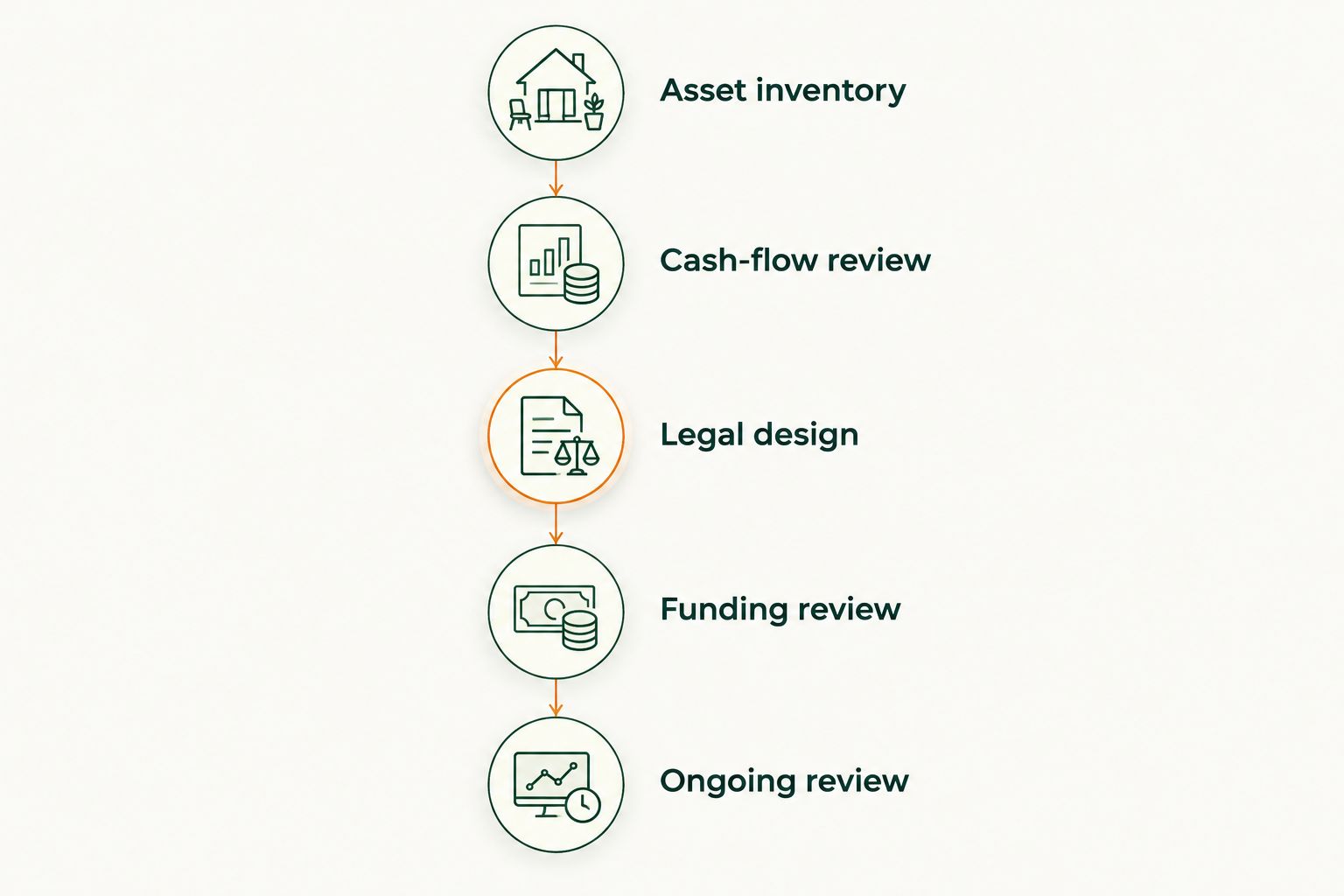
Use this sequence before moving assets. A trust recommendation is incomplete until ownership, taxes, and investment management agree.
- Asset inventory: List owners, beneficiaries, tax basis, debts, insurance, and property locations.
- Cash-flow review: Separate assets needed for your lifetime from assets available for irrevocable gifts.
- Legal design: Have estate counsel specify trustees, beneficiaries, powers, and governing law.
- Funding review: Confirm deeds, account registrations, assignments, and beneficiary instructions.
- Ongoing review: Revisit the plan after family changes, relocation, business transactions, and relevant legal changes.
For retirement accounts, do not assume ordinary trust-funding instructions apply. Naming a trust as beneficiary requires separate distribution analysis; retitling an IRA into a living trust during life can trigger a taxable distribution.
Review how to connect your estate plan to investment accounts before changing registrations. Ask who will verify completion, not merely who will send instructions.
Which trust should you choose?
Start with a revocable living trust when continuity and probate avoidance are the primary needs. Add an irrevocable structure only when a specific objective justifies its restrictions.
VIMNewEngland is best suited to families seeking estate-planning coordination within an integrated financial-planning and investment-management relationship. Your estate attorney handles legal design; tax counsel or your accountant evaluates tax treatment.
For 2026 planning, bring the proposed trust, current account registrations, beneficiary designations, and spending requirements to the same discussion. Ask Rusty Tredwell how the investment plan would operate under the proposed distribution rules.
Connect your estate and investment plans
Review how proposed trust funding fits your spending needs and investment management.
FAQ
What's the best trust for a high-net-worth family in 2026?
A revocable living trust is a common foundation for continuity and probate avoidance, while specialized irrevocable trusts address narrower objectives. The right combination depends on estate-tax exposure, access needs, beneficiaries, and charitable intent.
Does a revocable living trust reduce estate taxes?
A revocable living trust does not remove assets from your taxable estate merely because the trust owns them. Its principal benefits involve management continuity and probate avoidance for properly funded assets.
Is a SLAT better than a credit shelter trust?
Neither is universally better: a SLAT generally supports lifetime gifts, while a credit shelter trust typically receives assets after a spouse dies. Compare timing, survivor access, income-tax basis, and state estate-tax treatment.
Do Massachusetts families need trust planning below the federal exclusion?
Massachusetts families need a separate state estate-tax review even when they are below the federal exclusion. Massachusetts has a $2,000,000 filing threshold, while the federal basic exclusion for 2026 deaths is $15,000,000 per individual.
Can I place my IRA in my living trust?
Do not retitle an IRA into a living trust as though it were an ordinary brokerage account. Trust beneficiary designations require separate legal and tax analysis because retirement-account distribution rules apply.
Can a financial advisor draft my trust?
Trust drafting belongs with a qualified estate-planning attorney. VIMNewEngland provides integrated financial planning and investment management, while legal counsel determines the trust's terms and legal effect.
Does an irrevocable trust automatically protect assets from creditors?
An irrevocable trust does not automatically protect every asset from every creditor. Protection depends on governing law, retained rights, beneficiary provisions, transfer timing, and the nature of the claim.
One last thing
The most useful trust review often begins with an account statement, not the document. Check whether the owner and beneficiary listed there match the attorney's instructions; an unfunded trust cannot govern assets it does not own.
VIMNewEngland estate-planning coordination should connect those ownership decisions with your investment and retirement needs. This 2026 guide is educational, not individualized legal or tax advice.