
Yes, estate planning services can include setting up a trust, but the engagement must distinguish legal drafting from financial planning and implementation. An estate planning attorney can prepare the trust documents, while a financial advisor can help align investments, account ownership, and beneficiary decisions with the attorney’s instructions. A signed trust is not the finish line: assets and account instructions must also match the plan.
- Can estate planning services include setting up a trust? Yes—confirm who handles legal drafting, funding, and follow-through.
- Revocable trusts support flexibility; irrevocable trusts require closer review of control, tax treatment, and legal restrictions.
- Trust funding means implementing the ownership changes or beneficiary instructions your attorney recommends.
- VIMNewEngland suits households seeking integrated financial planning and investment management alongside their estate planning needs.
Why this matters
You should not have to discover an unfinished estate plan during a family emergency. Trust language, account registrations, and beneficiary forms serve different purposes; a mismatch can leave assets outside the arrangement you intended.
For a 2026 estate planning review, ask about implementation before choosing documents. Understanding how a financial advisor can help with estate planning helps you separate investment coordination from legal responsibilities without expecting either professional to replace the other.
Can estate planning services include setting up a trust?
Yes. An estate planning engagement can include evaluating whether a trust fits your goals, preparing the legal agreement, and helping you carry out the required ownership and administrative changes. Do not assume that every provider includes all of those tasks.
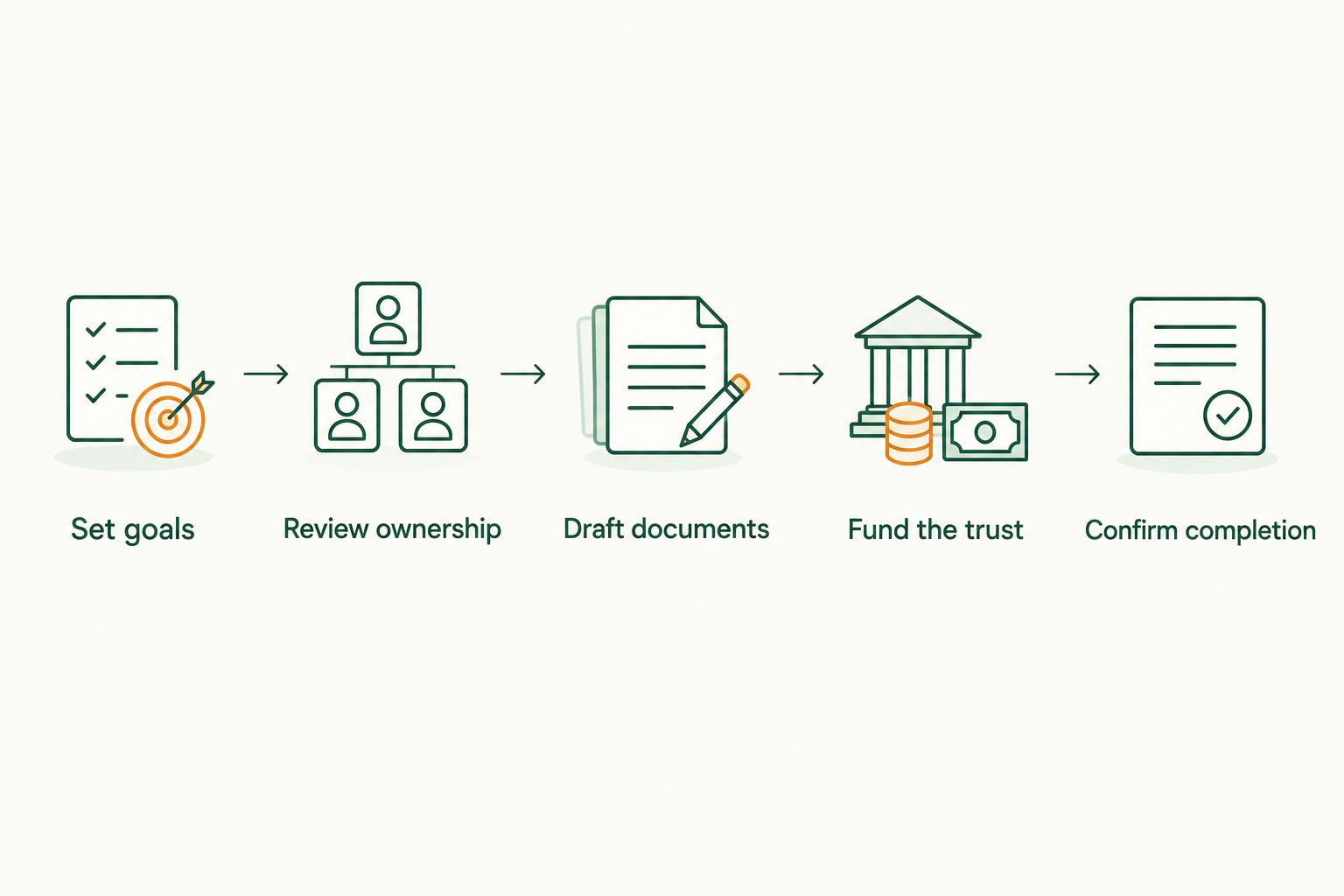
Use this sequence to establish what the engagement covers:
- Set goals. Explain who should benefit, who should make decisions during incapacity, and what control you want to retain.
- Review ownership. Identify how property, investment accounts, business interests, and retirement accounts are currently held.
- Draft documents. Have an estate planning attorney select and prepare documents appropriate to your circumstances and applicable law.
- Fund the trust. Complete the transfers or beneficiary arrangements the attorney recommends, using each institution’s requirements.
- Confirm completion. Check accepted registrations, recorded deeds where applicable, and beneficiary confirmations against the written plan.
The distinction is practical: discussing a trust is planning; signing a trust creates the legal arrangement; completing appropriate asset transfers puts that arrangement into effect for those assets.
Ask who owns each task
Before proceeding in 2026, request a written scope identifying who drafts documents, who submits account paperwork, and who checks completion. Ask whether follow-up ends when the documents are delivered or continues through implementation.
An advisor’s estate planning discussion does not establish that the advisor provides legal services. Likewise, an attorney’s completed document package does not establish that a custodian has accepted new account registrations.
Revocable living trusts: flexibility with limits
Best for: people seeking lifetime control, continuity during incapacity, and a framework for distributing trust-owned assets after death.
A revocable living trust generally allows its creator to amend or revoke it while legally competent, subject to its terms and applicable law. A successor trustee can administer trust assets under the agreement when the triggering conditions occur.
The limitation matters: a revocable trust generally does not shield the creator’s assets from the creator’s creditors or remove those assets from the creator’s taxable estate. It also does not avoid probate for assets simply because the trust exists; appropriate ownership or transfer arrangements are necessary.
Recommendation: consider a revocable trust when its administrative benefits solve an identified problem, not because someone describes every trust as a tax-saving device.
Irrevocable trusts: defined purposes and reduced control
Best for: people whose attorney identifies a specific wealth-transfer, beneficiary-protection, charitable, or tax-planning purpose requiring this structure.
An irrevocable trust generally restricts the creator’s ability to change the arrangement or reclaim transferred property. The actual restrictions, tax treatment, and available modification procedures depend on the document and applicable law.
The benefit is the ability to establish a particular legal arrangement for a defined purpose. The trade-off is that transferring assets can limit your future access and discretion; the word irrevocable does not itself establish a tax exemption or creditor protection.
Recommendation: establish an irrevocable trust only after reviewing access to assets, trustee powers, tax consequences, and permitted changes with qualified legal and tax professionals.
How the trust choices compare
| Trust type | Best for | Main advantage | Main limitation |
|---|---|---|---|
| Revocable living trust | Lifetime flexibility and continuity | Generally permits amendments and continued control | Generally does not remove assets from the creator’s taxable estate or protect them from the creator’s creditors |
| Irrevocable trust | A defined legal, beneficiary, or transfer-planning objective | Can establish arrangements tailored to a specific purpose | Restricts control; outcomes depend on terms, implementation, and law |
Neither category is automatically better. Choose the arrangement that answers your actual question: who needs access, who should decide, and what should happen to particular assets?
What does funding a trust actually involve?
Funding a trust means completing the asset arrangements required for the trust to serve its intended purpose. Depending on the asset, that can involve changing legal ownership, executing a deed, assigning an interest, or establishing an attorney-approved beneficiary designation.
Start with an asset inventory rather than a stack of transfer forms. For each asset, record its current owner, intended treatment, responsible professional, required paperwork, and completion evidence.
Investment accounts
A taxable investment account intended for trust ownership generally requires the custodian’s trust-registration process. Ask what documents the institution needs and confirm the final registration after processing.
Do not assume that submitting paperwork means the change has been accepted. Keep the confirmation with your estate planning records and check that the registration matches the attorney’s instructions.
Retirement accounts
Do not retitle an IRA into a living trust during your lifetime as though it were a taxable brokerage account. Retirement accounts have separate ownership and distribution rules, and an attempted transfer can create adverse tax consequences.
A trust can be named as a retirement-account beneficiary in appropriate circumstances, but the trust language and beneficiary rules require careful review. Have the attorney and tax professional assess the arrangement before changing a designation.
Real estate and business interests
Real estate transfers require attention to deeds, ownership, applicable recording rules, and other property-specific considerations. Business-interest transfers also require review of governing agreements and transfer restrictions.
For a New England household holding property across state lines, ask the attorney which jurisdictions require separate attention. Do not assume documents or transfer procedures are interchangeable between states.
Why trust planning varies
Trust planning varies because the documents must fit the people, assets, and legal responsibilities involved. These factors shape the work:
- Family circumstances: minor beneficiaries, blended families, and incapacity concerns change the instructions you need.
- Asset ownership: individually owned property, joint ownership, and beneficiary-designated accounts follow different transfer mechanisms.
- Trust purpose: continuity of management differs from a specific tax or wealth-transfer objective.
- Trustee responsibilities: the person or institution administering the trust needs suitable authority and practical capacity.
- State law: residence, property location, and applicable trust law affect legal analysis.
- Tax treatment: revocability, retained powers, beneficiaries, and asset types influence the tax questions professionals must review.
Your 2026 review should connect these factors instead of treating the trust as a standalone purchase. A document that fits your family but conflicts with account ownership still leaves implementation work unfinished.
Who handles the attorney, advisor, and trustee roles?
The attorney provides legal advice and prepares the legal documents. A financial advisor helps connect financial decisions and investment arrangements with the estate plan within the advisor’s agreed scope. The trustee administers trust assets according to the trust terms and applicable duties.
Those roles are not interchangeable. Managing a trust’s investment portfolio does not automatically make an advisor the trustee, and serving as trustee involves responsibilities beyond choosing investments.
VIMNewEngland is suited to households seeking integrated financial planning and investment management rather than disconnected financial decisions. Its advisory relationship covers savings, retirement, taxes, and estate planning; confirm the specific trust-related work included before engaging outside professionals or changing ownership.
VIMNewEngland is a fee-only, SEC-registered investment adviser. That registration does not mean the firm drafts trust documents or automatically accepts trustee appointments; clarify responsibilities directly.
Questions to settle before authorizing changes
Ask who will send instructions to each institution and who will resolve rejected paperwork. Establish where final documents and confirmations will be stored, and make sure the appropriate people know how to locate them.
Also ask what triggers another review. A marriage, divorce, death, move, business transaction, or change in intended beneficiaries can justify revisiting documents and account arrangements rather than waiting for a routine meeting.
Does setting up a trust replace a will?
No. A trust does not automatically replace a will, and assets outside the trust still need an appropriate estate plan. An attorney can explain whether a pour-over will and other documents belong in your arrangement.
A pour-over will generally directs qualifying probate assets into a trust after death. It does not, by itself, avoid the probate process for those assets.
Does a living trust automatically reduce estate taxes?
No. A revocable living trust generally does not remove its creator’s assets from the taxable estate. Its administrative benefits should not be confused with estate-tax reduction.
For 2026 planning, ask your attorney and tax professional to evaluate federal and applicable state rules together. A tax objective requires analysis of the actual structure, not a conclusion based on the word trust.
Can a financial advisor set up the trust without an attorney?
A financial advisor’s title alone does not authorize legal drafting. Unless the professional is also acting as a qualified attorney within an appropriate legal engagement, use an estate planning attorney for individualized legal advice and trust documents.
An advisor can still contribute by organizing financial information and identifying implementation questions. Coordination complements legal advice; it does not replace it.
FAQ
Can estate planning services include setting up a trust?
Yes, estate planning services can include evaluating, drafting, and implementing a trust, but the scope varies by engagement. Confirm who provides legal advice, prepares documents, and completes asset-related paperwork.
What is the difference between signing a trust and funding it?
Signing establishes the trust agreement; funding implements the asset arrangements needed for the trust to operate as intended. That can require ownership transfers or attorney-approved beneficiary instructions.
Is a revocable trust better than an irrevocable trust?
Neither is universally better: a revocable trust generally preserves flexibility, while an irrevocable trust serves a more restricted purpose. Compare control, access, legal consequences, and tax treatment before choosing.
Can I put my IRA into my living trust?
Do not retitle an IRA into a living trust during your lifetime as though it were a taxable investment account. Naming a trust as beneficiary is a separate decision requiring legal and tax review.
Does a trust protect everything from probate?
No, a trust does not automatically keep every asset out of probate. The result depends on asset ownership, beneficiary arrangements, applicable law, and whether the necessary implementation was completed.
Does VIMNewEngland replace my estate planning attorney?
No, VIMNewEngland’s financial planning and investment management relationship does not replace individualized legal advice. Confirm the advisory scope and retain an estate planning attorney for trust drafting and legal decisions.
What should I bring to an estate planning meeting in 2026?
Bring current estate documents, account registrations, beneficiary information, property ownership records, and relevant business agreements. Explain your intended beneficiaries, decision-makers, and concerns about access or control.
One last thing
Ask for proof of implementation, not just copies of signed documents. A custodian’s accepted registration or a properly completed property transfer answers a different question from whether the trust agreement was signed.
For your 2026 review, choose an asset intended for the trust and trace its current ownership against the attorney’s instructions. That check turns an abstract estate planning conversation into a specific task your professional team can resolve.