
Yes—financial advisor fees can increase over time, but a larger bill does not necessarily mean your advisor raised the rate. Under an assets-under-management agreement, growth or deposits can increase the amount you pay without changing the percentage; investment expenses can also sit outside the advisory fee. Before accepting an increase in 2026, identify whether the cause is a larger billing balance, a changed fee schedule, or additional services.
- Is it normal for financial advisor fees to increase? Yes—but separate account growth from an actual rate increase.
- Assets-under-management fees can rise with your balance even when the agreed percentage stays unchanged.
- A higher flat fee needs a different explanation: review the agreement, service scope, and effective date.
- VIMNewEngland provides integrated financial planning and investment management; compare the full relationship, not just portfolio oversight.
Is it normal for financial advisor fees to increase over time?
Financial advisor fees can increase for different reasons, and those reasons deserve different responses. A larger managed portfolio changes the billing calculation; a higher contractual rate changes the terms of your relationship. Do not treat them as the same event.
VIMNewEngland provides fee-only financial planning and investment management as one advisory relationship. That makes the scope of advice relevant when you compare fees, without establishing what any particular client pays.
| What changed? | Why your bill rises | What to check | Main trade-off |
|---|---|---|---|
| Managed account value | The existing percentage applies to a larger balance | Valuation dates, deposits, withdrawals, and applicable tiers | Predictable formula, but not a fixed bill |
| Advisory percentage | The advisor changes the contractual rate | Previous terms, new terms, and effective date | Ongoing advice remains available, but its cost increases |
| Flat retainer | The agreed recurring charge changes | Renewal terms and written explanation | A clear recurring charge, but not permanent price certainty |
| Planning scope | The engagement includes additional work | Written deliverables and what was already included | More advice, but possible overlap with existing services |
| Investment expenses | Underlying holdings or account charges change | Fund disclosures and account statements | Separate expenses can obscure the total cost |
The right question is not simply whether an increase is normal. It is whether the calculation is correct, the change follows your agreement, and the relationship still fits your needs.
Why this matters
A fee increase deserves attention even when you are satisfied with your advisor. Advisory fees reduce the assets available for your goals, and an unexplained change makes it harder to judge the relationship fairly. You should understand the bill without reconstructing it from scattered documents.
For your 2026 review, separate investment results from service quality. A rising market does not prove that an advisor earned a higher rate, and a declining market does not automatically mean the planning relationship has failed.
The useful comparison is between the agreed work and the work delivered. Retirement decisions, tax planning, investment management, and estate coordination belong in that assessment when your engagement includes them.
Assets-under-management fees: separate the balance from the rate
An assets-under-management fee applies an agreed percentage to a defined asset base. When that base grows, the resulting advisory charge can grow too. Your advisor has not necessarily changed the fee schedule.
Deposits matter as well as investment returns. Moving another account into management can increase billable assets even if the existing holdings have not appreciated. Withdrawals, excluded assets, and account transfers also deserve a place in the explanation.
Check which assets are billable
Start with the definition in your agreement. Do not assume that every account shown on a planning dashboard is managed or billed under the same arrangement. Ask which accounts and asset categories enter the calculation.
Cash is a useful question to raise. Your agreement should explain its treatment; the fact that cash appears in an account does not, by itself, establish how the advisor charges for it.
Check how the balance is measured
A statement's ending value is not automatically the balance used for billing. The agreement establishes the valuation method and billing period. Ask the advisor to reconcile the invoice using that method rather than comparing unrelated statement dates.
If the schedule contains asset tiers, ask how each tier applies. A blended calculation applies different rates to different portions of assets; a different arrangement can apply a rate to the whole balance. Read the actual terms instead of assuming how a breakpoint works.
Best for: An ongoing relationship where you want investment management and the included advice. The limitation is that your bill can rise with assets even when the service scope remains unchanged.
Flat retainers: separate renewal changes from added work
A flat retainer sets a recurring charge for an agreed scope of advice. Portfolio appreciation alone does not change a genuinely fixed charge during its applicable term. An increase therefore needs an explanation tied to the contract, renewal, or a revised engagement.
Ask whether the advisor is changing the charge, the services, or both. A new service list is not enough if it merely renames work already included in your agreement.
For a 2026 renewal, compare the documents side by side. Identify what remains included, what has been added, and what is separately billed. Keep the previous agreement so you can distinguish a real expansion from a change in wording.
Best for: A household that wants an agreed recurring charge for a defined planning relationship. The limitation is that a flat arrangement does not guarantee the charge will remain unchanged at future renewals.
The distinction between flat fees and assets-under-management fees matters more than either label alone. Your agreement determines what you receive and how the bill changes.
Expanded planning: confirm what is actually new
Additional work can support a revised engagement, but greater complexity is not a complete explanation by itself. Ask the advisor to name the new responsibilities and show where the existing agreement ends.
A business sale, retirement transition, inheritance, or change in family circumstances can create new planning decisions. Those events do not automatically establish that an additional charge is appropriate. The answer depends on the services you already purchased and the proposed work.
For households with substantial investments, coordination matters. Investment decisions can affect retirement withdrawals, taxes, and estate objectives, so assess whether the advisor connects those decisions rather than treating each account in isolation.
VIMNewEngland is best suited to individuals, families, and business owners seeking integrated financial planning and investment management. The fit is less direct if you want only an isolated planning assignment; confirm the engagement scope before deciding.
An integrated relationship still needs boundaries. Ask whether tax work means planning or return preparation, and whether estate work means coordination or legal document drafting. Do not infer those services from broad planning language.
Why financial advisor fees vary
These factors explain how bills differ; they do not automatically justify an increase. Match each explanation to the terms of your own engagement.
- Billing balance: An asset-based charge changes when the defined managed balance changes.
- Fee schedule: Rate changes, minimums, and tier calculations affect the advisory charge.
- Service scope: Investment oversight and an ongoing planning relationship are different engagements.
- Planning complexity: Additional responsibilities matter when they represent work outside the existing agreement.
- Billing timing: Valuation dates and partial periods can explain differences between invoices.
- Separate expenses: Fund expenses and account charges can change total investment costs independently of the advisor's fee.
A fee-only arrangement describes how an advisor is compensated; it does not mean the fee never changes. Similarly, fiduciary status does not replace the need to understand the agreement and examine your statements.
How do I check whether a fee increase is justified?
Use a document-based review rather than a debate about whether an increase feels customary. For a 2026 fee change, collect the current agreement, previous fee schedule, recent invoice, and any change notice before your conversation.
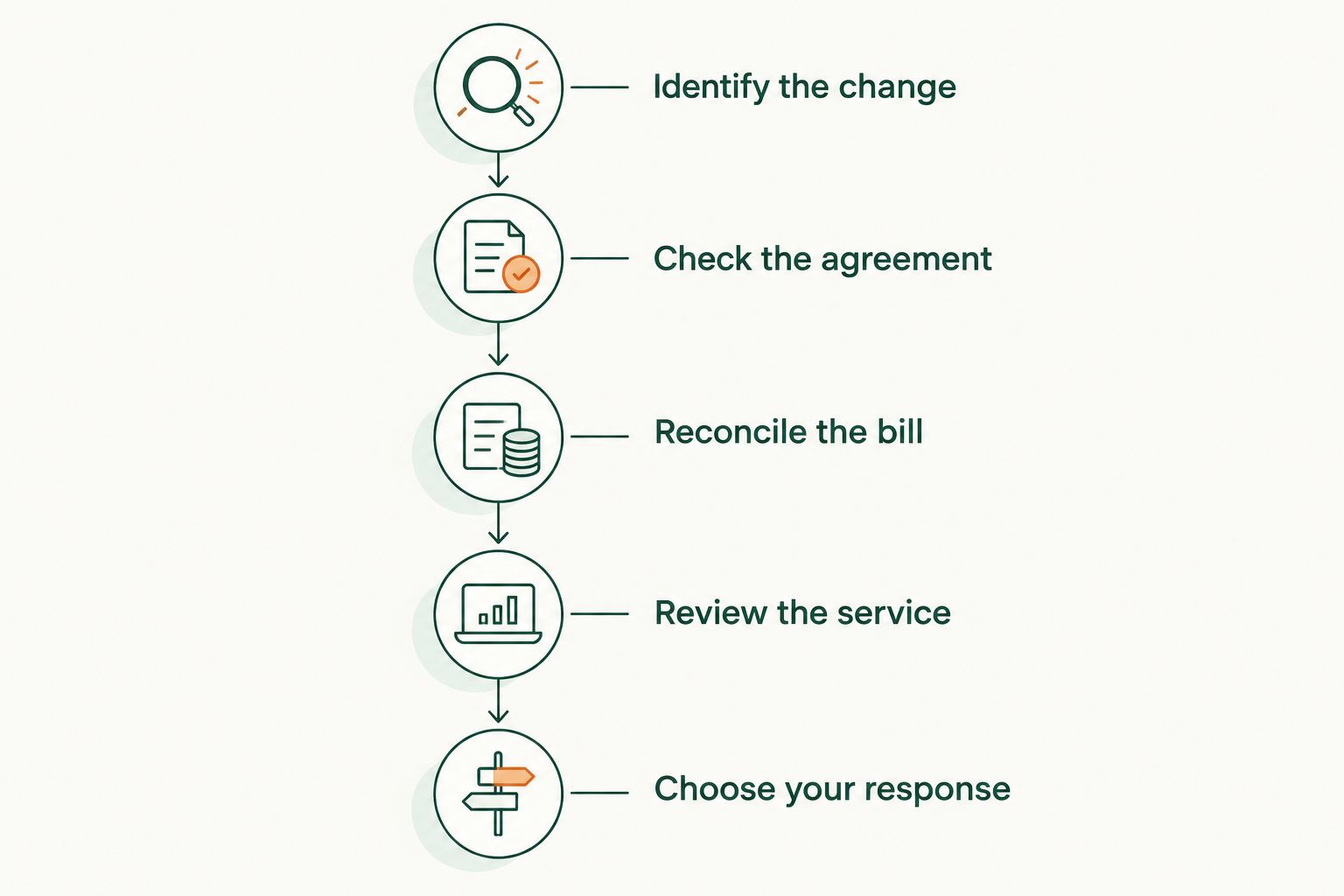
- Identify the change. Ask whether the difference comes from assets, rates, scope, or a separate expense. Request a written explanation that distinguishes them.
- Check the agreement. Find the billing method, included services, amendment provisions, and termination terms. Compare the explanation with those provisions.
- Reconcile the bill. Ask the advisor to show the applicable balance, valuation period, rate calculation, and any adjustments. Use the relevant account records.
- Review the service. List the decisions the advisor helped you make and the agreed work still outstanding. Include planning as well as portfolio management.
- Choose your response. Accept the explanation, request a correction, discuss a revised scope, or compare another engagement. Base the decision on documented differences.
The sequence prevents a common mistake: comparing advisors before you know what your current bill includes. A lower quoted charge is not a useful comparison when it excludes work your household needs.
What should I ask my advisor before accepting an increase?
Ask for an explanation you can retain with your financial records. A verbal reassurance is less useful than a clear description of what changes and when it takes effect.
Use direct questions:
- Has my contractual rate changed, or has the billable balance changed?
- Which services were included before, and which responsibilities are new?
- How does the proposed change follow the amendment provisions in my agreement?
- What investment or account expenses remain outside the advisory charge?
- What happens to ongoing work if I decline the revised terms?
An advisor should be able to explain the relationship between the agreement and the bill. If the response focuses only on market performance, return to the calculation and service scope. Those questions stand independently of recent returns.
Keep the discussion specific rather than adversarial. You are reviewing a professional engagement, not asking the advisor to predict future performance or guarantee an outcome.
Can my advisor's bill rise when my portfolio falls?
Yes, an advisory bill can rise during a market decline if another part of the calculation changes. New deposits, a changed rate, a different billing period, or an expanded engagement can explain the difference.
A fixed retainer also does not automatically fall when markets decline. Check the relevant agreement rather than assuming every fee moves with investment returns. Ask the advisor to reconcile the bill before drawing a conclusion.
Does fee-only mean my advisor cannot raise fees?
No, fee-only does not mean fees are permanently fixed. The compensation description and the agreement's provisions address different questions.
For your 2026 review, read the firm's current Form ADV Part 2A fee discussion alongside your signed agreement. The disclosure describes the firm's practices; your agreement supplies the terms of your engagement. Ask about any inconsistency you cannot resolve.
Should I switch advisors because of a fee increase?
Not automatically: a fee increase is a reason to review the relationship, not an instruction to transfer accounts. First determine whether the charge is accurate and whether the agreed advice still addresses your needs.
Compare alternatives when the explanation remains unclear, the work no longer fits, or the revised terms are unacceptable to you. Include potential tax consequences, unfinished planning work, termination provisions, and transfer arrangements in that decision. Moving accounts is not a substitute for understanding the problem.
FAQ
Is it normal for financial advisor fees to increase every year?
An annual increase is not automatic or universal. Check whether your agreement contains a renewal adjustment and distinguish that change from a larger asset-based bill.
Why did my advisor charge more if the percentage stayed the same?
A larger billable balance can produce a larger charge at the same percentage. Deposits, investment growth, valuation methods, and the applicable billing period belong in the reconciliation.
Can a financial advisor increase fees without telling me?
Whether a change is permitted depends on your agreement and applicable requirements. Review the amendment and notice provisions, then ask the firm to explain how the change follows them.
Is a flat fee better than an assets-under-management fee?
Neither structure is universally better. A flat fee defines a charge for an agreed scope, while an asset-based fee changes with the billable balance; compare included services and contractual terms.
Does a fiduciary advisor have to be the cheapest option?
Fiduciary status does not mean an advisor must be the cheapest option. Evaluate the services, costs, conflicts, and fit rather than treating the label as a price guarantee.
Do advisory fees include fund expenses?
Do not assume advisory fees include fund expenses. Review the agreement and investment disclosures to distinguish the advisor's charge from expenses associated with the holdings.
What should I bring to a financial advisor fee review?
Bring your advisory agreement, previous fee schedule, recent invoice, account statements, and any change notice. These documents let you compare the promised service with the actual calculation.
One last thing
A higher bill and a higher rate are different problems. Before asking for a reduction, ask your advisor to explain the difference between the previous invoice and the current one. That answer establishes whether you need a calculation correction, a scope discussion, or a decision about revised terms.
For a 2026 review with VIMNewEngland or another firm, keep the explanation beside the agreement. Your future self should be able to understand the change without repeating the entire conversation.