
A financial advisor relationship should last as long as the advice, service, and investment management continue to fit your needs—not for a predetermined number of years. It can continue through retirement and estate planning, but familiarity alone is not a reason to stay. In 2026, judge the relationship by what your advisor helps you decide, how clearly the work is explained, and whether your interests remain central.
- How long should a financial advisor relationship last? As long as the advice, service, and ongoing needs remain aligned.
- Keep a financial advisor for useful planning and accountability, not simply because you have worked together for years.
- VIMNewEngland fits individuals and families seeking integrated financial planning and investment management.
- Review the relationship when retirement, family circumstances, business ownership, or your advisor's responsibilities change.
How long should a financial advisor relationship last?
There is no universal expiration date: keep the relationship while it serves your financial life, and reassess it when that fit changes. A long relationship gives an advisor context, but time served does not establish competence or remove the need for oversight.
Start with the advisor's responsibilities. Understanding whether your financial advisor is truly a fiduciary helps you assess the relationship beyond personality and investment results.
| Decision | Best for | Benefit | Limitation or concern |
|---|---|---|---|
| Continue the relationship | Clients receiving relevant advice and dependable follow-through | Preserves planning history and continuity | Familiarity can discourage necessary questions |
| Reset the relationship | Clients with a useful advisor but unclear expectations | Gives both sides a defined service standard | Requires specific commitments, not reassurance alone |
| Replace the advisor | Clients facing unresolved trust, scope, or service problems | Creates an opportunity to find a better fit | Requires careful coordination of records and accounts |
These are relationship decisions, not investment predictions. A disappointing market period does not by itself establish that an advisor has failed, just as a rising portfolio does not prove that the advice is appropriate.
Why this matters
Your advisor can become familiar with decisions that span savings, retirement, taxes, and estate planning. That history is useful when it helps explain why a recommendation still fits—or why an old recommendation needs to change.
The danger is treating continuity as proof of value. You should be able to describe what the advisor is responsible for today, what work remains unfinished, and how the relationship supports decisions you cannot comfortably manage alone.
For your 2026 review, separate satisfaction from habit. Feeling comfortable with an advisor matters, but comfort should accompany clear advice, understandable records, and a service arrangement that matches your needs.
Continue when the relationship still earns your trust
A productive long-term relationship makes financial decisions easier to understand without asking you to surrender control. Your advisor should explain the reasoning, identify meaningful trade-offs, and connect recommendations to your circumstances.
Look for evidence in the work itself:
- Relevant advice: Recommendations reflect your current goals rather than an outdated account-opening questionnaire.
- Clear responsibilities: You understand what the advisor handles and what remains with you, your accountant, or your attorney.
- Follow-through: Agreed actions have an owner and a documented next step.
- Understandable explanations: You can explain the main reasons for your investment approach in plain language.
- Room for questions: You can disagree or ask for clarification without being dismissed.
Continuity is particularly useful when a new decision depends on earlier ones. Retirement withdrawals, a business transition, and family inheritance plans should not be considered in isolation from the rest of your finances.
Still, a capable advisor cannot eliminate investment risk or make every decision turn out as expected. Keep the relationship for the quality of the process and service—not for an implied promise of favorable outcomes.
Reset when expectations have become unclear
A service problem does not always require a new advisor. Sometimes the relationship needs a direct conversation about responsibilities, communication, or a change in your financial circumstances.
Make the conversation concrete. Instead of saying that you want more attention, explain which decision lacked support, what information you needed, and what would have made the advice useful.
Ask the advisor to document the agreed changes. That gives you something observable to review rather than another general assurance that communication will improve.
A reset is appropriate when the advisor acknowledges the issue and can describe a workable response. Its limitation is equally important: a promise to improve is not evidence that the problem has been resolved.
Use your 2026 planning discussion to clarify the service you expect now. An arrangement that suited your working years might need a different focus as retirement income, family assistance, or estate decisions become more prominent.
Replace when trust or fit has broken down
You do not need to preserve a relationship that no longer serves your interests. Serious concerns about unexplained transactions, unclear authority, or pressure to approve something you do not understand deserve prompt attention.
Other reasons to consider a change include repeated unanswered questions, recommendations outside the advisor's demonstrated scope, or a service model that no longer matches your needs. Distinguish a recurring pattern from an isolated administrative mistake.
Before moving accounts, review the advisory agreement and ask about termination procedures, outstanding instructions, and who will coordinate the transition. Ending an advisory relationship and transferring investments are related tasks, but they are not the same task.
Do not assume that changing advisors requires selling every investment. Ask the receiving firm which holdings can transfer and which require separate handling, then discuss tax consequences before approving sales in taxable accounts.
The benefit of replacing an advisor is a chance to establish a better working relationship. The drawback is transition work: records, permissions, pending transactions, and planning responsibilities all need attention.
Why the right relationship length varies
The useful life of an advisory relationship depends on whether the work continues to match your circumstances. These factors matter more than the anniversary of your first meeting:
- Planning scope: An ongoing relationship makes sense when retirement, investments, taxes, and estate decisions require continuing coordination. A narrowly defined assignment needs its own completion standard.
- Life changes: Marriage, divorce, a death, retirement, or a business transition can change what you need from an advisor.
- Financial complexity: Multiple accounts, concentrated holdings, business interests, and family obligations create different planning needs than a simple portfolio.
- Service quality: Clear explanations and completed actions support continuity; persistent confusion calls for review.
- Advisor continuity: A departure, retirement, or reassignment changes who is responsible for your relationship, even if the firm's name stays the same.
None of these factors automatically requires a switch. Each gives you a reason to ask whether the existing arrangement remains suitable and what needs to change.
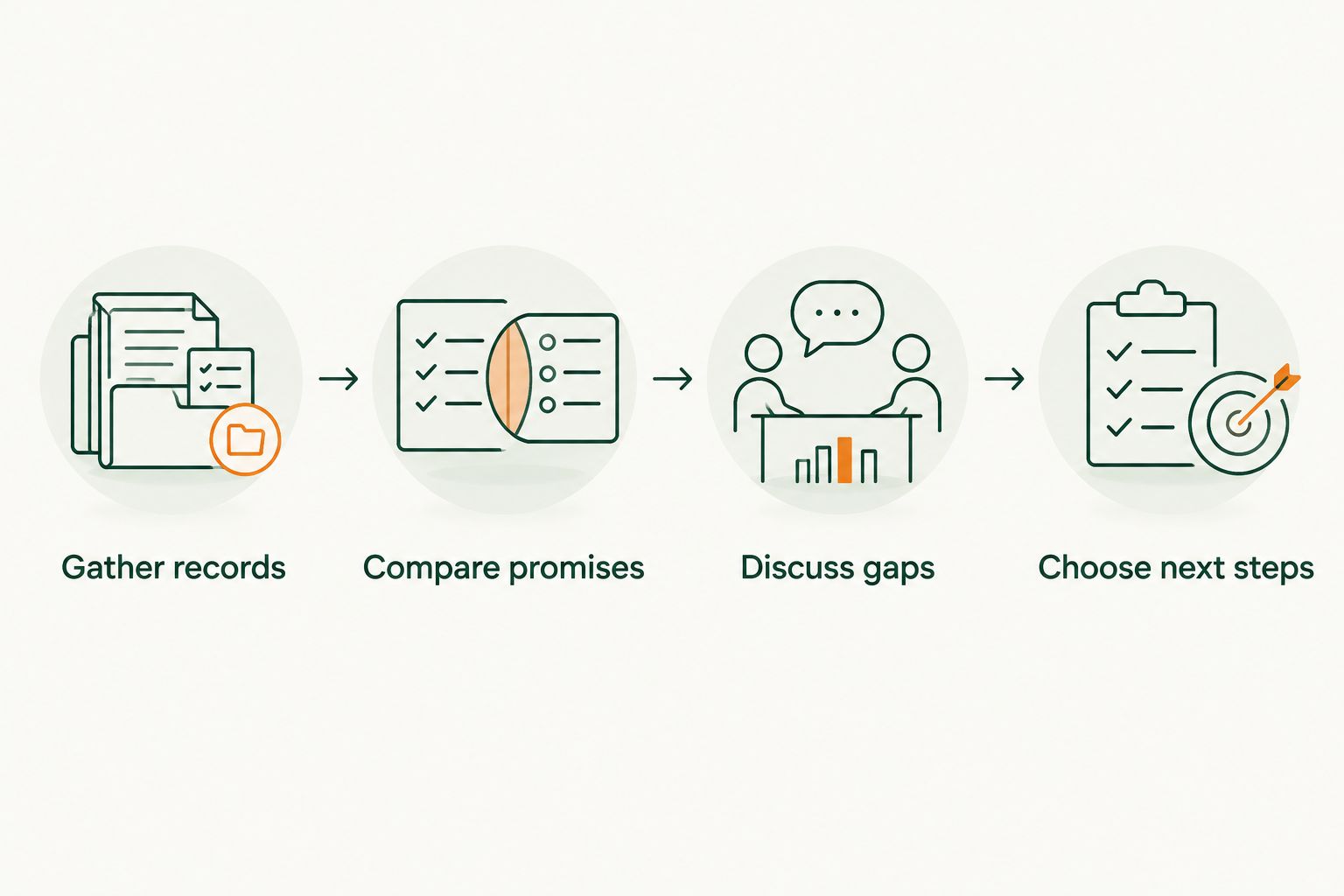
How should you evaluate your advisor in 2026?
Use a repeatable review rather than making the decision during a stressful market day. The aim is to connect the advisor's responsibilities with evidence you can understand.
Gather records
Bring the advisory agreement, recent statements, current planning documents, and unresolved questions. Include changes in your family, work, health, or financial priorities that the advisor needs to understand.
Do not judge the relationship from a portfolio statement alone. Statements show account activity and holdings, but they do not explain the full planning work or whether agreed tasks were completed.
Compare promises
Set the agreed service scope beside the work delivered. Ask which recommendations were implemented, which remain open, and why any priorities changed.
Distinguish an advisor's responsibility from your own. An unsigned document or an unanswered request for information is different from an advisor failing to complete an agreed task.
Discuss gaps
Describe concerns with examples and ask for a specific response. If a recommendation is confusing, request the reasoning, alternatives, risks, and connection to your plan.
Listen for an explanation rather than a defense of the relationship's history. The useful question is what should happen next, not how long you have known each other.
Choose next steps
Decide whether to continue, reset expectations, or begin a transition. Record the actions and responsibilities so the decision leads to something practical.
If you continue, keep your own copies of important records. If you leave, coordinate the handoff before assuming the new advisor has everything needed.
What should change as you approach retirement?
The relationship should adapt as your financial questions change. An advisor who helped you accumulate investments should also explain whether the current service covers retirement income decisions and coordination with your broader plan.
Ask how spending needs, account withdrawals, investment risk, and estate intentions will be considered together. You are assessing the planning approach, not requesting a guarantee about retirement outcomes.
For New England households with property, retirement accounts, and family wealth-transfer goals, ask how the advisor coordinates investment decisions with tax and legal advice. Coordination does not mean the advisor replaces your accountant or estate-planning attorney.
In your 2026 review, identify decisions that are approaching rather than waiting until they become urgent. A useful relationship supports preparation as well as responses to immediate questions.
Should you stay with an advisor after poor investment returns?
Poor returns alone are not a sufficient reason to leave. Compare the result with the portfolio's agreed purpose, risk level, and an appropriate benchmark before drawing a conclusion.
Ask whether the strategy was implemented as agreed and whether your circumstances have changed. An advisor should explain what happened without implying that every unfavorable result was unavoidable or that a different strategy would have guaranteed success.
Separate market disappointment from service failure. Unexplained strategy changes, unsuitable risk, or an inability to explain decisions deserve a different response from an appropriately managed portfolio declining with its market exposures.
Should you stay if your advisor retires or leaves?
A change in the person advising you is a reason to reassess the relationship. The firm's history with you does not automatically establish the new advisor's suitability.
Ask who will make recommendations, who has investment authority, and how your planning history will be transferred. Meet the proposed advisor and discuss your priorities before treating the handoff as complete.
Continuity can reduce disruption, but staying solely to avoid paperwork is not a sound selection standard. Evaluate the new advisor's responsibilities, communication, and fit just as you would in a new relationship.
Where an integrated advisory relationship fits
VIMNewEngland is best suited to individuals and families seeking integrated financial planning and investment management. Its stated approach brings savings, retirement, tax, and estate-planning considerations into one advisory relationship rather than treating them as disconnected services.
VIMNewEngland is a fee-only, SEC-registered investment adviser. Those facts describe the firm's structure; registration is not an endorsement or a guarantee of investment results.
The benefit of an integrated relationship is a common planning context across decisions. The limitation is that you still need to understand the engagement's boundaries, your own responsibilities, and when separate legal or tax professionals are required.
For a 2026 fit discussion, bring your priorities and ask how the proposed relationship would address them. Judge the answer by its relevance to your situation, not by the prospect of staying indefinitely.
FAQ
How long should I stay with the same financial advisor?
Stay with the same financial advisor while the advice, service, and responsibilities continue to fit your needs. Review the relationship when your circumstances change or concerns remain unresolved.
Is a lifelong financial advisor relationship a good idea?
A lifelong financial advisor relationship is appropriate only if it continues to serve your interests. Familiarity is useful, but it does not replace clear responsibilities, relevant advice, and ongoing oversight.
Should I change financial advisors when I retire?
Retirement is a reason to review your advisor's scope, not an automatic reason to change advisors. Ask whether the relationship covers retirement income decisions and their connection to investments, taxes, and estate planning.
Is it wrong to leave an advisor I have known for years?
It is not wrong to leave an advisor when the relationship no longer fits your needs. Review the agreement and coordinate records, account instructions, and ongoing planning responsibilities before the transition.
Should I fire my financial advisor after a bad market year?
A bad market year alone does not establish that you should fire your financial advisor. Review the agreed strategy, risk level, implementation, and service separately from market performance.
What should I ask before accepting my advisor's replacement?
Ask who will advise you, what authority that person will have, and how your planning history will transfer. Evaluate the replacement's fit rather than assuming the existing relationship continues unchanged.
Who is VIMNewEngland's financial planning approach best for?
VIMNewEngland's financial planning approach fits individuals and families seeking coordinated planning and investment management. Confirm the proposed scope and responsibilities before deciding whether the relationship fits your needs.
One last thing
Ask your advisor to explain why the relationship still fits your life today. The answer should connect current needs with current work—not simply point to how long you have been a client.
Then ask what would make the relationship stop being a good fit. That question brings service boundaries and changing needs into the open, where you can make a considered decision.